
Why Infrared Thermal Imaging Beats Visual Inspections for Finding Hidden Leaks in Maple Leaf Homes
A visual inspection misses roughly 80% of active moisture intrusion in Seattle homes. That number is not a scare tactic. It reflects the physical reality of how water moves through building assemblies, especially in the mid-century and Craftsman-era homes that define neighborhoods like Maple Leaf, Green Lake, and Wallingford. Water travels. It wicks through insulation, migrates along floor joists, and pools inside wall cavities long before it appears on a surface you can see.
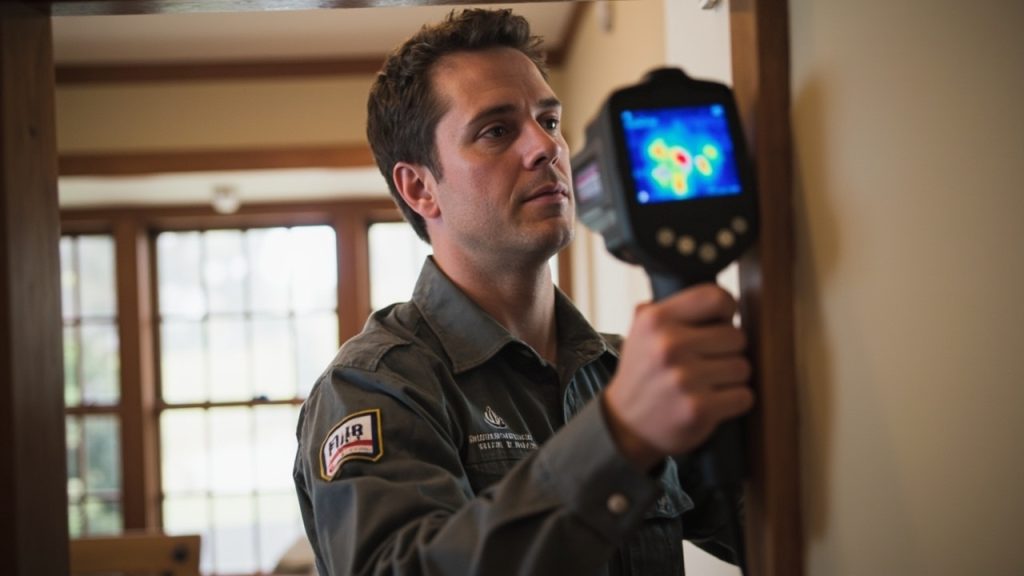
Infrared thermal imaging changes that equation completely. A FLIR thermal camera detects temperature differentials caused by moisture absorption, giving technicians a real-time map of hidden water damage without cutting a single hole in your drywall or lath plaster. For Seattle homeowners dealing with the region’s relentless rainfall cycles and aging housing stock, this technology is not optional. It is the difference between a targeted repair and a months-long gut renovation.

How Infrared Cameras Actually Detect Hidden Moisture
The science behind thermal imaging leak detection relies on a physical process called evaporative cooling. When building materials absorb water, they cool down as that moisture evaporates. A thermal camera reads surface temperature differences as small as 0.05 degrees Celsius, which is the sensitivity threshold on professional-grade FLIR Systems cameras used in IICRC-compliant inspections.
Wet insulation registers as a cold anomaly against a warmer dry wall surface. A leaking supply line behind a tile backsplash shows as a cool streak tracing the pipe path. Radiant floor heating systems with a compromised loop produce a visible gap in the thermal pattern at the slab level. None of these signatures are visible to the naked eye. All of them are immediate on a thermal display.
Technicians also use psychrometric principles during scanning. By measuring ambient air temperature, relative humidity, and surface temperature simultaneously, they can calculate dew point and determine whether a thermal anomaly represents active moisture or simply a thermal bridge like a steel beam. This eliminates false positives and produces a moisture map that reflects actual water intrusion, not just cold spots.
Per the IICRC (Institute of Inspection Cleaning and Restoration Certification) S500 Standard for Professional Water Damage Restoration, non-destructive testing methods, including infrared thermography, should be the first-line diagnostic tool before any structural opening. Skipping this step is a protocol violation in professional restoration work.
Why Seattle Homes Are Especially Vulnerable to Hidden Water Intrusion
Seattle receives over 37 inches of precipitation annually, but the pattern matters more than the total. The Pacific Northwest climate delivers long, persistent rain events rather than intense short bursts. This means building envelopes absorb moisture gradually, and walls can be saturated for days before any interior symptom appears.
Maple Leaf sits on glacial till soil, which has poor drainage characteristics. Hydrostatic pressure against foundation walls builds steadily during wet cycles, forcing water through micro-cracks in concrete block or poured concrete foundations. By the time a homeowner notices efflorescence on the basement wall or a musty odor in the crawl space, the moisture intrusion has often been active for weeks.
The local architecture compounds the problem. Historic Craftsman bungalows common to Maple Leaf, Queen Anne, and Fremont often have lath-and-plaster walls. Plaster is absorbent. A slow leak behind plaster can distribute moisture across a wide area before the surface shows any staining. The same dynamic applies to mid-century homes with original plumbing, where copper supply lines have been running for 60-plus years and are approaching the end of their service life.
Atmospheric river events, what local contractors call Pineapple Express storms, drive horizontal rain against west-facing building facades at pressures that exceed the drainage capacity of typical window and door flashing. These events cause water intrusion through the building envelope at points that are completely invisible until a thermal camera reveals the cold signature behind the finished interior surface.

Thermal Imaging vs. Traditional Search and Destroy Methods
The old approach to finding a hidden leak was straightforward and destructive. A technician suspected moisture in a wall, cut an inspection hole, found nothing, cut another hole, found something, and then opened the entire section between studs to assess damage. Homeowners paid for drywall repair, texture matching, and repainting on top of the actual water damage restoration cost.
In older Ballard or Capitol Hill homes with original plaster walls, destructive searches were even more costly because plaster repair requires skilled labor that standard drywall subcontractors cannot match. If you want to understand how destructive leak events can spiral in these neighborhoods, see our guide on how to get fast water damage help in Capitol Hill without the wait.
| Detection Method | Time to Locate Leak | Wall Openings Required | Accuracy Rate | Works on Hidden Moisture |
|---|---|---|---|---|
| Visual Inspection Only | Hours to Days | Multiple (3 to 10+) | 20 to 40% | No |
| Moisture Meter Only | 1 to 3 Hours | Pin holes only | 60 to 70% | Surface-limited |
| Infrared Thermal Imaging (FLIR) | 30 to 90 Minutes | Zero to Minimal | 90 to 95% | Yes, up to 24 inches deep |
| Thermal Imaging + Moisture Meter Combined | 60 to 120 Minutes | Zero | 95 to 98% | Yes |
The combination of FLIR thermal scanning followed by targeted moisture meter confirmation is the professional standard. The thermal image identifies the anomaly. The moisture meter confirms the reading at a single pin-probe point. No unnecessary wall openings. No cosmetic repair bills layered on top of your restoration cost.
Common Leak Sources That Thermal Imaging Finds in Seattle Architecture
Not all leaks behave the same way, and Seattle’s specific building types create predictable failure patterns. Thermal imaging finds each of these without destructive access.
- Flat roof moisture intrusion: Mid-century modern homes and modern Seattle Box townhomes in South Lake Union and Bellevue frequently have low-slope or flat roof assemblies. Ponding water works through membrane seams and shows as a broad cold zone on the ceiling assembly below.
- Slab leaks from radiant floor heating: Common in remodeled Craftsman basements, a compromised PEX loop under a concrete slab produces a recognizable thermal pattern. The warm floor zone goes cold where the pipe has failed.
- Window and door flashing failures: One of the most common sources of moisture intrusion in Puget Sound homes. Thermal imaging reveals the cold moisture trail behind drywall returns that flashing failures create after Pineapple Express events.
- Pipe burst damage in wall cavities: A burst supply line in a wall cavity can distribute water across three or four wall bays before reaching the floor. Thermal imaging maps the full extent immediately. For Queen Anne homeowners who have experienced this, our guide on burst pipe emergencies in Queen Anne covers the immediate response steps.
- Basement wall hydrostatic seepage: Clay-heavy glacial till soil in valley neighborhoods like Renton and Tukwila creates significant hydrostatic pressure against foundation walls. Thermal cameras reveal active seepage paths before they reach finish surfaces.
- Roof-to-wall junction failures: Common on Craftsman homes where original kick-out flashing was never installed or has corroded. Water infiltrates the wall assembly at the roof line and travels down inside the stud bay.
What Happens After the Thermal Scan Finds the Leak
Finding the leak is step one. The thermal imaging report documents the moisture extent, thermal anomaly locations, and relative severity. This documentation is critical for the next two phases of the restoration process.
First, it establishes the scope of structural drying. IICRC S500 drying protocols require technicians to set drying goals based on actual moisture readings and affected material categories. The thermal map tells the restoration team exactly where to place air movers and desiccant dehumidifiers for efficient drying without over-treating unaffected areas. Psychrometric calculations from the initial scan inform equipment selection and drying time estimates, which in active Seattle rain cycles can be longer than drying timelines in drier climates due to elevated ambient humidity.
Second, the thermal imaging report functions as objective third-party documentation for your insurance adjuster. King County insurance claims for water damage require demonstrable evidence of moisture extent to support the scope of work billed. A color-coded thermal image showing moisture distribution across a wall assembly is far more persuasive to an adjuster than a technician’s verbal description. Adjusters at major carriers operating in Washington State have become familiar with FLIR imaging reports as standard documentation, and claims supported by this data move through the approval process faster.
If your Ballard basement has flooded and you need context on what comes after detection, read our article on what to do when your Ballard basement floods during a storm.
The scan also flags mold risk zones. When moisture has been present long enough, thermal anomalies combined with elevated moisture meter readings in Class 2 or Class 3 categories indicate conditions where mold amplification is likely within 24 to 48 hours. This allows the restoration team to sequence mold remediation alongside drying rather than discovering active growth weeks later. Kirkland homeowners dealing with damp wall mold should review our breakdown of professional mold removal on damp walls for context on what that remediation process involves.
The Equipment Behind an Accurate Thermal Leak Inspection
Professional-grade thermal imaging for water damage detection requires specific camera specifications. Consumer-grade thermal attachments for smartphones do not meet the sensitivity threshold required for reliable moisture anomaly detection in a building environment.
| Equipment Specification | Consumer Grade | Professional FLIR (Restoration Use) |
|---|---|---|
| Thermal Sensitivity (NETD) | 100 to 150 mK | Less than 50 mK |
| Resolution | 80 x 60 pixels | 320 x 240 or higher |
| Temperature Range | Limited | Minus 20°C to 650°C |
| Data Logging and Reporting | Basic screenshots | Full radiometric data, FLIR software reports |
| Insurance Documentation Value | Not accepted | Accepted by major carriers |
FLIR Systems E-series and T-series cameras, calibrated within current manufacturer specifications, produce radiometric images where every pixel contains actual temperature data. This allows technicians to generate reports showing exact temperature readings at any point on the thermal image, not just a color picture.
Thermal imaging is also referenced in U.S. Department of Energy building diagnostic resources as a standard non-destructive testing method for identifying building envelope failures, which is exactly what moisture intrusion through wall and roof assemblies represents.
Moisture meters used in combination with thermal cameras fall into two categories. Pin-type meters penetrate the surface to measure electrical resistance in wood and drywall. Pinless meters use electromagnetic fields to read moisture content without surface penetration. Professional restoration technicians use both types to confirm thermal anomalies and classify materials according to IICRC moisture content standards before beginning the drying process.
Building Envelope Inspections Before Seattle’s Wet Season
Proactive thermal imaging inspections before the November-through-March wet season have become a practical tool for homeowners in higher-value Seattle real estate markets. A pre-season scan of the building envelope, including roof assemblies, window returns, and foundation-to-wall transitions, identifies existing moisture intrusion that dried over summer but left damaged insulation or compromised flashing in place.
This matters because damaged insulation and failed flashing do not self-repair during dry months. They simply wait for the next Pineapple Express event to introduce water again, and this time the intrusion moves faster because the pathway is already established. Medina and Mercer Island homeowners with high-value properties increasingly schedule annual building envelope scans as standard property maintenance, similar to a roof inspection but with significantly more diagnostic precision.
For properties that have experienced any sewage backup or gray water event, the thermal imaging scan takes on additional importance because elevated moisture in contaminated zones creates accelerated mold risk. Our article on why professional sewage cleanup in Bellevue matters before your floors are ruined explains why contaminated water damage requires a different response protocol entirely.
What to Expect During a Professional Thermal Imaging Inspection
- Pre-Scan Conditioning
The technician requests that exterior doors and windows remain closed for at least one hour before the scan to allow surface temperatures to stabilize. This eliminates false thermal readings caused by recent air movement.
- HVAC System Documentation
All HVAC systems, including radiant floor heating, are documented as on or off before scanning begins. Radiant systems produce heat that must be accounted for in the thermal baseline to avoid misreading floor temperatures as moisture anomalies.
- Systematic Room-by-Room Scanning
The technician moves through the home systematically, scanning each wall surface, ceiling plane, and floor area with the FLIR camera. Anomalies are flagged and GPS-tagged or hand-mapped on a floor plan.
- Moisture Meter Confirmation
Each thermal anomaly is confirmed with a pinless moisture meter reading, followed by a pin-type meter if the reading exceeds baseline. Material classifications are assigned per IICRC moisture content categories.
- Report Generation and Scope Development
The technician generates a thermal imaging report combining color images, temperature data, moisture meter readings, and an annotated floor plan. This report forms the basis for the restoration scope of work and insurance documentation.
Frequently Asked Questions
Does thermal imaging work in all weather conditions in Seattle?
Thermal imaging requires a meaningful temperature differential between wet and dry materials to produce reliable readings. Seattle’s cool ambient temperatures during the wet season actually create favorable conditions because cool infiltrated moisture contrasts strongly against interior surface temperatures maintained by home heating systems. Scans performed during or immediately after rain events tend to show the most accurate moisture intrusion patterns.
Will my King County insurance adjuster accept a thermal imaging report as documentation?
Major insurance carriers operating in Washington State recognize FLIR thermal imaging reports as valid documentation for water damage claims when produced by an IICRC-certified restoration firm. The reports provide objective, radiometric data that supports the scope of work billed and reduces disputes over moisture extent. Ask your adjuster specifically whether they have a preferred documentation format.
Can thermal imaging find a slab leak under a concrete floor?
Yes, with conditions. Active slab leaks from radiant heating systems or supply lines beneath concrete produce temperature differentials at the slab surface that FLIR cameras detect reliably. Cold water supply leaks may require the line to be running during the scan to produce a detectable thermal signature. Your technician will advise on scan conditions based on your specific system type.
How quickly can Evergreen Water Damage Restoration respond to a leak detection call in Seattle?
Evergreen Water Damage Restoration provides 24/7 emergency response across the greater Seattle metro area, including Shoreline, Burien, Bellevue, and surrounding King County communities. For active water intrusion events, a technician with thermal imaging equipment can typically be on-site within hours of your initial call.
If you suspect a hidden leak in your Maple Leaf home, or anywhere across Seattle’s diverse neighborhoods, do not wait for visible damage to confirm what thermal imaging can show you today. Contact Evergreen Water Damage Restoration for a thermal imaging inspection and get a complete moisture map before your next repair bill tells you what you missed.