
How to Get Fast Water Damage Help in Capitol Hill Without the Wait
Water is pooling on your floor right now. Every minute it sits, it works deeper into your subfloor, your wall cavities, and your baseboards. If you are in Capitol Hill, Seattle, Evergreen Water Damage Restoration can have a crew at your door fast, whether you are near Broadway and E Pine, a block from Cal Anderson Park, or in one of the older apartment buildings along 15th Ave E.
We serve zip codes 98102, 98112, and 98122 around the clock. Our IICRC-certified technicians bring truck-mounted extraction units, commercial-grade desiccant dehumidifiers, and thermal imaging cameras on every call. No dispatch delays. No subcontractors on the first night.

Why Capitol Hill Properties Face Higher Water Damage Risk
Capitol Hill is one of Seattle’s densest, oldest, and most architecturally rich neighborhoods. That combination creates specific vulnerabilities that generic restoration companies miss.
Many homes here were built in the early to mid-1900s. That means galvanized steel supply lines, cast-iron drain stacks, and lath-and-plaster wall assemblies. When those galvanized lines finally corrode through, the leak does not announce itself. It saturates the plaster, wicks into the old-growth fir framing, and spreads for days before it becomes visible.
The Pike-Pine corridor and the blocks east of Broadway are packed with mid-rise apartment and condo buildings. A single washing machine overflow or supply line failure on the 4th floor becomes a multi-unit event in under 20 minutes. Seattle’s combined sewer overflow systems, which are common in older districts like this one, can backflow during heavy atmospheric river events, pushing Category 3 sewage water up through basement floor drains.
Seattle averages over 37 inches of precipitation annually, and persistent cloud cover keeps relative humidity high. Wet materials dry slowly without mechanical intervention. Mold colonization can begin in as little as 24 to 48 hours on damp organic materials, and in a Capitol Hill Victorian with original horsehair plaster and dense wood framing, that window closes fast. The EPA’s mold remediation guidelines are clear that rapid drying within the first 24 to 48 hours is the critical intervention point.
Rapid Water Extraction for Capitol Hill Homes and Businesses
Speed is the single most important variable in water damage. The longer water sits, the deeper it migrates and the more categories of material become unsalvageable. Our target response window for Capitol Hill is under 45 minutes from your call.
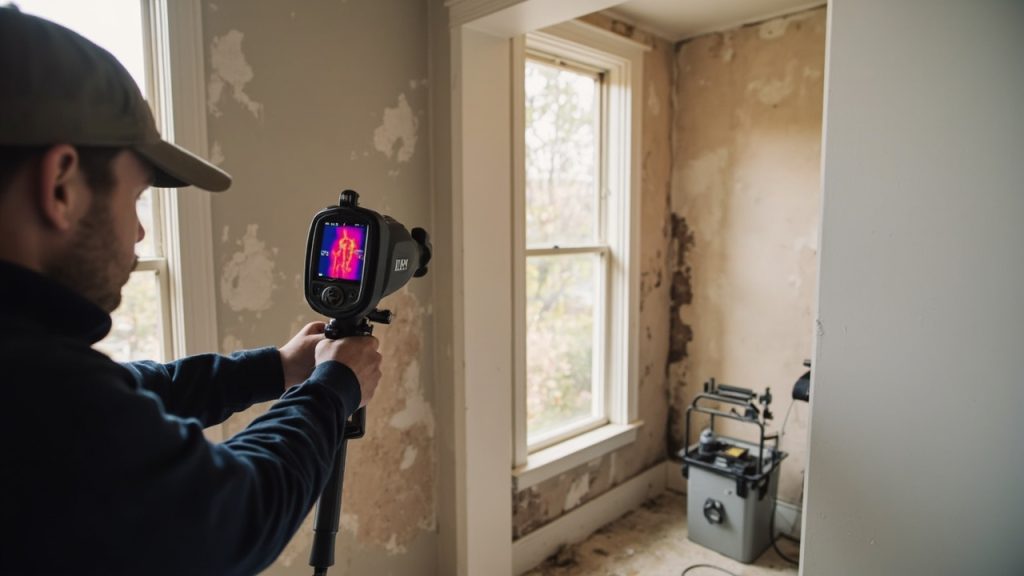
When the crew arrives, the first tool on the ground is a moisture meter and a thermal imaging camera. This is not optional. Capitol Hill’s older building stock frequently hides moisture inside wall cavities that look dry to the eye. Infrared thermography shows the thermal differentials that indicate trapped water behind plaster and inside ceiling assemblies.
From there, extraction begins with truck-mounted wet-vacs and submersible pumps for standing water. For carpeted areas, we use weighted extraction heads to pull water from both the face fiber and the padding at the same time. For hardwood floors, which are common in Capitol Hill’s historic homes, we monitor moisture content in real time. Old-growth fir and maple used in pre-war construction can sometimes be saved if drying begins within hours, but that window is tight.
The 5-Step Restoration Process We Use in Capitol Hill
- Inspection and Moisture Mapping — Thermal imaging, pin and pinless moisture meters, and psychrometric readings establish a baseline. We document everything for your insurance claim before touching a surface.
- Water Extraction — Truck-mounted extractors, submersible pumps, and specialty tools for carpet, hardwood, and concrete slab pull the bulk water fast.
- Structural Drying and Dehumidification — High-velocity air movers and low-grain refrigerant (LGR) dehumidifiers run in calculated placement based on the room’s psychrometric conditions. We calculate equipment placement, we do not guess at it.
- Cleaning, Sanitization, and Mold Prevention — EPA-registered antimicrobials are applied to affected surfaces. If microbial growth is already present, we shift to full mold remediation protocols with containment, HEPA air scrubbing, and negative air pressure.
- Full Restoration — From replacing drywall and insulation to addressing peeling paint and wallpaper caused by moisture migration, we bring the property back to pre-loss condition.

Specialized Protocols for Capitol Hill Architecture
Historic Homes and Victorian-Era Buildings
Capitol Hill has some of the best-preserved early-1900s residential architecture in the Pacific Northwest. When a pipe fails in a 110-year-old Craftsman, the restoration approach is fundamentally different from a newer townhome build.
Lath-and-plaster walls trap moisture differently than modern drywall. The plaster itself may survive, but the wood lath behind it will hold moisture for weeks without proper structural drying. We use in-wall drying systems that direct conditioned airflow directly into the wall cavity without requiring full demolition. This preserves original plaster where it is structurally sound.
Old-growth fir flooring is dense and slow to absorb, but once wet, it takes sustained airflow and careful monitoring to dry without cupping or buckling. If your floors are already showing signs of cupping or buckling, early intervention dramatically improves the odds of saving them.
Apartments and Condos in the Pike-Pine Corridor
Multi-story buildings along Broadway, 10th Ave E, and Pine Street present a coordination challenge. Water travels with gravity and air pressure differentials through building cavities in ways that single-family homes do not. A failure on the 6th floor may saturate units on floors 4 and 5 before anyone identifies the source.
We work with building managers and HOA representatives to coordinate access across multiple units. Our commercial water damage protocols apply here, including multi-zone moisture mapping, coordinated equipment placement across floors, and documentation that satisfies both the building’s insurance and individual unit owner policies.
Sewage backups in basement-level units are a separate category entirely. King County’s aging combined sewer systems under Capitol Hill create real backflow risk during heavy rain events. Sewage backup cleanup requires Category 3 biohazard protocols, full PPE, and EPA-registered disinfectants. This is not a job for a shop vac and a box fan.
Capitol Hill Water Damage Response Time and Equipment Reference
| Damage Scenario | Typical Crew Arrival (Capitol Hill) | Primary Equipment Deployed | Estimated Drying Time |
|---|---|---|---|
| Burst pipe (single room) | Under 45 minutes | Truck-mounted extractor, 3 to 4 LGR dehumidifiers, air movers | 3 to 5 days |
| Multi-unit apartment leak | Under 60 minutes | Submersible pumps, multi-zone drying system, thermal camera | 5 to 7 days |
| Sewage backup (basement) | Under 45 minutes | Biohazard extraction, HEPA air scrubbers, antimicrobial treatment | 4 to 6 days plus clearance testing |
| Sump pump failure (basement flooding) | Under 45 minutes | High-capacity submersible pump, structural drying, crawl space fans | 5 to 10 days depending on depth |
| Roof leak (storm-related) | Under 60 minutes | Emergency tarping, attic extraction, dehumidification | 4 to 7 days |
PNW Mold Risk in Capitol Hill Homes
Seattle’s climate does not give water damage survivors much margin. When outdoor humidity hovers between 75 and 85 percent during the fall and winter months, materials that are only slightly damp will not dry on their own. Open windows and fans are not a strategy. They are a way to buy mold more time.
Capitol Hill’s building density means poor airflow in many structures. Basement units along 12th Ave and the blocks near First Hill often have minimal solar exposure and thick vegetation that keeps exterior walls permanently damp. That external moisture pressure combines with any interior leak to create ideal mold germination conditions.
The IICRC S520 Standard for Mold Remediation defines the protocols our team follows for assessment, containment, and clearance testing. We do not self-certify clearance. Post-remediation verification is conducted via air sampling with results compared to outdoor control samples. You get documentation you can show your insurance company and your building manager.
If you are seeing visible mold growth on walls or noticing persistent musty odors, do not wait to call. What looks like surface discoloration is often the visible tip of a larger colony growing inside the wall assembly.
Burst Pipes During Seattle Freeze Events
Capitol Hill sits at elevation. When a true Pacific Northwest freeze event hits, wind chill on exposed pipe runs in older homes can push temperatures past freezing inside wall cavities that were never insulated to modern standards.
The copper supply lines in Capitol Hill homes built before the mid-1900s are particularly susceptible. When the water inside freezes, it expands. The pipe does not always burst at the frozen point. It ruptures where the pressure wave finds the weakest joint, often inside a wall or ceiling where you will not find it for hours.
If you had a freeze event and then suddenly notice low pressure, water staining, or a wet ceiling after the thaw, stop using the water immediately and call. Burst pipe water damage that is caught within the first few hours is a contained event. Left overnight, it becomes a structural project.

Water Damage Type Comparison for Capitol Hill Property Owners
| Water Category | Source Examples | Health Risk | Insurance Claim Complexity | Typical Protocol |
|---|---|---|---|---|
| Category 1 (Clean Water) | Supply line break, appliance overflow | Low | Low to moderate | Extract, dry, monitor |
| Category 2 (Gray Water) | Washing machine overflow, dishwasher leak | Moderate | Moderate | Extract, sanitize, dry, test |
| Category 3 (Black Water) | Sewage backup, CSO overflow, floodwater | High (biohazard) | High, requires documentation | Full biohazard protocol, HEPA containment, clearance testing |
Insurance Claims Assistance for Seattle Homeowners and Property Managers
Washington State homeowners insurance policies vary significantly in how they treat water damage. Sudden and accidental discharge from a supply line is typically covered. Long-term seepage or flood events require separate flood insurance under FEMA’s National Flood Insurance Program. Knowing which category your damage falls under before you file affects your claim outcome.
Evergreen works directly with major carriers active in the Seattle market. We document every step of the extraction and drying process with moisture logs, psychrometric data, and timestamped photos. This documentation protects you. Adjusters look for evidence that the damage was mitigated promptly and professionally. Gaps in documentation give them grounds to reduce or deny portions of your claim.
If you are navigating a complex claim, our guide on how to handle insurance claims walks through the process in detail. We can also connect you with public adjusters in the Seattle area if your carrier disputes the scope of loss.
For property managers dealing with a multi-unit event, our disaster recovery planning resources help you build a response protocol before the next event. Capitol Hill has enough aging infrastructure that another event is a matter of when, not if.
Sump Pump Failure and Basement Flooding in Capitol Hill
Basements in Capitol Hill face hydrostatic pressure from Seattle’s clay-heavy glacial till soils. During a sustained rain event, those soils become saturated and push water through foundation walls and floor cracks with considerable force. A functioning sump pump is the only line of defense for many basement units.
When that pump fails, the result is often a foot or more of standing water in under an hour. Our sump pump failure cleanup service deploys high-capacity submersible extraction units first, then transitions to structural drying once standing water is removed. We also evaluate crawl space conditions and subfloor saturation, which are frequently overlooked in rushed cleanup attempts.
If your sump pump has not been tested recently, our sump pump maintenance guide walks you through what to check before the rainy season peaks.
Serving the Greater Capitol Hill Area and Surrounding Seattle Neighborhoods
Our crews stage from locations that allow rapid deployment across the Seattle core. Beyond Capitol Hill, we serve neighboring areas including Queen Anne, South Lake Union, Beacon Hill, and the Central District. For clients across the broader metro, we also provide full-service water damage restoration in Bellevue, Shoreline, and Burien.
If you are unsure whether your situation qualifies as an emergency or needs a scheduled assessment, err toward calling immediately. Water damage never gets cheaper with time. The first 24 hours determine whether you are dealing with a contained drying project or a full structural restoration.
Call Evergreen Water Damage Restoration now. Give us your address in Capitol Hill. We will tell you exactly how fast we can be there.