

Main Water Line Leak Detection and Restoration for Bothell Homeowners
A main water line leak in Bothell can quietly destroy your yard, undermine your foundation, and spike your water bill for months before you ever see standing water inside the house. The tricky part is that most of the damage happens underground, in glacial till soil that holds moisture like a sponge and gives the leak nowhere to drain. By the time you notice the symptoms, the problem is already serious.
This guide gives you the full picture, from spotting the first warning signs to knowing exactly who to call, who is responsible for the repair, and how to dry out your home after a main line failure. If you are already dealing with water inside your home, call Evergreen Water Damage Restoration Seattle now. We serve Bothell and the surrounding King and Snohomish County corridor 24 hours a day, every day.
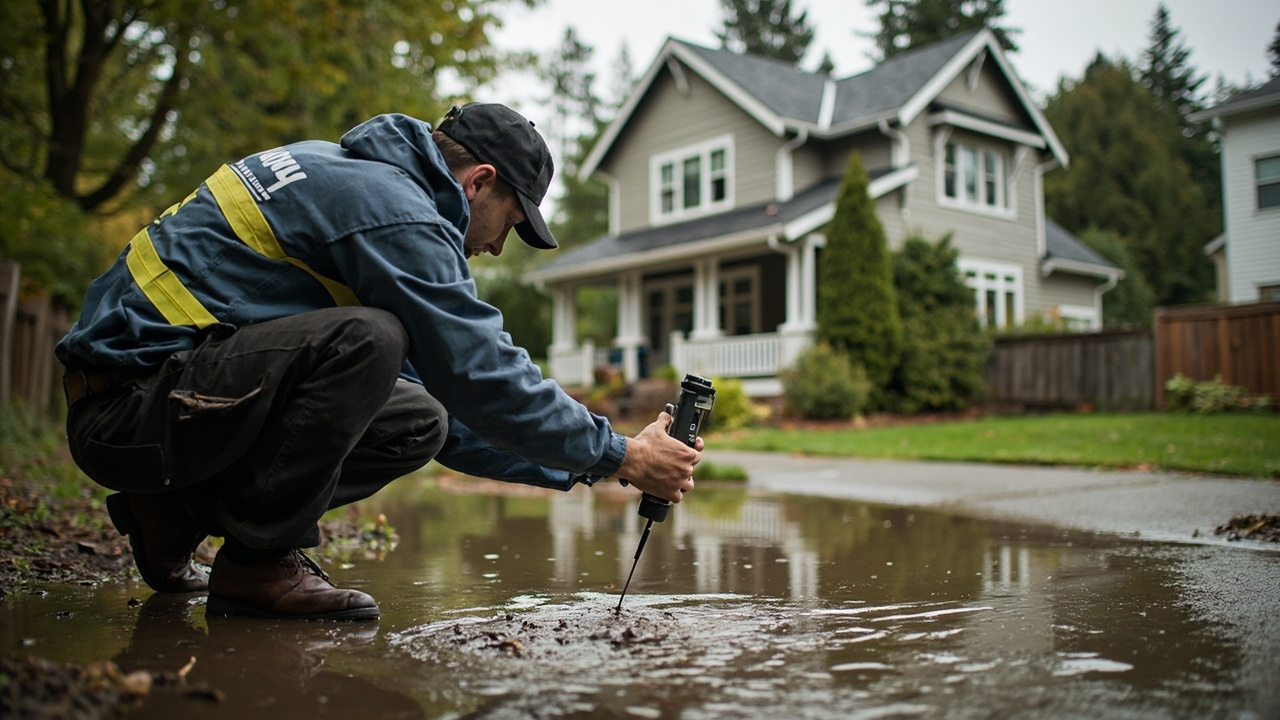
Signs You Have a Main Water Line Leak on Your Bothell Property
Main water line leaks rarely announce themselves with a flood. They whisper first. Here is what to watch for on a typical Bothell residential property.
Soggy or Unusually Green Patches in the Yard
The main service line runs from the City of Bothell water meter pit at the street to your home. If that line develops a crack or joint failure underground, pressurized water seeps upward. In Bothell’s clay-heavy soils, especially in neighborhoods like Norway Hill and Canyon Park, that water has nowhere fast to go. The result is a localized patch of lawn that stays wet after dry weather, or a strip of grass that is noticeably greener and lusher than the surrounding turf.
Do not dismiss this as a sprinkler issue. A running main line leak loses water continuously, not just during irrigation cycles.
Sudden Drop in Water Pressure
If your showerhead pressure drops without a utility notice from Bothell Public Works, a breach somewhere on your service line is the likely cause. The pipe cannot maintain full pressure when it is losing volume underground. Check whether the pressure drop is isolated to your property or affects your neighbors as well. If it is just your home, the break is on your side of the meter, which means it is your responsibility to repair.
An Unexplained Spike in Your Water Bill
The City of Bothell uses automated meter reading technology. Many residents in the Thrasher’s Corner and Queensborough areas have access to the EyeOnWater app, which connects to your smart meter and sends alerts when your consumption jumps outside your normal usage pattern. If you have not set up leak alerts through that platform yet, do it today. Catching a slow leak weeks earlier can mean the difference between a minor excavation and a full foundation drying project.
Foundation Cracks or Heaving Near the Water Entry Point
Hydrostatic pressure is the force exerted by water-saturated soil against your foundation walls. Bothell sits on a mix of glacial till and dense clay, two soil types with very low permeability. When a main line leaks near the foundation, that soil becomes fully saturated and exerts enormous lateral pressure. Over time, you will see horizontal cracks in concrete block walls, floor slab heaving, or persistent dampness in the basement even without heavy rainfall.
Air or Discolored Water at the Tap
A crack in a buried line can allow air to enter the system under certain pressure conditions. If you are getting sputtering water or intermittent air bursts from your faucets, that is a red flag. Discolored or sediment-heavy water can also indicate a line breach that is pulling in soil particles.
City vs. Homeowner Responsibility in Bothell
This is the question most homeowners get wrong under pressure. In Bothell, the water main in the street and the connection up to the water meter pit is the responsibility of the City of Bothell Public Works Department. Everything from the meter pit to your home’s main shut-off valve and all plumbing beyond it is the homeowner’s responsibility.
If you suspect a leak on the city’s side, you can reach Bothell Public Works at their 24-hour emergency line. For leaks on the homeowner side, a licensed plumber handles the pipe repair, and a water damage restoration company handles everything that gets wet as a result.
| Section of Line | Who Is Responsible | Who Handles Repair |
|---|---|---|
| Water main in the street | City of Bothell | Bothell Public Works crew |
| Meter pit connection | City of Bothell | Bothell Public Works crew |
| Service line from meter to house | Homeowner | Licensed plumber (permit required) |
| Interior plumbing and fixtures | Homeowner | Licensed plumber |
| Water damage to structure and contents | Homeowner (insurance dependent) | Water damage restoration company |
Emergency Steps to Take Right Now While You Wait for Help
If you suspect an active main line leak, these steps can reduce damage while professional crews are en route. Time matters enormously here. Water migrating through Bothell’s clay soils can reach your basement slab within hours of a line breach.
- Locate and close your main shut-off valve
In most Bothell homes built before the early 2000s, the main shut-off is located where the service line enters the house, typically in the utility room, crawl space, or basement wall facing the street. In newer construction in areas like Queensborough, it may be in a utility closet near the garage. Turn it clockwise until it stops. If the valve is corroded and will not turn, do not force it. Call your plumber immediately.
- Check your water meter for movement
After closing the interior shut-off, go to the meter pit at the curb. If the meter dial is still spinning, water is still moving somewhere between the street and your valve, confirming an active leak on the service line.
- Contact Bothell Public Works
Call their public works emergency line to report the situation. If any portion of the leak appears to involve the meter connection or the street-side infrastructure, they need to know immediately. Flooding that reaches the street can also affect storm drainage, which falls under King County or Snohomish County jurisdiction depending on your Bothell address.
- Document everything before cleanup begins
Take photos and video of all visible water, wet surfaces, muddy soil patches, and any visible pipe damage. This documentation is critical for your insurance claim, especially if you are pursuing a service line coverage endorsement under your homeowner’s policy.
- Move valuables out of wet areas
If water has reached the basement or crawl space, remove documents, electronics, and furniture to dry areas immediately. Do not use electrical outlets or switches in rooms with standing water.
- Call a water damage restoration company
Once the pipe flow is controlled, the structural drying process needs to begin as soon as possible. Mold colonization in wet building materials can begin within 24 to 48 hours, a timeline that Bothell’s persistently humid air accelerates further.
Why Bothell Soil and Infrastructure Make Main Line Leaks More Likely
Bothell’s geology is not forgiving on buried pipes. The area sits atop glacial till deposits left behind from the last ice age, a dense mixture of clay, silt, sand, and gravel that shifts seasonally as it absorbs and releases water. That expansion and contraction cycle exerts constant stress on older pipe joints.
Root intrusion is also a major factor. The Pacific Northwest’s native tree species, including big-leaf maple and western red cedar, develop aggressive lateral root systems that seek out even micro-fractures in buried lines. Older neighborhoods in Bothell with mature tree canopy cover carry a significantly higher risk of root-related main line damage.
Older service lines in Bothell are often galvanized steel or cast iron, both of which corrode from the outside in when exposed to the acidic, mineral-rich groundwater common to this region. Copper lines, common in mid-century homes, can develop pinhole leaks from the electrolytic reaction between copper and certain soil mineral compositions found in this part of the greater Seattle metro.
For a broader look at how Seattle-area soil conditions affect water damage, the IICRC (Institute of Inspection, Cleaning and Restoration Certification) publishes technical standards that guide how restoration professionals assess and treat water damage in these specific soil and climate conditions.
Trenchless vs. Traditional Pipe Repair in King and Snohomish County
Once the plumber confirms the break location, you face a repair method decision. Both trenchless and traditional excavation have legitimate applications in Bothell’s residential environment.
| Repair Method | Best Suited For | Disruption Level | Permit Required in Bothell |
|---|---|---|---|
| Trenchless pipe lining (CIPP) | Cracks, joint gaps, minor corrosion on intact pipe runs | Low (minimal excavation) | Yes, City of Bothell plumbing permit |
| Trenchless pipe bursting | Severely deteriorated pipes needing full replacement | Low to moderate | Yes, City of Bothell plumbing permit |
| Open-cut excavation | Complex breaks, root intrusion, pipe collapse | High (landscape disruption) | Yes, plus right-of-way permit if near street |
Trenchless methods are often preferred in Bothell’s older neighborhoods where mature landscaping, concrete driveways, or utility conflicts make open excavation disruptive and costly. Your plumber should perform a camera inspection of the line before recommending either approach.
Water Damage Restoration After a Main Line Failure
Fixing the pipe is only the first step. The water that escaped the line before it was shut off is now in your soil, potentially in your crawl space or basement slab, and possibly wicking upward through your framing and wall assemblies. This is where water damage restoration becomes critical, and where plumbing repair companies are not equipped to help.
Structural Drying and Dehumidification
After a main line failure, the affected structure needs professional-grade drying equipment. Industrial air movers create high-velocity airflow across wet surfaces while commercial dehumidifiers pull extracted moisture out of the air. This is not a process that box fans and open windows can replicate, especially in Bothell’s climate where ambient outdoor humidity is often high enough to slow evaporation significantly.
IICRC S500 standards guide the drying protocol. Technicians set moisture content targets for each material class, wood framing, concrete slab, gypsum wallboard, and monitor daily readings until those targets are reached. Cutting corners on drying time is the most common reason homeowners call a second restoration company after developing mold problems weeks later.
If you have dealt with a similar situation in a neighboring community, our guide on what to do when your Ballard basement floods during a storm covers the same structural drying priorities in detail.
Mold Remediation After Slab and Yard Leaks
Slab leaks and yard-origin water events are particularly problematic for mold because the moisture source is below grade. Water enters the structure from underneath, where it is hardest to detect and slowest to dry. By the time you see surface mold on drywall or smell that characteristic musty odor, spore counts in the air are already elevated.
If your main line leak went undetected for more than a few days, you should have a mold assessment done alongside the restoration work. Our team handles both services. For more background on what professional mold remediation involves in the greater Seattle area, see our article on what Kirkland homeowners need to know about professional mold removal on damp walls.
Navigating Insurance Claims for Service Line Damage in Washington State
Standard homeowner’s insurance policies in Washington State typically exclude damage caused by slow leaks or gradual water intrusion. A sudden, accidental main line failure may be covered under the dwelling or other structures section, but coverage depends heavily on the specific policy language and how quickly you reported and responded to the damage.
The policy endorsement you want to ask your agent about is service line coverage. This add-on specifically covers the repair of the underground utility line from the street to your home, a gap left by standard policies. If you do not currently carry this endorsement, add it before a problem occurs.
- Document the failure date and initial discovery as precisely as possible
- Save all water bills showing the consumption spike as supporting evidence
- Get a written diagnosis from the plumber confirming the break location and cause
- Request a scope-of-loss report from your restoration company to support the structural damage claim
- Do not sign off on any permanent repairs before your adjuster has inspected the site, unless doing so would prevent additional damage
- Ask your adjuster specifically whether your policy includes coverage for mold remediation resulting from the water intrusion event
If your situation involves sewage backup along with the main line failure, the damage category changes entirely. For properties in Bellevue with similar concerns, our team covers that process in this guide on why professional sewage cleanup in Bellevue matters before your floors are ruined.
What to Expect From the Evergreen Water Damage Restoration Process
When you call our team for a main water line event in Bothell or the surrounding Kenmore and Kirkland corridor, here is what happens.
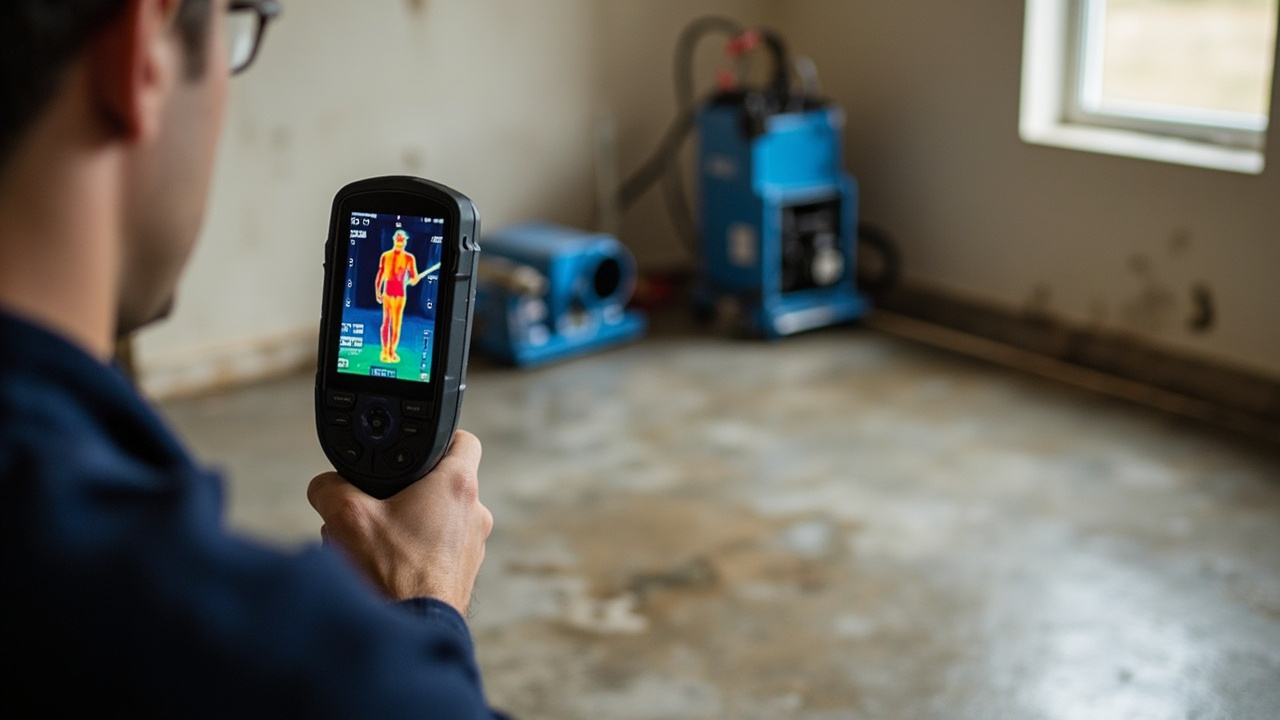
We arrive with moisture meters, thermal imaging cameras, and extraction equipment. The first step is a full scope assessment. We map moisture readings across every affected surface, including floors, walls, and subfloor assemblies, before any equipment is placed. This baseline reading is what your insurance adjuster will reference to confirm the extent of damage.
Extraction comes first if there is standing water. Then air movers and dehumidifiers are staged according to a psychrometric drying plan. Readings are taken on each visit and documented. If wall cavities are wet, we use flood cuts or inject drying air directly into the wall through drill ports to reach moisture trapped behind gypsum board.
For events that have affected Capitol Hill properties under comparable circumstances, the same systematic approach applies. You can review a similar emergency response outline in our guide on how to get fast water damage help in Capitol Hill without the wait.
Backflow prevention is also something to address after any main line event. A compromised service line can, under certain pressure conditions, allow contaminants to enter your potable water system. Your plumber should assess your backflow prevention device as part of the repair scope.
Frequently Asked Questions
How do I find my main water shut-off valve in a Bothell home?
In most single-family homes in Bothell, the main shut-off valve is located where the service line enters the home, typically on an interior wall facing the street in the basement, crawl space, or utility room. In homes with a slab foundation, it may be in the garage. If you cannot find it, the secondary shut-off is at the meter pit near the curb, which requires a meter key or flat-head tool to operate.
Does the City of Bothell have an emergency water line contact number?
Yes. The City of Bothell Public Works Department maintains a 24-hour emergency line for utility emergencies including water main breaks. You can find the current contact number on the official City of Bothell public works page. Call them if water is appearing at the street or if you believe the break may be on the city’s side of the meter.
How long does structural drying take after a main water line leak?
Drying timelines depend on the materials affected, the volume of water, and ambient conditions. In Bothell’s climate, most residential drying projects range from three to five days for contained events to seven or more days for events involving slab infiltration or significant wall cavity moisture. Daily moisture readings determine when the structure has reached acceptable dryness standards per IICRC S500 protocol.
Will my homeowner’s insurance cover a main water line break in Bothell?
Sudden and accidental breaks may be covered under your dwelling or other structures coverage, but service line repair is typically excluded unless you carry a service line endorsement. Washington State homeowners should review their policy’s water damage exclusions carefully and ask their agent about adding service line coverage if it is not already included.
If you are seeing any of the warning signs described here, or if your water meter is spinning with all fixtures off, do not wait. Call Evergreen Water Damage Restoration Seattle and get a technician to your Bothell property today. The faster you respond, the less structural damage you face and the stronger your insurance claim will be.