

Expert Rain Runoff and Water Damage Restoration in Mount Baker, Seattle
If your home sits along the slopes between Rainier Avenue and Lake Washington Boulevard, you already know what a hard Pacific Northwest rain can do. Water comes fast, it follows gravity, and it does not care about your finished basement or your foundation walls. Mount Baker’s hillside topography makes runoff damage one of the most common — and most underestimated — threats homeowners in the 98144 and 98118 zip codes face every single rainy season.
This guide covers why your property is at risk, what warning signs to watch for, and what professional restoration actually looks like when water has already gotten inside.
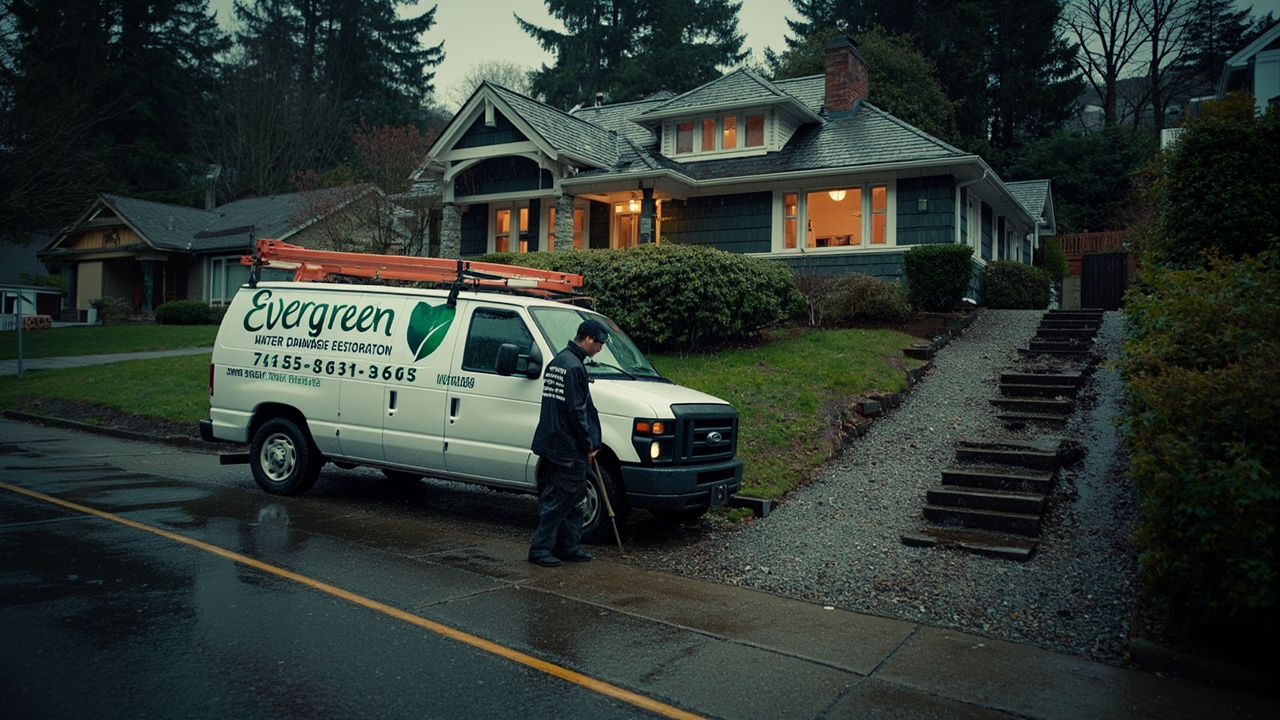
Why Mount Baker Homes Are Especially Vulnerable to Runoff Damage
Mount Baker Ridge drops sharply toward Lake Washington. That elevation change is one of the neighborhood’s defining features, but it also creates a gravity-fed runoff problem that flat neighborhoods like South Lake Union simply do not experience. When a storm cell drops two or three inches of rain in a few hours, that water moves downhill at speed.
The geology makes it worse. Seattle sits on a foundation of glacial till — a dense, compacted mix of sand, gravel, and clay deposited by retreating glaciers thousands of years ago. The clay layers in particular are nearly impermeable. Water cannot soak through them quickly, so it runs laterally along the surface or builds up hydrostatic pressure against any buried concrete it encounters.
Older homes in Mount Baker were built before modern drainage standards. Many sit on foundations that were never designed to resist sustained hydrostatic pressure. Add aging combined sewer systems that back up during heavy storms, and you have a recipe for basement flooding that repeats every wet season.
Atmospheric river events — sometimes called Pineapple Express storms — drive the worst episodes. These are elongated bands of moisture originating in the subtropical Pacific that funnel directly into Western Washington. According to Seattle Public Utilities, the greater Seattle area receives more than 37 inches of precipitation annually, with the heaviest events concentrated between October and March. A single atmospheric river can drop several inches of rain in 24 to 48 hours, overwhelming every drainage system from Beacon Hill to White Center.
Common Signs of Stormwater Intrusion in South Seattle Properties
Water damage from runoff rarely announces itself with a dramatic flood. More often, it shows up as subtle warning signs that compound over time until a major event forces the issue.
- White, chalky efflorescence on basement or crawl space walls — a mineral deposit left behind when water moves through concrete
- Persistent damp or musty odor in below-grade spaces, even when no visible water is present
- Peeling paint or bubbling wallpaper on basement walls or lower-level rooms
- Rust stains or waterlines on foundation walls indicating repeated wetting cycles
- Soft or springy subfloor near exterior walls, suggesting moisture trapped beneath finished surfaces
- Hairline cracks in foundation walls that widen after heavy rain events
- Sump pump that runs continuously during storms, or worse, a sump pump that has failed silently
- Yard areas that stay saturated for days after rain, indicating clay soil saturation and poor drainage grade
If you recognize more than two or three of these in your Mount Baker home, water is already working against your structure. The longer you wait, the more expensive the repair becomes.
Hydrostatic Pressure and Foundation Seepage
When rain-saturated soil surrounds a basement or foundation wall, the weight and pressure of that water builds against the concrete or masonry. This is hydrostatic pressure. It is the primary mechanism behind foundation cracks in hillside homes, and it is a particular problem in Mount Baker because of how quickly water accumulates in the clay-heavy soil during a hard storm.
Hydrostatic pressure does not need a gap to begin damaging a foundation. It forces water molecules through the concrete matrix itself — a process called capillary action. Over time, those repeated wetting and drying cycles weaken the concrete, widen microfractures, and eventually create the cracks and seepage paths that lead to full basement flooding.
Foundation seepage from hydrostatic pressure is distinct from a burst pipe or overland flooding, and that distinction matters enormously for your insurance claim. We will cover that separation in more detail below.
Landscape Erosion and Basement Flooding
Slope instability compounds the runoff problem in Mount Baker. When the vegetative layer on a hillside lot is thin or damaged, heavy rain strips away topsoil and redirects water flows in unpredictable directions. Eroded channels develop along property lines or along exterior foundation walls, concentrating flow exactly where you do not want it.
Homes with finished basements are at highest risk. A finished basement represents significant invested value, and water that enters through a failing foundation drain or overwhelmed sump pump does not stop at the concrete. It wicks into framing, drywall, carpet padding, and insulation within hours.

Our Professional Water Damage Restoration Process for Mount Baker Homes
When runoff water has entered your home, the clock starts immediately. Mold can begin colonizing wet organic materials within 24 to 48 hours in Seattle’s high-humidity environment. Here is what a professional extraction and structural drying process looks like from start to finish.
- Emergency Assessment and Water Extraction
A technician uses a moisture meter and thermal imaging camera to map the full extent of water intrusion before any equipment is placed. Truck-mounted or portable extraction units remove standing water from flooring, carpet, and below-grade spaces. Finished basements in historic Craftsman homes — common throughout Mount Baker — require careful extraction around lath and plaster walls to avoid secondary damage.
- Structural Drying with Commercial-Grade Equipment
High-capacity LGR (Low Grain Refrigerant) dehumidifiers are positioned to draw moisture from the air and from building materials simultaneously. These units far outperform consumer-grade dehumidifiers in extraction rate and grain-per-pound capacity. HEPA air scrubbers run in parallel to capture mold spores and particulates disturbed by the drying process. Drying typically takes three to five days for a finished basement, depending on material types and ambient humidity.
- Moisture Monitoring and Documentation
Technicians return daily to take readings across all moisture monitoring points. This data is documented and provides the paper trail your insurance adjuster will need to process your claim. Daily readings confirm when materials reach the target equilibrium moisture content for your climate zone.
- Antimicrobial Treatment
Once structural drying is complete, affected surfaces receive an EPA-registered antimicrobial treatment to inhibit mold growth. In homes where water was present for more than 24 hours, or where visible mold colonies are found, a separate mold remediation protocol follows IICRC S520 standards.
- Restoration and Repair
Damaged drywall, insulation, baseboards, and flooring are removed and replaced. If the source of intrusion was a failed foundation drain or sump pump, a waterproofing contractor assessment is recommended before restoration is finalized. Peeling paint and water-stained surfaces are addressed as part of the final aesthetic restoration phase.
DIY Drying vs. Professional Structural Drying
| Factor | DIY Box Fan and Consumer Dehumidifier | Professional LGR Dehumidifier Setup |
|---|---|---|
| Daily moisture removal capacity | 15 to 30 pints per day | 100 to 150+ pints per day |
| Drying time for a 500 sq ft basement | 10 to 21 days | 3 to 5 days |
| Mold risk window | High (exceeds 48-hour threshold) | Low (drying begins within hours of setup) |
| Insurance documentation | None | Daily moisture logs, photo documentation |
| Hidden moisture detection | None | Thermal imaging and calibrated moisture meters |
| Mold spore filtration | None | HEPA air scrubbers rated to 0.3 microns |
The extended drying window of a DIY approach almost always results in mold growth behind walls and under flooring — a problem that costs far more to remediate than the professional drying would have cost in the first place. If you have experienced a similar situation in a Ballard basement, our guide on what to do when your Ballard basement floods during a storm covers the immediate steps in detail.
Preventing Future Runoff Damage with Mount Baker Drainage Solutions
Reactive restoration is expensive. Proactive drainage management is not cheap either, but it protects your property value and keeps your insurance premiums from climbing after repeated claims.
The following drainage strategies are appropriate for hillside lots in the Mount Baker and South Seattle area, and most are eligible for Seattle Public Utilities RainWise rebate programs.
French Drain Installation for Hillside Lots
A French drain intercepts subsurface water before it reaches your foundation. For a Mount Baker hillside lot, this typically means a trench dug along the uphill side of the foundation, lined with landscape fabric, filled with gravel, and fitted with a perforated pipe that redirects water away from the structure to a lower discharge point or drywell.
In clay-heavy glacial till soil, French drain sizing matters. Undersized drains clog with fine particulates within a few seasons. A properly designed system for Mount Baker soil conditions should include a cleanout access port and annual flushing.
Sump Pump Maintenance and Backup Systems
A sump pump is the last line of defense for any below-grade space. In Mount Baker, during a hard atmospheric river event, your sump pump may run continuously for 24 to 48 hours. That is a stress test most homeowners have never thought about.
Sump pump failure during peak storm load is one of the most common causes of finished basement flooding we see throughout South Seattle. Check your pump quarterly. Pour water into the pit to confirm the float switch activates. Inspect the discharge line to ensure it is not frozen, blocked, or discharged too close to the foundation.
A battery backup sump pump is essential for Mount Baker homes. Power outages during major storm events are common, and your primary pump is useless without electricity. A secondary battery or water-powered backup system keeps the pit draining even when the grid goes down.
Native Plantings for Slope Stabilization
Vegetation is a significant factor in slope runoff management. Deep-rooted native plants absorb rainfall, stabilize soil structure, and slow surface runoff velocity. For Mount Baker slopes, the following plants are well-suited to local soil and precipitation conditions:
- Oregon grape (Mahonia aquifolium) for dense ground cover on steeper slopes
- Red flowering currant (Ribes sanguineum) as a shrub layer anchor
- Sword fern (Polystichum munitum) for deep fibrous root systems in shaded areas
- Snowberry (Symphoricarpos albus) for erosion control along property edges
- Western red cedar (Thuja plicata) as a larger canopy layer for high-water-demand planting
Basement Waterproofing for Historic Homes
Mount Baker has a significant number of homes built between the early 1900s and mid-century — Craftsman bungalows, four-squares, and cape cods with original or partially updated foundations. These homes were not built with interior drainage membranes, dimple mats, or crystalline waterproofing treatments.
Interior waterproofing systems — interior drainage channels, a properly sized sump pit, and a wall membrane that drains seeping water to the sump rather than into your finished floor — can resolve chronic seepage without requiring full exterior excavation. Exterior waterproofing is more effective in theory but costs several times more and requires significant landscaping disruption on a hillside lot.
For mold concerns that have developed in below-grade spaces, the remediation process requires expertise specific to the moisture conditions of Seattle homes. If you are dealing with mold on damp walls elsewhere in the region, our resource on what Kirkland homeowners need to know about professional mold removal on damp walls applies to the same core biology and treatment standards.

Navigating Your Insurance Claim for Rain Runoff Damage
This is where many Mount Baker homeowners lose money they should recover. The terminology on your policy matters enormously, and the wrong claim classification can result in denial.
| Damage Source | Coverage Type | Typical Policy Section | Common Exclusion Risk |
|---|---|---|---|
| Foundation seepage from hydrostatic pressure | Usually excluded from standard homeowners policies | Flood exclusion clause | High — requires separate flood rider or NFIP policy |
| Sewer or drain backup due to storm overwhelm | Covered if sewer backup endorsement is purchased | Water backup rider | Medium — requires specific endorsement, not automatic |
| Sump pump failure allowing water entry | Covered if sump pump failure endorsement is active | Equipment breakdown or water backup rider | Medium — often bundled with sewer backup endorsement |
| Sudden and accidental water intrusion (not flood) | Typically covered under standard HO-3 policy | Dwelling coverage, Coverage A | Low — if documented as sudden, not gradual |
| Overland flooding from surface water runoff | Excluded from standard homeowners policies | Flood exclusion clause | High — requires NFIP or private flood insurance |
Document everything before you remove a single wet item. Photograph water levels, waterlines on walls, damaged contents, and the exterior drainage conditions. A restoration company that provides daily moisture logs and a detailed scope of work gives your adjuster what they need to process the claim accurately.
If your situation involves sewage contamination from a backed-up drain, the health stakes increase significantly. For perspective on what that category of damage involves, our article on professional sewage cleanup in Bellevue explains the contamination classifications and why they matter for restoration protocol.
Local Emergency Response for 98144 and 98118 Zip Codes
When water is actively entering your home, response time determines how much you lose. Evergreen Water Damage Restoration serves Mount Baker and the broader South Seattle corridor — including Beacon Hill, Rainier Valley, and Columbia City — with 24/7 emergency dispatch.
The same response capacity extends across Seattle. Homeowners in Queen Anne dealing with burst copper pipes during a freeze event can find immediate guidance in our article on what to do after a burst pipe in Queen Anne. And if you are in Capitol Hill and need water damage help without a long wait, this resource covers the fast-response process for Capitol Hill homeowners.
For Mount Baker specifically, our technicians understand the neighborhood’s drainage geometry, the typical foundation types found in historic homes along the 34th and 36th Avenue corridors, and the common failure points in properties near the Lakeside Avenue and Lake Washington Boulevard grade transitions.
The worst thing you can do after runoff flooding is wait to see if it dries on its own. In Seattle’s climate, with ambient relative humidity consistently above 75 percent during the rainy season, wet building materials do not dry without mechanical intervention. Mold will establish. Structural members will begin to degrade. And what starts as a drainage problem becomes a remediation and reconstruction project.
If your Mount Baker home has taken on water from heavy rain runoff, call Evergreen Water Damage Restoration now for an immediate assessment. Early intervention is the single most effective thing you can do to control both the damage and the cost.
Frequently Asked Questions
Does standard homeowners insurance cover basement flooding from rain runoff in Seattle?
Standard homeowners insurance in Washington State typically excludes damage caused by surface water runoff or overland flooding. You need a separate flood insurance policy through the National Flood Insurance Program or a private carrier for that type of coverage. Sump pump failure and sewer backup may be covered under specific endorsements. Review your policy declarations page carefully and confirm with your agent before storm season.
How long does professional structural drying take for a finished basement?
For a finished basement in a Mount Baker home, professional structural drying typically takes three to five days when commercial LGR dehumidifiers and air movers are deployed correctly. Factors that extend the timeline include the presence of engineered wood flooring, spray foam insulation, or thick concrete walls that hold moisture longer than standard framing.
What permits does Seattle require for drainage system upgrades?
Drainage improvements such as French drains, catch basins, and discharge systems that connect to the public right-of-way or City drainage infrastructure require a permit through Seattle’s Department of Construction and Inspections. King County also regulates stormwater management for properties near sensitive areas. Your contractor should pull the appropriate permits before work begins.
When should I be worried about mold after a basement flood?
Mold can begin colonizing wet drywall, carpet padding, and wood framing within 24 to 48 hours at typical Seattle indoor temperatures. If your basement was wet for more than one day before extraction began, treat mold assessment as a required step in the restoration process, not an optional add-on.