
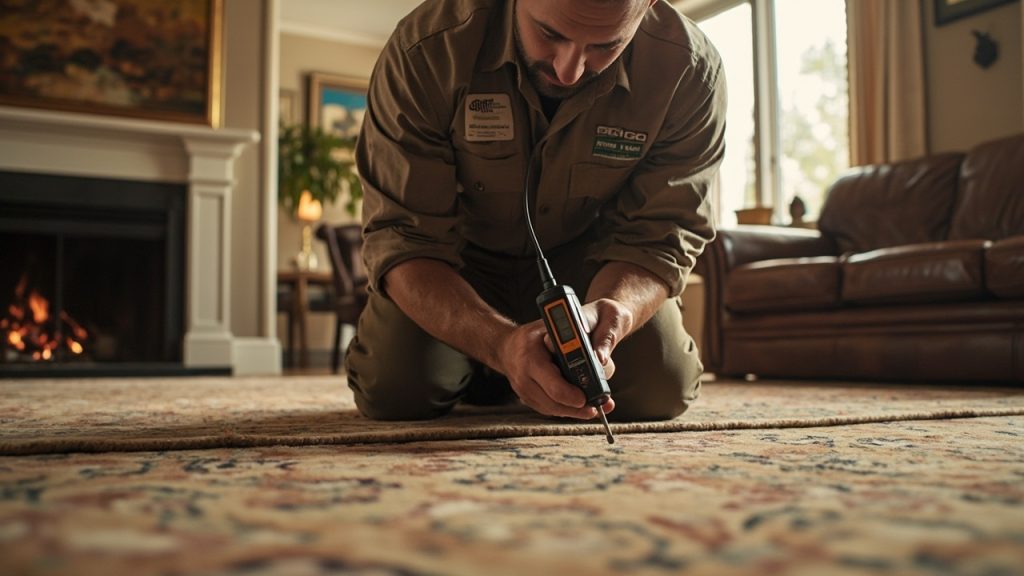
Professional Rug Drying Services in Clyde Hill, WA
A saturated wool rug is a race against time. Within 24 to 48 hours of water exposure, high-pile fibers begin to wick moisture deep into the foundation, dyes migrate toward the edges, and mold spores find a warm, dark place to colonize. In Clyde Hill, where a single Persian or hand-knotted wool rug can represent a five-figure investment, the stakes are real.
This is not a job for a shop vac and a few box fans. Evergreen Water Damage Restoration Seattle specializes in the careful, science-backed drying of high-end area rugs throughout the Clyde Hill 98004 zip code and the broader Eastside corridor, including Medina, Bellevue, and Mercer Island.

Why Standard Carpet Cleaning is the Wrong Response to a Water-Damaged Rug
Carpet cleaning and rug drying are completely different disciplines. Carpet cleaning uses moisture to lift soil. Rug drying uses controlled psychrometrics — the science of managing heat, airflow, and relative humidity — to remove water without causing secondary damage.
When you call a standard carpet cleaner after a flood, they may extract surface water and apply a cleaning solution. What they will not do is monitor subsurface moisture levels, test for colorfastness, or set up a calibrated drying chamber. That gap is where permanent damage happens.
For the types of rugs common in Clyde Hill homes — hand-knotted Afghan wool, Iranian Tabriz, Tibetan high-pile, and antique Oushak pieces — even one wrong move causes irreversible harm. We are talking about color bleeding, dry rot in the foundation weave, pile distortion, and structural shrinkage.
Why Clyde Hill Homeowners Face a Unique Risk
The Pacific Northwest climate creates conditions that accelerate mold growth on wet rugs. Seattle and its Eastside communities receive over 37 inches of precipitation annually, and the region’s high relative humidity means outdoor air rarely drops below 60% RH. Open windows do not dry a waterlogged rug in this climate. They often make it worse.
Clyde Hill sits on a ridge above Lake Washington with glacial till and clay-heavy soils beneath. During atmospheric river events — the kind that dump two inches of rain in a few hours — hydrostatic pressure builds against foundation slabs. Basements flood. Water finds the lowest point, which is usually the floor where your most valuable rugs are laid.
If you have experienced a burst pipe during a cold snap, you already know the damage that can follow. For more on handling that situation fast, see our guide on what to do when a burst pipe strikes, which covers the first critical steps before a technician arrives.
Wool, Silk, and Persian Rugs Require a Different Drying Protocol
Not all rugs respond to water the same way. The fiber type and construction method determine everything about how a rug should be dried.
| Rug Type | Primary Risk After Water Damage | Drying Approach | Typical Drying Time |
|---|---|---|---|
| Hand-knotted Wool (Persian, Afghan) | Dry rot in warp and weft threads, color migration | Off-site, controlled-environment drying | 48 to 72 hours |
| Silk or Silk-blend | Fiber degradation, irreversible pile crush, dye bleed | Off-site only, low-heat airflow, colorfastness testing first | 72 to 96 hours |
| Machine-tufted Wool | Latex backing delamination, mold under padding | On-site or off-site depending on size | 24 to 48 hours |
| Tibetan High-Pile Wool | Pile matting, long dry time due to fiber density | Off-site, directional airflow from pile face | 60 to 80 hours |
| Synthetic Area Rug | Backing mold, odor retention | On-site with air movers and LGR dehumidifier | 12 to 24 hours |
The IICRC S500 Standard for Professional Water Damage Restoration is the industry benchmark that governs how water-damaged materials should be handled. It classifies water contamination into three categories and defines the equipment, drying goals, and documentation requirements for each. A technician operating to IICRC certification standards will follow these protocols on every job, not just the straightforward ones.

Our 5-Step Professional Rug Restoration Process
- Inspection and Moisture Mapping
A certified technician uses calibrated moisture meters and thermal imaging to map saturation throughout the rug, including the pile, backing, and any underlayment. This establishes a drying baseline and identifies any pre-existing damage that water may have worsened.
- Water Extraction
Truck-mounted or portable extraction units remove bulk water from the rug. For delicate hand-knotted pieces, we use low-pressure wand extraction to avoid distorting the pile or stressing the foundation knots. Padding is almost always removed and discarded at this stage — it cannot be reliably dried in place.
- Controlled Dehumidification and Drying
We deploy low-grain refrigerant (LGR) dehumidifiers alongside industrial air movers positioned to create laminar airflow across the rug surface. Temperature and relative humidity are monitored continuously using psychrometric calculations to maintain the optimal drying vapor pressure differential. The goal is consistent, even drying that prevents surface crusting while moisture remains in the core.
- Sanitization and Deodorization
Water damage introduces bacteria and organic material that produce odor as they break down. After the structural drying phase, we apply EPA-registered antimicrobials appropriate for natural fiber rugs. Ozone treatment or hydroxyl generation may be used for severe odor cases. Colorfastness testing is performed before any chemical application on antique or hand-dyed pieces.
- Final Grooming and Inspection
Once moisture readings return to dry standard levels, the rug pile is groomed directionally to restore texture. A final inspection checks for any residual moisture pockets, color migration at selvedge edges, and structural integrity of the foundation weave. Documentation is provided for your insurance claim.
Off-Site Drying Versus On-Site Drying for High-Value Rugs
Most high-end wool and silk rugs should come off-site for drying. Here is why this matters for Clyde Hill homeowners.
On-site drying works well for wall-to-wall carpet or large, machine-made area rugs. You set up air movers, run dehumidifiers, and monitor until dry. The floor stays in place. The process is efficient.
A hand-knotted Persian rug needs more than airflow. It needs a controlled-temperature environment where humidity can be managed to precise levels. It may need to be suspended vertically to allow drainage and even airflow through the pile. The foundation fibers need to dry at the same rate as the surface pile, or you get differential shrinkage and buckle distortion that no amount of re-stretching will fully correct.
Our Eastside service area includes a climate-controlled rug drying facility where antique and luxury rugs are processed under consistent conditions. We transport rugs in protective wrapping, document their condition at pickup, and return them fully dried and groomed.
The Science Behind Drying a Saturated Rug
Psychrometrics is the physical science of moist air behavior. In practical terms, it means understanding how temperature, relative humidity, and airflow interact to move water out of a wet material and into the surrounding air, where dehumidifiers can capture it.
When a rug sits in standing water, moisture does not just sit on the surface. It moves by capillary action through every fiber, wicks into the backing, and saturates the padding beneath. A standard fan moves air but does not lower the humidity of that air. The water simply evaporates and re-deposits somewhere else — on walls, subfloor, or inside the rug again when airflow stops.
LGR dehumidifiers drop the dew point of the drying chamber, creating a vapor pressure deficit that pulls moisture out of the material. Pair that with air movers positioned to maximize boundary layer disruption at the rug surface, and you have a system that dries efficiently without overheating natural fibers.
Mold becomes a concern in as little as 24 hours on a wet wool rug in a Seattle-area humidity environment. Wool’s natural lanolin content does not protect it from mold indefinitely — it actually gives mold spores something to feed on. The faster the rug is extracted and placed in a controlled drying environment, the lower the mold risk. Homeowners near Ballard dealing with storm flooding can also review our resource on managing basement flooding for steps to take immediately after water enters your home.

Colorfastness Testing and Why It Changes Everything
Before any water, cleaning agent, or antimicrobial touches an antique or hand-dyed rug, a technician should perform a colorfastness test. This involves applying a small amount of distilled water to an inconspicuous area and pressing white blotting paper against the wet fibers. If color transfers, the rug has unstable dyes.
Unstable dyes are common in certain classes of antique Persian and naturally dyed Afghan rugs. They are not a defect — they are a characteristic of traditional dyeing with plant and mineral pigments. But they change the drying protocol significantly. These rugs require cooler drying temperatures, gentler airflow, and no chemical treatment beyond pure water rinse.
A technician who skips this step and applies a standard antimicrobial spray to a naturally dyed Ghashghai kilim can strip the reds and oranges from the entire field in hours. That kind of damage is not restorable.
Certified Technicians Serving Clyde Hill and the Greater Eastside
Evergreen Water Damage Restoration Seattle holds IICRC certification in Water Damage Restoration (WRT) and Applied Structural Drying (ASD). Our technicians train specifically on textile and rug restoration, not just structural drying.
We serve the Clyde Hill 98004 area and the surrounding Eastside communities including Bellevue, Kirkland, and Redmond, as well as Seattle neighborhoods from Capitol Hill to Magnolia. If you are dealing with mold appearing on walls after a water event — which often accompanies rug saturation in a flooding situation — our team handles that remediation as well. Kirkland homeowners can find relevant guidance in our article on mold removal on damp walls.
For sewage-related flooding — which carries Category 3 contaminated water and requires a completely different rug protocol — see our resource on sewage cleanup in Bellevue. Category 3 events often require rug disposal rather than restoration, and we will give you an honest assessment upfront.
| Factor | DIY Drying | Professional Rug Drying Service |
|---|---|---|
| Moisture Detection | Visual inspection only | Calibrated moisture meters, thermal imaging |
| Drying Equipment | Box fans, household dehumidifier | Industrial air movers, LGR dehumidifiers |
| Mold Risk Management | None — no antimicrobial protocol | EPA-registered antimicrobials, controlled environment |
| Colorfastness Protection | Not tested | Pre-treatment colorfastness testing on all antique rugs |
| Insurance Documentation | No formal report | Moisture logs, photo documentation, itemized report |
| Dry Standard Verification | Feels dry to touch | Readings compared against IICRC dry standard benchmarks |
Navigating Insurance Claims for High-Value Rug Damage
Most homeowner policies in Washington State cover sudden and accidental water damage, which includes burst pipes and appliance failures. Whether your rug is covered depends on your specific policy language and how the rug is scheduled.
High-value rugs — anything appraised above a few thousand dollars — are often excluded from standard personal property limits. If you own antique or collector-grade pieces, they should be on a personal property floater or fine arts rider. If they are not, the insurance payout may fall short of replacement cost.
Evergreen provides detailed documentation of the damage, the drying process, moisture readings, and restoration outcomes. This documentation supports your claim and gives your adjuster what they need to process the file. We can also communicate directly with your insurance company during the mitigation phase to ensure the scope of work is pre-authorized where required.
Capitol Hill homeowners dealing with any water emergency can also find immediate guidance in our article on getting fast water damage help without delays.
Emergency Rug Drying Response for Clyde Hill, 24 Hours a Day
Time is the variable that determines whether your rug survives a flooding event. Every hour that passes after saturation increases the depth of moisture penetration, accelerates mold germination, and gives dyes more time to migrate.
We dispatch emergency crews to the Clyde Hill area around the clock. When you call, a technician picks up — not an answering service. We can typically have a crew on-site within one to two hours for Eastside locations during non-peak hours.
If you are reading this after a flood, do not wait. Remove the rug from standing water if you can do so without injuring yourself. Do not fold it — roll it loosely pile-inward. Place it on a clean, elevated surface if possible. Then call for professional extraction.
Frequently Asked Questions
Can a wool rug be dried on-site, or does it always need to leave the house?
It depends on the rug construction and the extent of saturation. Machine-tufted wool rugs can often be dried on-site with the right equipment. Hand-knotted antique or silk-blend rugs almost always benefit from off-site drying in a controlled environment, where temperature, humidity, and airflow can be precisely managed throughout the full drying cycle.
How long does professional rug drying take?
Most wool rugs reach dry standard in 48 to 72 hours under professional drying conditions. Silk and high-pile Tibetan rugs may take up to 96 hours. The timeline depends on fiber density, how long the rug was saturated before extraction began, and whether there is any subfloor or backing material that needs to dry simultaneously.
Will my antique rug look the same after drying?
If drying begins quickly and the correct protocol is followed — including colorfastness testing and controlled drying temperatures — most antique wool rugs retain their appearance. Dyes that were already unstable before the flood may show some migration, and rugs that sat in water for more than 48 hours may have foundation damage that affects long-term durability. We document the pre-treatment condition so you have an accurate record for insurance and your own reference.
Does homeowner insurance cover rug drying costs?
In most cases, yes — if the source of water damage was sudden and accidental. Slow leaks or maintenance failures are often excluded. High-value rugs above the standard personal property limit require a scheduled floater to be fully covered. We provide complete moisture documentation and itemized restoration records to support your claim.