

Your garage fills with water every time the rain picks up. You know the drill. You hear the patter on the roof, you check the forecast, and then you brace for it. That shallow sheet of water creeping under your garage door is not just an inconvenience. It is actively damaging your foundation, your stored belongings, and the air quality inside your home.
In View Ridge and across Seattle’s hillside neighborhoods, garage flooding from driveway runoff is one of the most common calls we receive at Evergreen Water Damage Restoration Seattle. The reasons are specific to this city, and the fixes require solutions built for this terrain. This guide walks you through exactly why it happens and what you need to do about it.

Why Seattle’s Geography Makes This Problem Worse
View Ridge sits on a glacially shaped hillside with slopes that channel water directly toward attached garages. When atmospheric river events hit the Puget Sound region, water volume overwhelms what standard residential drainage can handle. These are not gentle Pacific Northwest drizzles. These events dump inches of rain in hours, and they are happening with greater intensity.
The underlying soil type compounds the problem. Seattle sits on glacial till and dense clay deposits. Unlike sandy loam, clay absorbs water slowly and reaches saturation quickly. Once saturated, it sheds every additional drop as surface runoff. Your driveway becomes a river.
Neighborhoods like Queen Anne, Magnolia, and Beacon Hill share similar geology. But View Ridge’s northward-facing slopes and long, straight driveways make it a particularly high-risk zone for garage flooding from driveway runoff. The water has a clear, unobstructed path straight to your garage door threshold.
The Root Causes Behind Every Flooded Garage
Negative Grading Toward the Structure
Grading describes the slope of the ground around your home. Positive grading slopes away from the structure. Negative grading slopes toward it. On View Ridge driveways, years of soil compaction, frost heave during Seattle’s occasional freeze-thaw cycles, and driveway settling create low spots that funnel water directly to the garage threshold.
Even a slope of less than two percent toward the garage is enough to send hundreds of gallons of runoff through your door during a heavy rain event.
Undersized or Missing Channel Drains
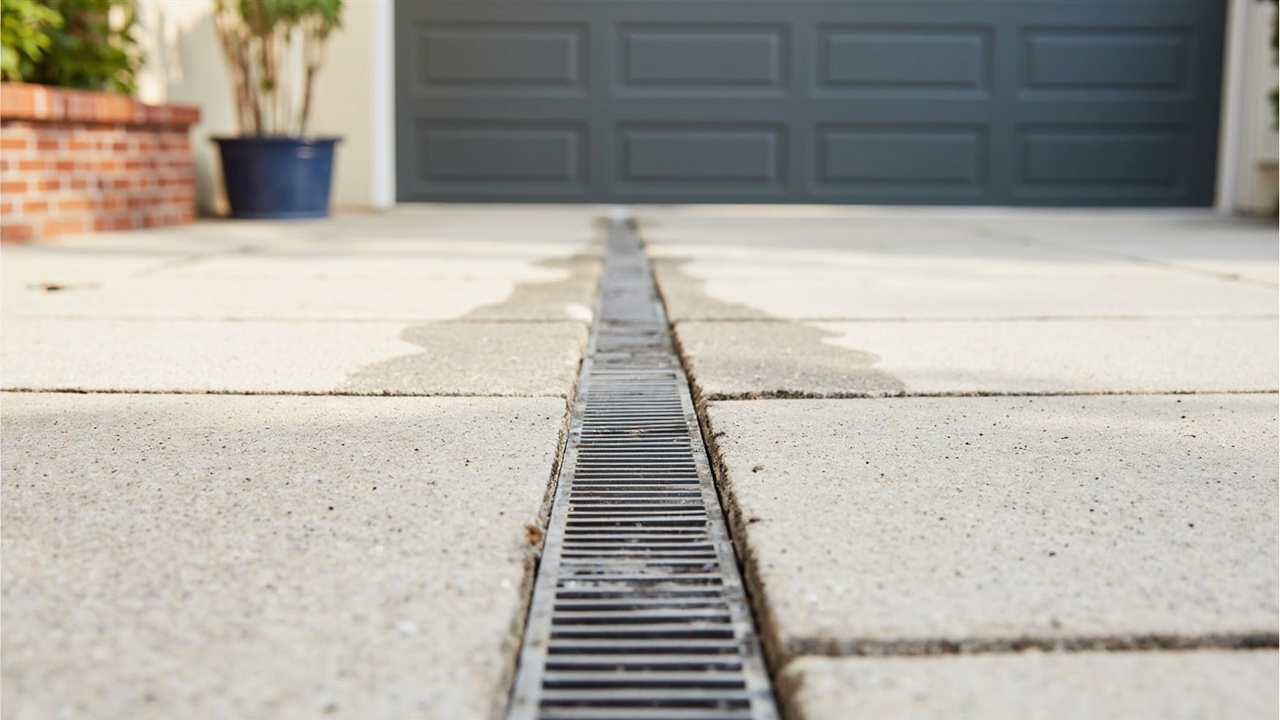
A channel drain, also called a trench drain, is a linear drainage fixture installed perpendicular to the driveway slope, typically just outside or inside the garage door. Many Seattle homes built before current drainage standards either lack these entirely or have ones that are too narrow for the flow rates generated by steep driveways.
Flow rate matters. A 20-foot wide driveway with a 5 percent slope can generate over 40 gallons per minute during a moderate rain event. Undersized grates back up and overflow before they can divert the water.
Clogged Catch Basins and Street Drains
Seattle Public Utilities manages the city’s stormwater infrastructure, but homeowners are responsible for the drainage on their private property. Catch basins on your side of the property line fill with leaves, sediment, and debris over time. Seattle’s tree canopy, while beautiful, generates enormous amounts of organic material that clogs residential drainage systems every fall.
When your catch basin backs up, water has nowhere to go except toward the lowest point, which is usually your garage.
Hydrostatic Pressure Against the Garage Foundation
When water saturates the clay soil around your garage foundation, it exerts hydrostatic pressure against the concrete. Water finds every hairline crack, every cold joint, every poorly sealed expansion gap. This is how garages flood even when no water visibly enters through the door. It seeps through the slab and the lower courses of block or concrete wall.
This type of intrusion is harder to spot and easier to misdiagnose. If your garage floor is wet but the door seal looks fine, hydrostatic pressure is likely the culprit. Learn more about how slow seepage creates long-term structural damage in our article on what slow water intrusion does to your home’s foundation in Magnolia.
What to Do Right Now During an Active Flood Event
- Cut Off Electrical Power
Before you step into standing water, shut off the circuit breaker to your garage. Water and live outlets are a lethal combination. Do not skip this step.
- Deploy Sandbags or Water Barriers
Place sandbags across the garage door threshold to slow additional inflow. Tube-style water barriers are faster to deploy and available at most Seattle hardware stores. This buys you time to address the source.
- Clear the Channel Drain Grate
Run outside and check your channel drain or catch basin. Remove leaves, debris, and sediment by hand or with a stiff brush. Even partial clearing during the event can significantly reduce inflow volume.
- Begin Water Extraction
A wet-dry shop vac handles small volumes. For anything over an inch of standing water, a submersible sump pump with a garden hose discharge is far more effective. Discharge the water to a lower area of your yard or to the street gutter, not back toward your foundation.
- Document Everything for Insurance
Photograph and video the flooding before you move anything. Insurance adjusters need visual evidence. Distinguishing between surface water intrusion (often excluded) and sewer backup or seepage affects your claim. Read our detailed walkthrough on navigating a water damage insurance claim in Seattle.
Permanent Drainage Solutions That Actually Work on Seattle Slopes
Trench Drains vs. French Drains for Sloped Driveways
These two systems get confused constantly. They are not interchangeable, and the difference matters on a steep View Ridge driveway.
| Feature | Trench Drain (Channel Drain) | French Drain |
|---|---|---|
| Primary function | Intercepts surface runoff at a specific point | Relieves subsurface and groundwater pressure |
| Best application | Across the base of a sloped driveway before the garage | Along foundation perimeter or yard edges |
| Water type handled | High-volume surface sheet flow | Saturated soil and hydrostatic seepage |
| Visible at surface | Yes, grated channel | No, buried perforated pipe in gravel trench |
| Effectiveness on Seattle clay soils | High for surface runoff | Moderate; clay limits percolation rate |
| Typical install complexity | Moderate, requires saw cutting concrete | Low to moderate, requires trenching |
| Ideal Seattle scenario | Steep driveways in View Ridge, Ballard, Queen Anne | Flat yard drainage in Fremont, Wallingford |
For a steep driveway that funnels surface water toward the garage, a trench drain installed across the width of the driveway at the base is the right primary solution. The grated channel intercepts the sheet flow before it reaches the door. Pair it with a French drain along the garage foundation perimeter to address the hydrostatic pressure component.
Re-Grading the Driveway Surface
If your driveway has developed a negative grade toward the garage, resurfacing or re-grading the approach corrects the flow direction at the source. A properly graded driveway should slope away from the structure at a minimum of two percent. On steeper sites in View Ridge, you may need to create a cross-slope that diverts runoff to the sides rather than straight down the center.
This is not a DIY concrete pour. Grading on a hillside requires a contractor who understands the downstream implications of redirecting stormwater flow. Check Seattle Public Utilities requirements before directing new drainage to the storm system.
Permeable Pavers as a Runoff Reduction Strategy
Permeable pavers allow rainwater to infiltrate through the surface rather than run off. They work best on moderately sloped driveways where the volume of runoff is manageable. On steep View Ridge driveways, permeables reduce runoff volume but are not sufficient as a sole solution during atmospheric river events when clay soils are already saturated and infiltration rates drop to near zero.
Used in combination with a trench drain, permeable pavers can meaningfully reduce the volume your drainage system needs to handle. Seattle Public Utilities offers rebate programs for green stormwater infrastructure, including permeable pavement installations that reduce stormwater discharge to the combined sewer system.
Sump Pump Installation and Battery Backup
A sump pump installed in a pit at the lowest point of the garage floor provides active water removal during flood events. The pump activates when water reaches a set level and discharges it away from the structure.
In Seattle, a battery backup for your sump pump is not optional. Power outages are common during the same Pacific Northwest storm systems that cause the flooding. A pump that fails when you need it most because the power went out provides zero protection. Invest in a battery backup system rated for at least 8 hours of runtime.
Seattle Public Utilities Regulations You Need to Know
Before you install any drainage system that connects to the city infrastructure, understand how SPU regulates residential stormwater discharge. Seattle separates storm drains from the sanitary sewer in most neighborhoods, but older districts in Ballard and South Lake Union still use combined sewer overflow systems. Discharging to the wrong system carries fines.
Key SPU rules for residential drainage work include the following requirements.
- Side sewer permits are required for any work connecting to or altering the private side sewer lateral.
- Stormwater must be discharged to the storm system, not the sanitary sewer, in separated drainage zones.
- Significant grading changes over 500 square feet may trigger a grading permit under King County drainage regulations.
- Impervious surface additions over a certain threshold require a drainage management plan submitted to SPU.
- Dry wells and infiltration systems require soil percolation testing, which is rarely favorable in Seattle’s clay-heavy soils.
Pull the permit. Unpermitted drainage work creates liability issues and can complicate home sales.
After the Flood, The Restoration Work Begins
Structural Drying and Mold Prevention in the Garage
Standing water in a garage is not just a wet floor. Water wicks up into framed walls, soaks drywall, saturates OSB sheathing, and penetrates concrete block. Seattle’s persistently high humidity, often above 70 percent relative humidity even in dry months, means that natural evaporation takes far too long to be effective.
Mold colonization on garage drywall and framing can begin within 24 to 48 hours under the right temperature and moisture conditions. Once mold establishes itself in the framing behind your garage walls, the remediation scope grows significantly. You cannot paint over it or bleach it and walk away. The affected materials typically require removal and replacement.
If you have had recurring flooding events, there is a real chance mold growth is already present inside your wall cavities. Our article on detecting hidden mold behind drywall covers the diagnostic signs to look for.
Post-Flood Garage Concrete Sanitation Checklist
Garage concrete is porous. Floodwater that sits on a concrete slab carries silt, organic matter, and in some cases sewage contamination from backed-up drains. Leaving residue behind creates ongoing moisture retention and salt deposits called efflorescence, that white powdery crust you see on concrete walls and floors.
Follow these steps after every flood event.
- Extract all standing water completely using a wet vac or pump.
- Rinse the slab with clean water to dilute contaminants, then extract again.
- Apply an enzyme-based cleaner appropriate for concrete to break down organic residue.
- Run a dehumidifier rated for the square footage of the garage continuously until moisture readings from a pin-type moisture meter return to below 15 percent for concrete.
- Inspect the lower 12 inches of any drywall for saturation using a moisture meter. Saturated drywall that does not dry completely within 48 hours should be removed.
- Check wood framing, door jambs, and any wood storage shelving for moisture levels above 19 percent. Above that threshold, mold risk is elevated.
- Once fully dry, seal the concrete slab with a penetrating silane or siloxane sealer to reduce future water absorption.

Comparing Drainage Solutions by Cost Factors and Complexity
| Solution | Relative Cost | DIY Feasibility | Effectiveness on Steep Driveways | Permit Required |
|---|---|---|---|---|
| Trench drain installation | Moderate to high | Low (requires saw cutting) | High | Often yes |
| French drain (perimeter) | Low to moderate | Moderate | Medium (addresses seepage) | Depends on connection |
| Driveway re-grading | Moderate to high | Low | High (if executed correctly) | Possibly |
| Permeable pavers | High | Low to moderate | Medium (supplemental use) | Sometimes |
| Sump pump with battery backup | Low to moderate | Moderate | High (reactive, not preventive) | No |
| Catch basin cleaning | Very low | High | Medium (maintains existing capacity) | No |
| Foundation waterproofing | High | Low | High (addresses hydrostatic) | Yes |
When to Call a Professional Restoration Team
Some garage flooding situations go beyond drainage hardware. Call a professional restoration team when you see any of the following.
- Standing water has been present for more than a few hours.
- Water has contacted drywall, insulation, or stored contents.
- You can smell a musty or earthy odor after the water recedes.
- You find visible mold growth on any surface.
- The flooding has occurred more than twice in a single season.
- Water appears to be seeping through the slab or foundation walls rather than entering through the door.
IICRC-certified restoration teams use psychrometric calculations to determine the exact number of industrial air movers and desiccant dehumidifiers needed to dry a structure properly. They also use thermal imaging cameras to locate moisture that is invisible to the naked eye inside wall cavities.
If you are unsure whether your garage has been fully dried after a previous flood event, that moisture reading matters more than whether the floor looks dry. Concrete and OSB sheathing hold moisture long after the surface appears dry. Our guide on why delayed drying makes water damage significantly worse explains why timing is critical.
For homeowners newer to the restoration process and trying to identify the right contractor, our resource on how to hire a water restoration company covers what to look for in an IICRC-certified team before you sign anything.
Frequently Asked Questions
Will homeowner’s insurance cover garage flooding from driveway runoff?
It depends on the source. Standard homeowner’s policies in Washington State typically exclude surface water flooding. Water that enters through a door threshold or window from outside rainfall is categorized as surface water and requires a separate flood policy through the National Flood Insurance Program. Water that enters because a city drain backed up into your private drain may qualify under sewer backup coverage if you carry that rider. Document the source of entry carefully and contact your insurer before cleanup begins.
How do I know if my trench drain is the right size for my driveway?
Calculate the square footage of driveway that drains toward the garage door, then multiply by the anticipated rainfall intensity for your area. Seattle’s 100-year storm design intensity is approximately 1.5 to 2 inches per hour. A 20-foot wide driveway with a 30-foot run generates roughly 40 to 50 gallons per minute at peak intensity. Your trench drain and outlet pipe need to move that volume without backing up. Most residential trench drains with 4-inch outlet piping are adequate for driveways under 600 square feet, but steeper slopes require larger grate widths or dual-outlet configurations.
Can I connect my new trench drain directly to Seattle’s storm sewer?
Not without a permit and SPU approval. You must verify that your street has a separated storm sewer, not a combined sewer, before connecting. In combined sewer areas, residential stormwater discharge to the sewer system may be prohibited or require mitigation. Contact Seattle Public Utilities directly or hire a licensed civil contractor to perform the connection legally.
How soon after a garage flood can mold start growing?
Mold spores are always present in the air. Given the right combination of moisture, organic material, and temperature, active growth can begin in 24 to 48 hours. Seattle’s ambient humidity keeps the moisture levels in partially dried materials elevated longer than in drier climates, which accelerates that window. If your garage had standing water and you are past the 48-hour mark without professional drying equipment running, treat the situation as a potential mold event and get a moisture assessment done.
If you are dealing with an active flood or have recurring garage flooding in View Ridge, Ballard, Shoreline, or anywhere across the Seattle metro area, Evergreen Water Damage Restoration Seattle responds 24 hours a day. We handle water extraction, structural drying, and mold remediation with equipment and experience built for Pacific Northwest conditions. Call us before the next rain event turns into a restoration project.