

Your gutters are overflowing after another atmospheric river pushed through the Puget Sound region, and you think the problem stops at the roofline. It does not. In Broadview and across Seattle’s north end, clogged gutters packed with Douglas Fir needles and Bigleaf Maple leaves are quietly destroying interior walls, rotting fascia boards, flooding crawlspaces, and feeding mold colonies that grow behind drywall long before any homeowner notices a smell.
This is not a gutter cleaning article. This is about what happens inside your walls after the water gets in.

Why Seattle Gutters Clog Faster Than Anywhere Else
Seattle averages more than 37 inches of rainfall annually, but it is not just the volume that causes problems. It is the type of debris that enters gutters here. Douglas Fir needles are thin, matted, and water-retentive. They form dense plugs inside downspouts that even moderate rainfall cannot push through. Bigleaf Maple leaves, which shed heavily in fall and again during spring wind events, collapse into flat layers that seal gutter channels completely.
Moss, which thrives in Seattle’s persistent cloud cover and high relative humidity, grows along the inside of gutters and hardens like concrete. Once established, moss anchors debris in place and accelerates the clogging cycle. Broadview properties bordered by mature evergreens face this cycle every single season.
According to the National Weather Service, atmospheric river events that hit the Pacific Northwest deliver rainfall at rates that overwhelm even clean, properly sized gutters. When those gutters are already 60 percent blocked with pine needle plugs and moss, overflow is not occasional. It is routine.
The Path Water Takes From Your Gutter Into Your Interior Walls
When a gutter overflows, most homeowners watch the cascade of water fall off the roofline and assume the problem ends in the flowerbeds. The water they see is only part of the story. The water they do not see is the real threat.
Fascia Board Rot and Soffit Damage
Overflowing gutters saturate the fascia boards directly behind them. Fascia boards in many Broadview Craftsman bungalows and mid-century ranchers are original wood, often painted but not sealed to modern standards. Once moisture penetrates the paint layer, rot begins. Rotted fascia pulls away from the rafter tails, opening a direct gap between the exterior and the attic or wall cavity behind it.
Soffit panels directly below the roofline suffer next. Water wicks into the soffit, soaks the insulation above the top plates of your exterior walls, and begins migrating downward. This is the moment the damage moves from exterior cosmetic to interior structural.
Water Inside the Wall Cavity
Once moisture saturates the insulation inside an exterior wall, it does not dry out on its own in Seattle’s climate. Persistent cloud cover and high relative humidity slow natural evaporation to a near stop, especially during November through March. The water sits. The drywall paper facing absorbs it. The wood framing studs begin to swell and then to decay.
Mold growth can begin in as little as 24 to 48 hours under these conditions. In a wall cavity with no airflow and consistent moisture, colonies establish within that window and expand rapidly. By the time you notice a dark stain on your interior paint or a musty odor in a bedroom, the colony has likely been active for weeks.
If you suspect mold is already growing behind your drywall, read how to tell if your home has hidden mold behind the drywall for the specific signs to look for before calling for remediation.

Hidden Warning Signs Most Broadview Homeowners Miss
Interior wall damage from gutter overflow rarely announces itself with a flood. It shows up in small, easy-to-dismiss ways that compound over months.
- Paint bubbling or blistering near the top of an exterior wall
- Drywall tape separating at corners near the ceiling line
- Peeling wallpaper along a single exterior wall
- Siding discoloration or dark streaking below the roofline
- A persistent musty odor in a specific room, not the whole house
- Soft spots in baseboard trim along an exterior wall
- Visible rust staining on window frames adjacent to the affected gutter run
Each of these signs points to moisture that has been present long enough to change the surface you can see. The damage below the surface is always worse.
Crawlspace and Foundation Risks Specific to PNW Soil
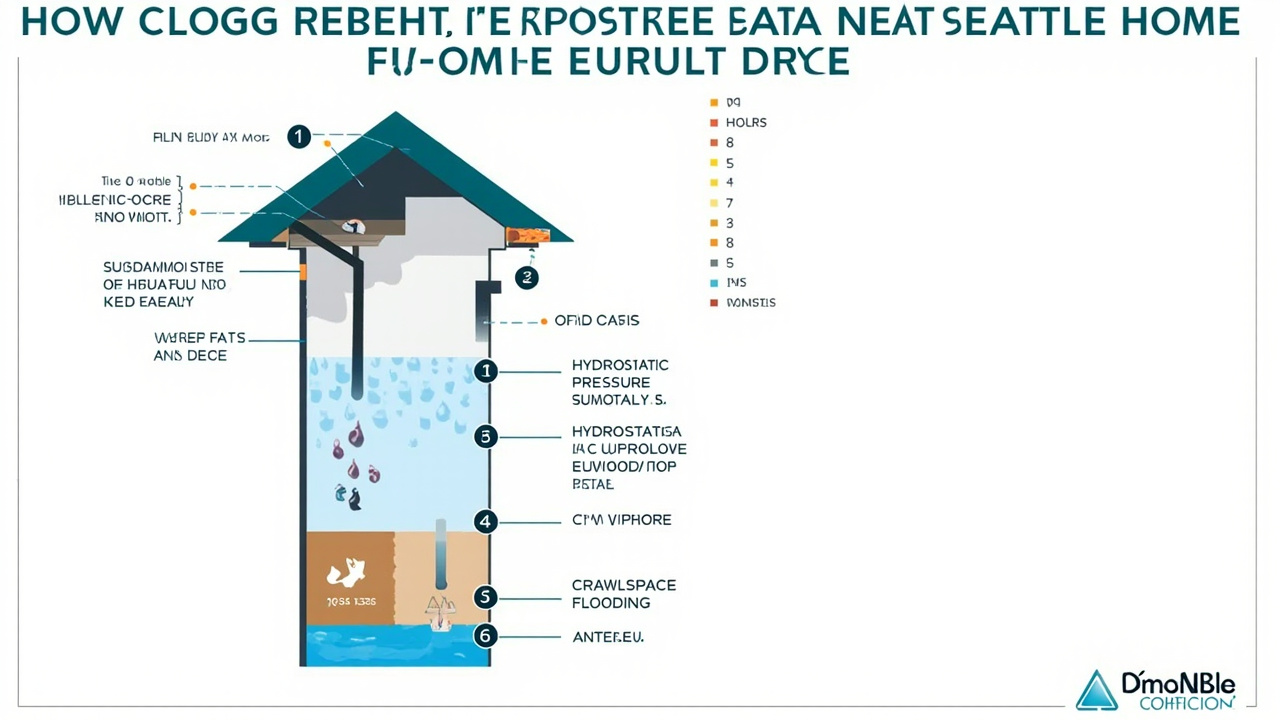
Broadview sits on glacial till, the clay-heavy, compacted soil left behind by ice-age glaciation across the Puget Sound basin. Clay soil drains poorly. When gutters overflow and dump large volumes of water at the foundation perimeter, that water has nowhere to go quickly. It pools against the foundation wall and generates hydrostatic pressure.
Hydrostatic pressure forces water through hairline foundation cracks, through the mortar joints of older masonry foundations, and into crawlspaces. Crawlspace moisture in a Seattle home with a clay-soil perimeter is an extremely serious condition. Subfloor sheathing, floor joists, and the vapor barrier all face fungal decay when moisture levels stay elevated.
Homes in West Seattle, Queen Anne, and Magnolia face the additional risk of steep slope seepage, where water from uphill neighbors’ drainage paths accumulates against the downhill foundation wall. Gutter overflow on these properties accelerates a process that was already applying pressure to the structure.
For more on what slow, persistent moisture does to a foundation area, see what persistent basement moisture is really doing to your home.
How the Damage Progresses Over Time
| Timeframe After Initial Water Intrusion | What Is Happening Inside the Wall | Visible Symptoms |
|---|---|---|
| 24 to 48 hours | Drywall paper absorbs moisture, mold spores activate | None yet, or faint odor |
| 3 to 7 days | Mold colonies establish, insulation batts saturate | Paint softening, faint discoloration |
| 2 to 4 weeks | Wood framing absorbs moisture, structural swelling begins | Paint bubbling, wallpaper peeling, odor worsening |
| 1 to 3 months | Mold covers significant wall cavity area, fascia rot advances | Visible staining, soft drywall, trim damage |
| 3+ months | Structural framing decay, potential mold migration to adjacent cavities | Sagging drywall, severe odor, possible pest intrusion |
Professional Moisture Detection and What Restoration Actually Looks Like
When you call Evergreen Water Damage Restoration Seattle, the first step is not ripping out drywall. It is a thorough moisture mapping inspection using calibrated moisture meters and thermal imaging cameras. Thermal imaging reads temperature differentials in wall surfaces that indicate hidden wet zones. This tells us exactly where the water traveled and how far the damage has spread without opening walls unnecessarily.
The IICRC (Institute of Inspection Cleaning and Restoration Certification) sets the standards our team works to for structural drying and mold remediation. Those standards define acceptable moisture content levels for wood framing, drywall substrate, and insulation materials before a property can be considered dry and safe for reconstruction.
The Structural Drying Process
- Emergency Moisture Mapping
Technicians use thermal imaging and pin-type moisture meters to document all affected materials and map the full extent of water migration through the wall assembly.
- Controlled Demolition
Saturated drywall sections are removed to expose the wall cavity, allow airflow, and give the restoration team direct access to affected framing and insulation.
- Mold Remediation
Any mold-affected materials are removed and disposed of following Washington State guidelines. Antimicrobial treatments are applied to framing surfaces before drying begins.
- Industrial Dehumidification and Air Movement
Commercial-grade dehumidifiers and high-velocity air movers are positioned to drive moisture out of wall cavities, subfloor assemblies, and crawlspaces. This phase typically runs three to five days depending on saturation levels.
- Clearance Testing
Moisture meter readings confirm materials have reached acceptable dryness levels per IICRC S500 standards before reconstruction begins.
- Reconstruction and Finish Restoration
New drywall, insulation, paint, and trim are installed. Peeling paint and damaged wallpaper are professionally remediated to restore the wall to pre-loss condition.
Water Damage Severity Comparison by Gutter Failure Type
| Gutter Failure Cause | Typical Interior Damage | Average Restoration Complexity | Mold Risk Level |
|---|---|---|---|
| Pine needle plug at downspout | Fascia rot, soffit damage, upper wall moisture | Moderate | High if undetected for weeks |
| Full gutter channel blockage | Siding intrusion, upper wall and ceiling moisture, possible attic impact | Moderate to High | High |
| Detached gutter pulling fascia away | Exposed rafter tails, attic moisture, wall cavity saturation | High | Very High |
| Overflow at foundation perimeter | Crawlspace flooding, subfloor damage, foundation hydrostatic pressure | High to Severe | Very High |
| Downspout discharge at foundation | Basement seepage, lower wall moisture, floor damage | Moderate to High | High |
What Your Homeowners Insurance May Actually Cover
This is where Seattle homeowners get caught off guard. Washington homeowners insurance policies typically distinguish between sudden damage and gradual damage, and that distinction determines whether your claim gets approved or denied.
If a single atmospheric river event caused your gutters to overflow and water entered your wall in one episode, that may be classified as sudden and accidental damage, which most standard policies cover. If your gutters have been partially blocked for a season and the damage built up over months, insurers will often classify that as gradual damage caused by deferred maintenance, which is typically excluded.
The documentation you have matters enormously. If you called a gutter cleaning service and received a written assessment showing the gutters were functional, that protects you. If there is no maintenance record, adjusters often default to the gradual damage exclusion.
For a detailed look at how to navigate the claims process when water damage affects your home, read how to handle a water damage insurance claim for your home. The same principles apply across Ballard, Fremont, and Green Lake homes dealing with gutter-related intrusion.
One important note: waiting to report the damage or delaying remediation gives insurers grounds to argue that secondary damage was caused by your inaction, not the original event. Speed matters in both the restoration process and the claims process. The longer saturated materials sit, the more documentation you need to separate the original damage from the damage caused by delay.
If you want to understand what the hiring and claims process looks like before you are in an emergency, this guide on hiring a water restoration company walks through what to ask and what to expect.
Emergency Steps to Take Right Now If You Suspect Gutter Water Intrusion
If you have already noticed the warning signs described above, do not wait for the next rain event to confirm the problem.
- Photograph all visible signs of damage, including paint changes, staining, and any exterior siding discoloration, before touching anything.
- Check the wall cavity temperature with your hand. A cold, damp feel along an interior exterior wall in winter suggests active moisture behind the drywall.
- Look inside your gutter at the point closest to the stained wall. If you see a solid mass of needles or moss, the blockage source is confirmed.
- Do not attempt to open the wall yourself. Without moisture meters, you cannot know how far the damage has spread, and improper demolition can disrupt mold colonies and spread spores through your HVAC system.
- Call a professional restoration team for moisture mapping before any contractor begins reconstruction work.
Delaying action is the most expensive choice you can make. As shown in the timeline table above, mold and structural damage escalate significantly after the first week. Restoration work performed within the first 48 to 72 hours of discovery consistently results in less demolition, faster drying, and smaller claims compared to jobs that sat for weeks before being addressed.
If you have had prior water damage events that were addressed but you are still noticing symptoms, read about why waiting to dry out water damage always makes the situation worse. The same compounding effect applies to wall cavity moisture from gutter overflow.
Preventing Gutter Overflow in Seattle’s Specific Climate
Prevention here requires a different approach than in most of the country. Standard cleaning schedules designed for deciduous-only environments do not account for year-round needle drop from Douglas Firs, Western Red Cedars, and other evergreens that drop debris in every month of the year, not just fall.
For Broadview and Shoreline properties surrounded by mature evergreens, two cleanings per year are not enough. A minimum of three inspections, including one in late January when late-fall debris has compacted through winter rains, is a more appropriate schedule. Micro-mesh gutter guards that specifically filter needle-diameter debris perform better in this environment than standard screen guards, which pine needles pierce easily.
Downspout extensions that discharge water at least six feet from the foundation perimeter reduce hydrostatic pressure risk significantly, particularly on properties built over clay-heavy glacial till soils common throughout north Seattle and Kenmore.
King County drainage regulations also require that residential runoff not be directed in ways that create nuisance flooding on neighboring properties. If your downspout discharge is redirected toward a neighbor’s yard, you may face both property damage liability and a King County code complaint.
Frequently Asked Questions
Can gutter overflow really cause mold inside my walls if it only happens once?
Yes. A single overflow event that saturates your fascia and introduces moisture into the wall cavity can trigger mold growth within 24 to 48 hours if conditions inside the wall stay damp. Seattle’s high relative humidity prevents rapid natural drying, which is why even a single event can cause lasting damage.
How do I know if the damage is behind the wall and not just on the surface?
Surface paint bubbling or staining is a symptom of what is behind the wall, not the problem itself. Professional moisture mapping with thermal imaging and calibrated meters is the only reliable way to confirm the full extent of moisture behind a wall assembly without unnecessary demolition.
Does my Seattle homeowners insurance cover wall damage from overflowing gutters?
It depends on whether the damage is classified as sudden or gradual. A single storm event may be covered. Damage that built up over a season due to maintenance neglect is typically excluded. Documentation of recent gutter maintenance helps support a sudden-damage classification with your adjuster.
How long does structural drying take after interior wall water damage?
In Seattle’s climate, commercial structural drying of an exterior wall cavity typically takes three to five days using industrial dehumidifiers and air movers. Heavily saturated assemblies or those involving crawlspaces may take longer. Clearance testing confirms dryness before reconstruction begins.
Evergreen Water Damage Restoration Seattle responds to gutter overflow damage assessments across Broadview, Ballard, Shoreline, Burien, and Bellevue. If you have noticed any of the warning signs in this article, call us now for emergency moisture mapping. We dispatch within 60 minutes across King County, 24 hours a day.