
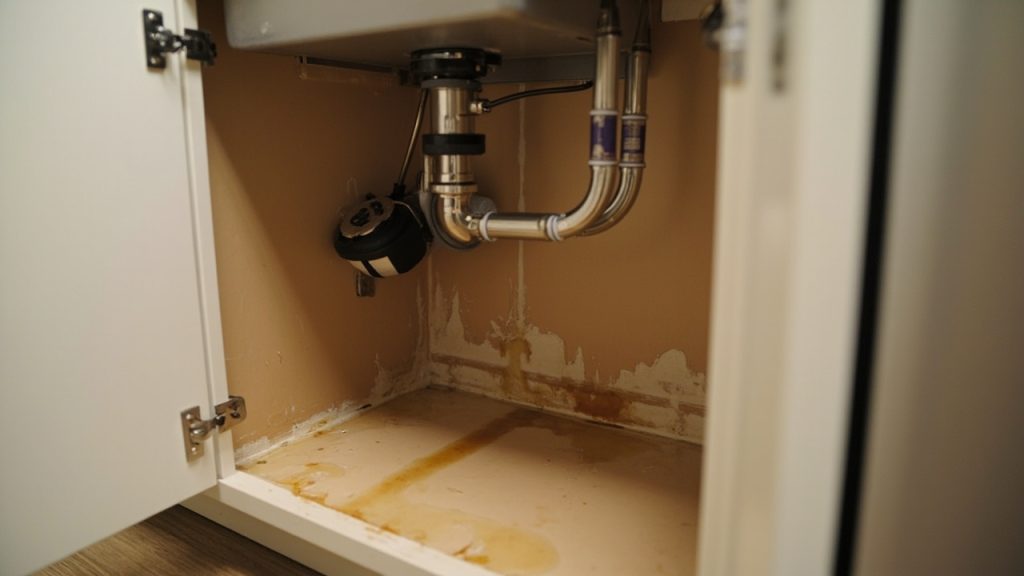
A slow drip from your reverse osmosis system can quietly destroy your kitchen cabinet base, rot your subfloor, and feed a mold colony for weeks before you notice anything. In SeaTac and across the Greater Seattle area, we see this pattern constantly. The homeowner opens the cabinet to grab dish soap and finds a warped floor panel, a swollen cabinet bottom, and sometimes a dark stain spreading up the back wall.
This guide gives you the exact steps to stop the leak, assess the damage honestly, and know when DIY cleanup stops being enough.

Immediate Steps to Stop an Active Under Sink Water Filter Leak
Speed matters here. Mold spores can begin colonizing wet organic material within 24 to 48 hours. Every minute of active water exposure increases the cost and complexity of restoring your cabinetry and subfloor.
- Shut Off the Feed Water Valve
Find the cold water supply line running to your RO system and turn the saddle valve or dedicated shut-off valve clockwise until it stops. If you cannot locate it or it is stuck, shut off the main supply valve under your home or at the street meter. Do this first, before anything else.
- Empty the Cabinet
Remove everything stored under the sink. Cleaning products, spare filters, trash bags, and anything else sitting on that cabinet floor needs to come out so you can assess the actual water contact area. Wet items in closed spaces trap humidity and accelerate mold growth.
- Absorb Standing Water Immediately
Use old towels or a wet-dry shop vac to pull up any pooled water. Do not leave standing water on the cabinet floor for even a few hours. Particleboard cabinet bases are especially vulnerable because they absorb water like a sponge and begin swelling almost immediately.
- Identify the Leak Source
With the cabinet dry enough to see clearly, trace every line in the RO system. Common failure points are the O-rings on filter housings, John Guest quick-connect fittings where tubing meets the system manifold, the drain saddle clamp on your waste line, and the small feed line running to the storage tank. Look for mineral staining or slick residue around each connection point.
- Relieve System Pressure
Even after you shut off the feed valve, your RO storage tank holds pressurized water. Open the dedicated RO faucet on your sink and let it run until water stops flowing. This depressurizes the system so you can safely disconnect and inspect components.
- Ventilate the Cabinet
Leave the cabinet doors open and place a small fan aimed into the space. This alone will not dry saturated wood, but it slows the progression while you gather more information on the damage.
Common Causes of Reverse Osmosis System Leaks in Seattle Homes
RO systems have multiple potential failure points, and the SeaTac and broader South King County area has a few local factors that accelerate wear.
High Water Pressure in Residential Lines
Seattle’s varied topography creates significant pressure differences across neighborhoods. Homes in elevated areas like Queen Anne and Capitol Hill often experience residential line pressure above 80 PSI. The standard residential target under Seattle Residential Code guidelines is 60 to 80 PSI, but aging pressure reducing valves (PRV) can fail, letting pressure spike well beyond that range. RO systems are typically rated for 40 to 80 PSI. When pressure climbs above that, O-rings deform, quick-connect fittings pop loose, and filter housings crack at their threads.
If your home lacks a working PRV or you have not had it tested recently, high pressure may be the root cause of your leak, not just a failing O-ring.
O-Ring and Filter Housing Failures
Every filter housing on an RO system uses a rubber O-ring to create a watertight seal. Over time, chlorine in municipal water degrades these O-rings, making them brittle and prone to cracking. Replacing O-rings on a standard three-stage RO system takes about 20 minutes and costs very little. The problem is that most homeowners skip this during filter changes and only discover the failure when water starts pooling.
Loose or Fatigued John Guest Fittings
John Guest push-to-connect fittings are reliable but not indefinite. Repeated pressure cycles over several years cause the internal collet to lose grip on the tubing. A slow weep from a fitting connection can run for months before the cabinet floor becomes noticeably wet. If you pull the tubing out of a fitting and it comes free with minimal resistance, the collet is fatigued and the entire fitting needs replacement.
Drain Saddle Clamp Corrosion
The drain saddle connects your RO waste line to the sink drain pipe. In older SeaTac homes with galvanized or older PVC drain lines, the saddle clamp can corrode or the gasket can dry out, creating a slow leak directly onto the cabinet floor. This one is easy to miss because the water tends to run down the drain pipe and pool at the lowest point of the cabinet, far from the obvious RO unit.
What a Slow Drip Actually Does to Your Cabinet and Subfloor
The real damage from an under sink water filter leak is rarely the water you can see. It is the water that soaked into the materials around it over days or weeks before you discovered the problem.
Cabinet Base Saturation
Most kitchen cabinets use particleboard or MDF for the base and lower walls. These materials have essentially no resistance to sustained moisture. A drip of even a few drops per hour will saturate particleboard within days, causing it to swell, delaminate, and lose all structural integrity. By the time you see the floor buckling or the finish peeling, the material is often beyond repair and needs full replacement.
Subfloor Rot and Delamination
Water does not stay in the cabinet. It wicks through the cabinet base into the subfloor below, especially along the toe-kick seam where the cabinet meets the finished floor. Plywood subfloors delaminate when wet. OSB subfloors soften and lose shear strength. In Seattle homes with hardwood or engineered wood flooring, you will see cupping, where the edges of each plank raise above the center, as moisture causes the wood fibers to swell unevenly. This is a clear sign that water has moved beyond the cabinet.
We have responded to jobs in Burien and Tukwila where a leaking RO system went unnoticed for two months and caused subfloor damage extending three feet beyond the cabinet footprint. What started as a minor fitting failure became a flooring and subfloor replacement job. If you are seeing cupping or soft spots near your sink base, read about why delayed drying makes kitchen water damage significantly worse.
Mold Behind the Cabinet Back Panel
The back wall of your sink cabinet is typically the shared wall with the cabinet next to it or an exterior wall. Water migrates to this surface and sits in the gap between the cabinet and the drywall. This dark, humid space is an ideal mold environment. In the Pacific Northwest, with Seattle averaging over 37 inches of annual precipitation and persistently high relative humidity indoors and out, mold growth accelerates faster than in drier climates. You may not see visible mold for weeks, but a musty odor when you open the cabinet door is a reliable early signal.
If you suspect mold is already present behind your cabinet walls, the diagnostic steps outlined in our guide on detecting hidden mold behind drywall apply directly to this situation.
Seattle Climate Factors That Make Under-Sink Leaks More Damaging
A slow cabinet leak in Phoenix behaves differently than the same leak in SeaTac. The local climate matters.
Seattle’s persistently high relative humidity means that wet building materials dry far more slowly without mechanical dehumidification. Natural evaporation is largely ineffective from October through April. When you open cabinet doors and aim a fan at the damage, you are fighting ambient air that may already be at 70 to 80 percent relative humidity. The moisture simply has nowhere to go.
Glacial till and clay-heavy soils across King County also affect homes with any slab-on-grade construction or pier-and-beam foundations. Poor drainage around the foundation can create additional moisture pressure from below, compounding damage from an interior leak. For homeowners in valley neighborhoods like Renton or in lower-elevation parts of Bellevue, this is a real factor.
The EPA’s guidance on mold and moisture confirms that sustained relative humidity above 60 percent is sufficient to sustain mold growth on most building materials. Seattle’s climate regularly exceeds that threshold indoors without active climate control.
Leak Severity Assessment Guide
| What You Find | Likely Damage Level | Recommended Action | Estimated Time Before Mold Risk |
|---|---|---|---|
| Puddle only on cabinet floor, discovered same day | Minimal, surface only | Dry thoroughly, monitor for 72 hours | 24 to 48 hours if not dried |
| Soft or swollen cabinet base, no odor | Moderate, material damage beginning | Remove cabinet base, dry subfloor, consider professional assessment | Already at risk, dry immediately |
| Musty odor present, no visible mold | Significant, likely hidden mold behind surfaces | Professional moisture mapping required | Mold likely already active |
| Warped or cupped flooring outside cabinet footprint | Extensive, subfloor and finish flooring affected | Call a professional restoration team immediately | Mold very likely, subfloor structurally compromised |
| Visible black or green mold on cabinet walls or drywall | Severe, active mold colony | Professional mold remediation required, do not disturb surfaces | Mold already present and spreading |
DIY Drying vs. Professional Restoration — What Actually Works
Consumer-grade fans and open cabinet doors will handle a genuinely fresh and minor surface spill. They will not handle anything that has been wet for more than a few hours or where water has contacted porous materials like particleboard, drywall, or wood subfloor.
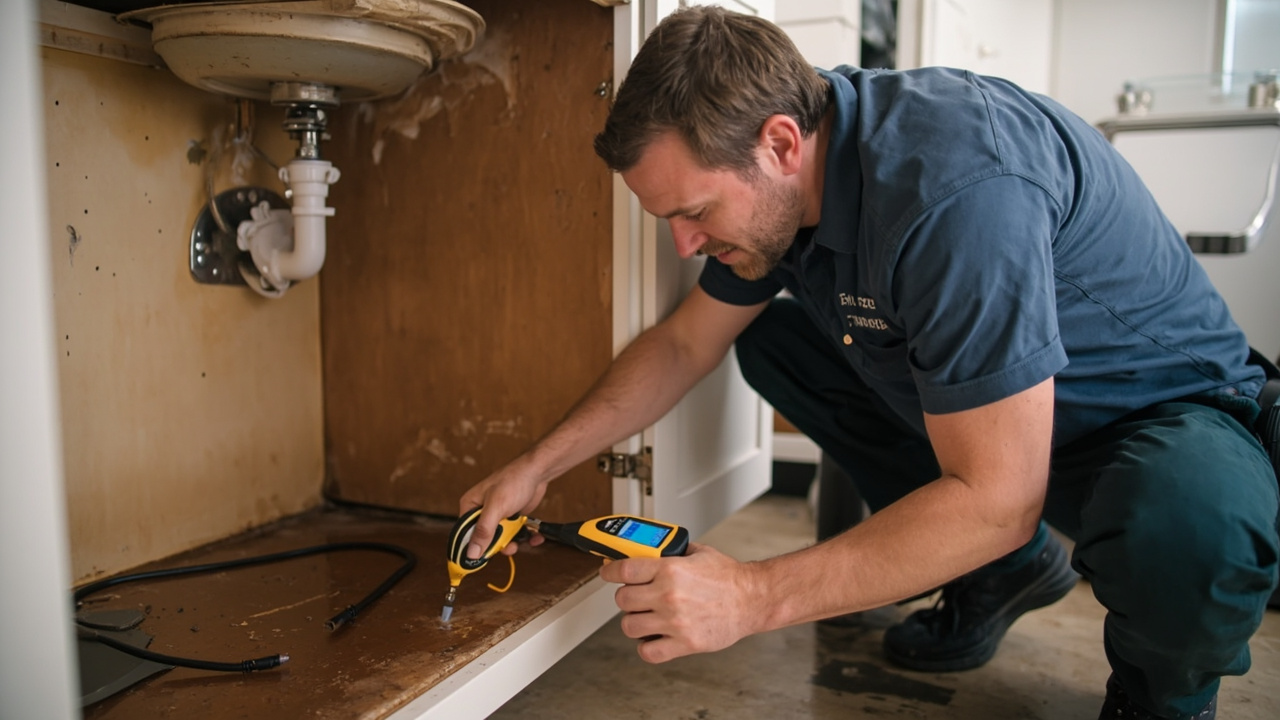
Professional structural drying uses commercial-grade dehumidifiers that pull far more moisture per day than any equipment a homeowner can rent, combined with thermal imaging and calibrated moisture meters. IICRC-certified technicians use moisture meters to read the actual moisture content of the subfloor and wall cavity, not just the visible surface. This matters because materials that feel dry to the touch can still hold enough moisture to support mold growth for weeks.
Thermal imaging cameras reveal moisture migration paths that are completely invisible to the naked eye. Water in your cabinet may have traveled six feet in an unexpected direction before being stopped by the vapor barrier or building wrap.
Automatic Leak Detection to Prevent Future Damage
One of the most cost-effective investments for any SeaTac home with an RO system is an automatic leak shut-off sensor. These devices sit on the cabinet floor and cut water supply to the system the moment they detect standing water. Brands like Flume and Moen Flo offer whole-home options, while simpler under-sink sensors from companies like Govee or Phyn are widely available. The cost of a sensor is a fraction of the cost of even a minor cabinet restoration job.
RO System Maintenance Schedule to Prevent Leaks
| Maintenance Task | Recommended Frequency | Why It Matters in Seattle |
|---|---|---|
| Replace sediment and carbon pre-filters | Every 6 to 12 months | High filter load from Seattle municipal water reduces filter life |
| Replace RO membrane | Every 2 to 3 years | Maintains system efficiency and reduces pressure on fittings |
| Inspect and replace O-rings on all housings | Annually or at each filter change | Chloramine in Seattle water degrades rubber faster than standard chlorine |
| Check all John Guest fittings and tubing for cracks | Annually | High municipal pressure and pressure fluctuations stress connections |
| Test PRV and residential line pressure | Every 2 years | Aging PRVs in older Ballard, Wallingford, and Fremont homes commonly fail silently |
| Inspect drain saddle gasket | Annually | Hard water mineral buildup can crack gaskets over time |

Homeowners Insurance and Slow Leak Coverage in Washington State
This is where many SeaTac homeowners get a difficult surprise. Washington State homeowners insurance policies generally cover sudden and accidental water damage but commonly exclude damage from slow or continuous leaks that the homeowner should have discovered through reasonable maintenance.
The key documentation question your adjuster will ask is how long the leak was occurring. If your cabinet base is fully rotted and your subfloor is delaminated, that suggests weeks or months of exposure, which may trigger a maintenance exclusion denial. If you caught the leak the same day and called a restoration company immediately, you have a much stronger claim.
Always photograph the damage before any cleanup begins. Document the source of the leak, the affected materials, and the date of discovery. A professional restoration company that provides a moisture mapping report and a scope of work gives your insurance adjuster the technical documentation they need to approve a claim. Our team has helped homeowners in Shoreline, White Center, and Mercer Island navigate exactly this process. For a detailed walkthrough of the insurance claim process after water damage, see our guide on filing a water damage insurance claim in the Seattle area.
When to Call a Professional Restoration Team
Stop attempting DIY drying and call a professional team when you observe any of the following.
- A musty or earthy odor that persists after you have dried and ventilated the cabinet for 48 hours.
- Visible mold growth on any surface, including the back wall of the cabinet, the cabinet base, or the visible subfloor edge along the toe-kick.
- Soft spots, spongy areas, or visible cupping in the finished floor around or beyond the sink cabinet.
- Swollen or delaminating drywall on the wall behind or beside the affected cabinet.
- Evidence that water migrated under the toe-kick and beyond the cabinet footprint onto the kitchen floor.
- Any situation where you cannot confirm the moisture content of the subfloor without a calibrated meter, meaning you cannot see the full extent of the wet area.
A slow water heater leak in a basement shares many of the same hidden damage mechanisms as an under-sink RO leak. If you want to understand how much structural harm a slow leak causes over time, the breakdown in our article on what a slow Magnolia basement leak actually does to a home is directly applicable here.
If this is your first time navigating professional restoration services, our guide on what to look for when hiring a water restoration company covers the questions you should ask before signing any work authorization.
Frequently Asked Questions
How long can a slow RO system leak go undetected?
Months, in some cases. A drip rate of just a few drops per minute is slow enough that the cabinet base absorbs and partially evaporates the moisture before visible pooling occurs. The first visible sign is often swelling at the cabinet base seam or a faint odor, not standing water.
Will my homeowners insurance cover a reverse osmosis leak in King County?
It depends on how quickly you discovered the leak and whether you can document sudden onset. Washington State policies typically cover sudden and accidental water damage. Long-term slow leaks are frequently denied under maintenance exclusions. Document everything, call a restoration company, and file promptly.
How do I know if water reached my subfloor under the kitchen sink?
Press your hand firmly on the finished floor immediately in front of and beside the cabinet toe-kick. Soft, spongy, or bouncy areas indicate subfloor damage. Cupping of hardwood planks, where plank edges raise above the center, is also a direct indicator of moisture in the subfloor or beneath the flooring layer. A professional technician can confirm extent using a moisture meter within minutes.
Is an RO system leak considered a plumbing emergency?
Not always in the traditional sense, but treat it as one for the purpose of water damage prevention. The moment you have confirmed a leak and cannot stop it by shutting off the RO feed valve, shut off your main water supply and call both a plumber and a restoration company. Do not wait to see if it dries on its own.
Evergreen Water Damage Restoration serves SeaTac, Burien, Shoreline, Bellevue, and the broader Greater Seattle metro area around the clock. If you have discovered an under-sink water filter leak and need an honest assessment of the damage, call us before the damage progresses further. We can be on-site fast, assess moisture content with professional equipment, and give you a clear picture of what needs to happen next.