

Water is spreading across your laundry room floor right now, and the drain is gurgling instead of swallowing it. Stop the washing machine immediately, cut power to any electrical outlets near the flood zone, and get towels or a mop to slow the spread. That is your first 60 seconds. Everything after that is about understanding what broke and making sure your floors, walls, and subfloor do not pay for it for the next decade.. Read more about Emergency Water Removal for Mountlake Terrace Homeowners After a Sump Pump Failure.
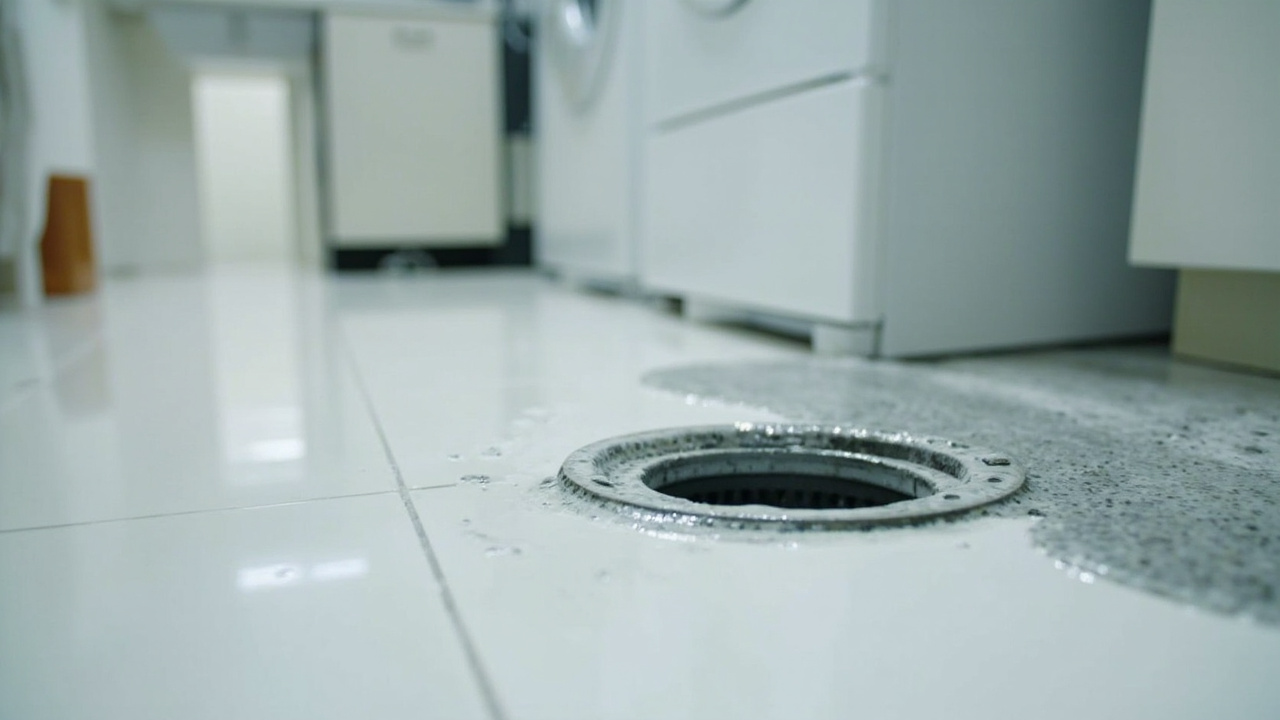
Laundry room floor drain backups are one of the most common emergency calls in Seattle neighborhoods including West Seattle, Ballard, and Capitol Hill. The problem is almost never just a clogged drain. What looks like a simple overflow usually signals a deeper issue in your plumbing system, and the standing water it leaves behind can trigger mold growth within 24 to 48 hours in Seattle’s persistently humid climate.
Immediate Safety Steps During an Active Floor Drain Overflow
Your first priority is personal safety, not property. The IICRC classifies laundry room water as Category 2 gray water. It contains skin cells, detergent residue, lint, and potentially fecal matter from soiled clothing. You do not want to walk through it barefoot, and you absolutely do not want children or pets near it.
- Cut the Water Source
Turn off the washing machine and close the hot and cold supply valves behind it. If your floor drain is still overflowing with no active machine running, your problem is a main sewer line backup, not a local clog. Locate your home’s main shutoff valve and close it.
- Kill the Power to the Room
Flip the circuit breaker for your laundry room if water has reached any outlets, the washer, or the dryer. Water and live circuits kill people. Do not skip this step.
- Stop Cross-Contamination
Use rolled towels or folded rugs to block doorways and keep gray water from spreading into hallways, adjacent rooms, or finished basement areas. Every square foot of flooring the water touches becomes a restoration problem.
- Document Everything Before You Clean
Take photos and a short video of the standing water, the affected drain, and any visible damage. Washington state insurance claims require solid documentation. Read our guide on handling a water damage insurance claim before you start mopping anything up.
- Call a Restoration Professional
A plumber fixes the pipe. A restoration company fixes the property damage left behind. You need both, but you need the restoration call first if water has been sitting for more than 30 minutes.
Why Seattle Laundry Room Drains Back Up
Seattle’s plumbing infrastructure creates specific conditions that make laundry drain backups more common here than in drier regions. Understanding the cause helps you explain it to your plumber and your insurance adjuster.
Combined Sewer Overflow Events During Heavy Rain
Older Seattle districts including Ballard, Fremont, and parts of Queen Anne still operate on combined sewer systems. These systems carry both stormwater and sewage in the same pipe. During an atmospheric river event, when the Puget Sound region receives several inches of rain in 24 to 48 hours, the combined system can exceed capacity. When that happens, sewage has nowhere to go but backward, and your floor drain is the lowest point of entry in the house. For example, SPU logged a significant CSO activation during the November 2024 atmospheric river that dropped over four inches of rain on Seattle in 36 hours, pushing combined sewer pressure high enough to reverse flow into dozens of low-lying floor drains across Ballard and Fremont. Seattle Public Utilities maintains current information on combined sewer overflow events that you can check to confirm whether a city-wide event triggered your backup.
Tree Root Intrusion in the Sewer Lateral
Capitol Hill, Wallingford, and Green Lake are full of mature trees with root systems that have been growing for 60 to 80 years. Those roots seek out moisture and find it in the hairline cracks of aging clay sewer laterals. Pre-1950 bungalows in Capitol Hill and Wallingford commonly feature original vitrified clay pipe laterals installed between 1910 and 1949, and that pipe is now at the end of its design life. A sewer lateral is the private pipe connecting your home to the city main. Under King County Plumbing Code, that lateral from your foundation to the property line is your financial responsibility, not the city’s. Root intrusion narrows the pipe, and laundry discharge is one of the first flows to back up because of the volume of water a washing machine dumps in a short window.
Lint and Sediment Buildup in the Floor Drain Trap
Every floor drain has a P-trap beneath it, a curved section of pipe that holds water to block sewer gases. Over years of use, lint from the washing machine’s standpipe, soap scum, and mineral deposits from Seattle’s moderately hard water accumulate inside that P-trap and the drain body above it. The result is a drain that moves water slowly on a good day and overflows on a heavy wash day. This is the one cause you can address yourself with a drain snake and some patience, though a wet vacuum or submersible pump is usually necessary first to clear the standing water.
Main Sewer Line Clogs vs. Local Clogs
This distinction matters enormously for what you do next and how much it costs. A local clog lives in the drain line between your floor drain and where it connects to the main stack. A main line clog sits in the sewer lateral or the main stack itself, and it affects every drain in the house.
| Sign | Local Floor Drain Clog | Main Sewer Line Backup |
|---|---|---|
| Toilets gurgling | No | Yes, in multiple bathrooms |
| Tub drains slow | No | Yes |
| Multiple fixtures backing up | No | Yes |
| Floor drain only affected | Yes | Rarely |
| Sewage smell from multiple drains | Mild, localized | Strong, widespread |
| Recommended Fix | Snake or hydro-jet the local drain line | Camera inspection followed by hydro-jetting the lateral |

Hydro-Jetting vs. Drain Snaking for Seattle Floor Drains
Your plumber will offer you two primary options for clearing the obstruction. Both work. Neither is always the right answer without knowing what is actually in the pipe.
Drain snaking uses a rotating metal cable to punch through or break up the blockage. It costs less upfront and works well on soft clogs like lint accumulation or minor grease buildup. The limitation is that snaking does not clean the pipe walls. It leaves biofilm, residue, and partial obstructions behind.
Hydro-jetting sends pressurized water at 3,000 to 4,000 PSI through the pipe, scrubbing the interior walls and flushing debris completely out to the main. For West Seattle bungalows with clay lateral pipes and root intrusion, hydro-jetting is the correct long-term solution. Ask your plumber for a camera inspection first so you know what you are dealing with before anything goes into the pipe.
The Gray Water and Black Water Health Risk You Cannot Ignore
The IICRC classifies water by contamination level. Laundry room backups typically start as Category 2 gray water, which contains biological and chemical contaminants. If the backup originates from a main sewer line overflow, the water becomes Category 3 black water immediately. Black water contains human waste and pathogens at concentrations that cause serious illness.
You cannot safely remediate Category 3 water with a mop and household bleach. King County Plumbing Code and Washington state health guidelines require proper PPE, containment, and disposal procedures. A certified IICRC restoration technician carries the equipment and training to handle both categories correctly.
Exposure risks from gray and black water contamination include bacterial infections, respiratory irritation from aerosolized contaminants, and long-term health effects from mold colonization of porous materials like drywall and subfloor sheathing.
The 24 to 48 Hour Mold Window in the Pacific Northwest
Seattle’s average relative humidity runs between 75 and 85 percent for much of the year. That baseline humidity means your saturated laundry room subfloor does not need additional moisture to sustain mold growth. It only needs time.
Mold colonies begin establishing within 24 hours on wet porous materials at ambient temperatures between 60 and 80 degrees Fahrenheit. A Seattle laundry room in any season except a rare summer heat wave sits squarely in that range. At the 48-hour mark, surface mold becomes structural mold, penetrating drywall, subfloor OSB, and framing lumber.
This is why waiting to see if things dry on their own is the single most expensive decision a homeowner makes after a laundry room flood. Read our article on why delayed drying always makes flood damage worse to understand the full cost of inaction.
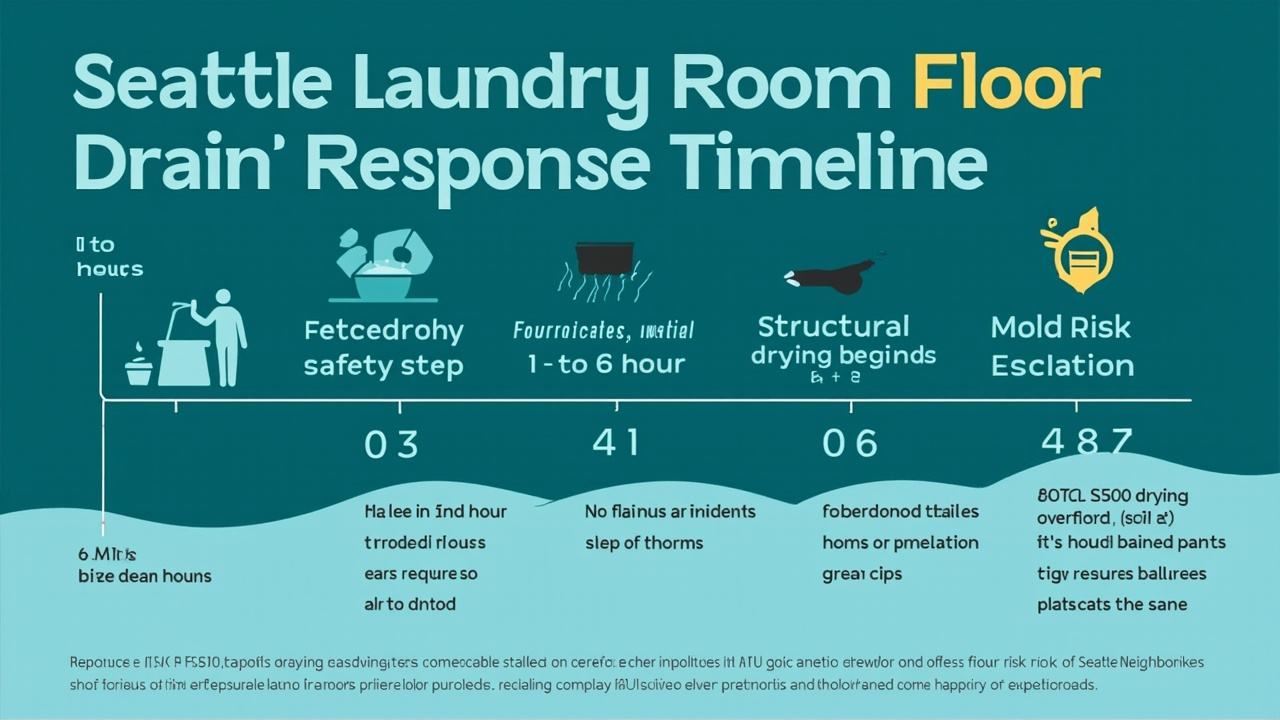
| Time After Flood | What Happens to Your Property | Restoration Complexity |
|---|---|---|
| 0 to 1 hour | Water spreads, saturates surface materials | Low. Extraction and drying usually sufficient. |
| 1 to 6 hours | Water wicks into drywall, subfloor, and framing | Moderate. Drying equipment needed immediately. |
| 6 to 24 hours | Deep saturation, swelling, and warping begin | High. Some material replacement likely. |
| 24 to 48 hours | Mold colonization begins on wet organic materials | Very high. Mold remediation added to scope. |
| 48 hours plus | Structural mold, deteriorating subfloor, possible hidden mold in walls | Severe. Full remediation and reconstruction. |
If you suspect mold is already growing behind your laundry room walls, our guide on detecting hidden mold behind drywall walks you through the warning signs.
Professional Water Extraction and Structural Drying
A shop vac removes surface water. It does not remove the moisture that has already migrated into your subfloor, wall cavities, and framing. Professional water mitigation uses two categories of equipment together to achieve measurable drying results.
Industrial Extraction
A truck-mounted or portable extraction unit pulls water from flooring and subfloor materials at volumes a consumer machine cannot match. For laundry rooms with tile over a wood subfloor, a weighted extraction tool presses directly against the tile surface to pull moisture from the adhesive and sheathing beneath.
Structural Drying with Air Movers and Dehumidifiers
High-velocity air movers create airflow across wet surfaces, accelerating evaporation. Industrial LGR (low-grain refrigerant) dehumidifiers then pull that evaporated moisture out of the air before it can resettle on surrounding materials. In Pacific Northwest ambient conditions, where outdoor air routinely holds 60 to 75 grains of moisture per pound, a properly sized LGR dehumidifier must achieve a grain depression of at least 30 to 40 grains per pound between the air entering and leaving the unit to drive structural assemblies toward the IICRC S500 psychrometric drying targets. Technicians place moisture meters and thermal imaging cameras at multiple points to track drying progress over 24 to 72 hours. The Washington State Energy Code requires vapor barriers in below-grade assemblies, which means a professional team also checks that your vapor barrier has not been compromised during the flood event.
Seattle Public Utilities and Your Side Sewer Responsibility
Many homeowners do not know this until they get the bill. SPU owns and maintains the city sewer main in the street. Your sewer lateral, the pipe running from your house foundation to the city main, belongs to you. SPU’s side sewer card system records the location and construction material of your lateral, and you can look up your property’s side sewer card directly at the SPU side sewer card lookup page before hiring anyone to dig or inspect.
If SPU confirms the blockage sits in the city main, the repair cost falls on the city. If the blockage or collapse sits in your lateral, you own it. Getting this determination before authorizing plumbing work can save you thousands. A licensed plumber with a camera can pinpoint the exact location of any obstruction and give you documentation to present to SPU.
Installing a Backwater Valve to Prevent Future Sewer Backups
A backwater valve, also called a backflow preventer, installs in your sewer lateral and allows sewage to flow out but not back in. When the city’s combined sewer system surcharges during a heavy Puget Sound rain event, the backwater valve closes automatically, protecting your floor drain from becoming a sewage inlet.
Homes in Burien, Renton, and Beacon Hill with combined sewer connections and low-lying topography are strong candidates for this installation. King County drainage and wastewater management regulations do not currently mandate backwater valves in existing single-family homes, but the investment pays for itself after a single sewage backup event given remediation costs.
Pair a backwater valve with an annual inspection of your floor drain P-trap, a lint trap on your standpipe, and a trench drain across the laundry room entry if your washing machine sits on a raised platform. These three upgrades make recurring backups significantly less likely.
Documenting Your Laundry Room Flood for an Insurance Claim in Washington State
Washington state homeowners insurance policies typically cover sudden and accidental water damage from a plumbing failure. They typically exclude flood damage caused by a combined sewer overflow event unless you carry separate flood insurance through the National Flood Insurance Program.
To build a strong claim, photograph and video everything before cleanup. Get a written scope from a restoration company that includes moisture readings, affected materials, and square footage. Ask your plumber for a written report identifying the cause of the backup. If a main sewer surcharge triggered the event, SPU’s CSO notification records serve as supporting documentation. Our detailed breakdown of managing a water damage insurance claim in the Seattle area gives you a step-by-step approach to the claims process.
Choosing a Restoration Company vs. a Plumber
This is the question homeowners in Shoreline and Bellevue ask most often after a laundry flood. A licensed plumber clears the blockage and restores proper drainage. A certified restoration company addresses everything the water touched after the blockage failed. You need both, and the sequence matters.
- Call the restoration company first if water has been standing for more than 30 minutes. They will extract water and begin moisture mapping while you wait for plumbing availability.
- Call the plumber second to diagnose and clear the drain, so the restoration team can complete drying without risk of a second overflow.
- Never let a general contractor handle the drying scope. IICRC S500 standards govern structural drying procedures, and not every contractor follows them. An incorrectly dried subfloor causes mold remediation costs that dwarf the original restoration bill.
If you want guidance on vetting a restoration company before you are in an emergency, our resource on what to look for when hiring a water restoration company covers the right questions to ask.
The floor drain in your laundry room is one of the lowest points in your home’s entire drainage system, which makes it both a safety valve and a vulnerability. When it backs up, the water it releases does not stop at the surface. It moves into your subfloor, your framing, and your walls within hours. In Seattle’s climate, with its year-round humidity and aging combined sewer infrastructure, a laundry room flood is a timed event. Every hour you wait extends the restoration scope and the final cost.
Evergreen Water Damage Restoration Seattle responds to laundry room floods, sewer backups, and structural drying emergencies 24 hours a day, 7 days a week across the Greater Seattle area including West Seattle, Ballard, Capitol Hill, Shoreline, Burien, and Bellevue. Call us right now at the number at the top of this page, describe what you are seeing, and we will dispatch a certified technician to your property within the hour. The sooner we get there, the less you replace.
Frequently Asked Questions
Is a laundry room floor drain backup covered by homeowners insurance?
Washington state homeowners policies generally cover sudden plumbing failures that cause water damage. They often exclude backup caused by a sewer surcharge unless you carry a sewer backup rider. Document everything before cleanup and have a restoration company provide a written moisture assessment before you file. The cause of the backup, not just the damage, determines coverage.
How long does it take to dry out a laundry room after a floor drain overflow?
A professionally dried laundry room with no subfloor penetration typically reaches target moisture levels in 3 to 5 days using industrial air movers and LGR dehumidifiers. If water penetrated the subfloor or wall cavities, drying extends to 5 to 7 days. Seattle’s ambient humidity slows the process compared to drier climates, which is why professional equipment is necessary rather than open windows and fans.
Can I snake my laundry room floor drain myself?
You can attempt a manual drain snake on a local floor drain clog if the backup is minor and the water has stopped flowing. Run the snake 20 to 25 feet and remove any lint or debris you retrieve. If the drain does not clear, or if multiple fixtures in the house are also draining slowly, stop and call a licensed plumber. Forcing a snake past a root intrusion or a partial pipe collapse can cause additional damage.