
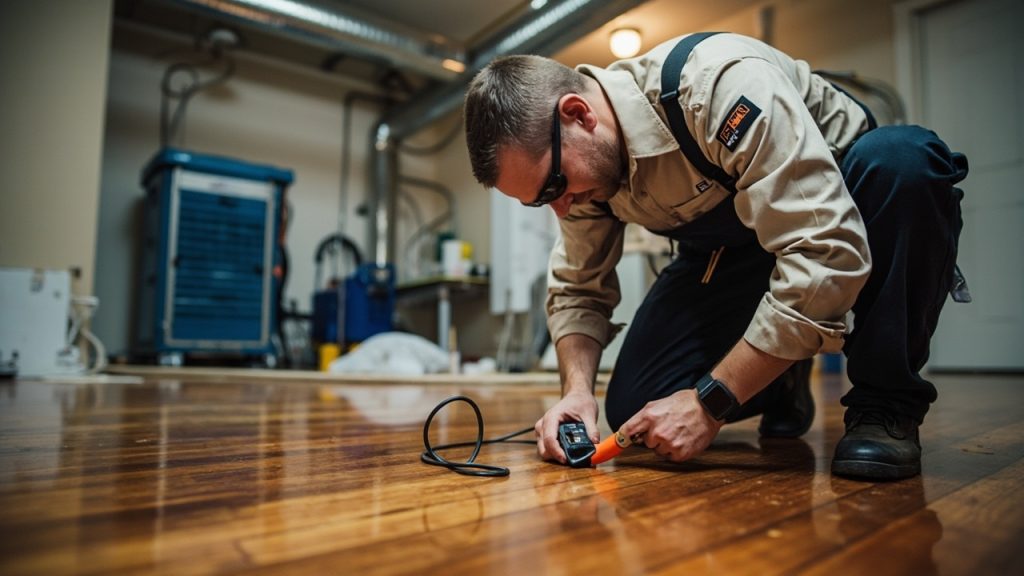
Your air conditioner drips a small amount of water as a normal part of cooling your home. When that drip becomes a puddle on your utility room floor, or a water stain spreading across your ceiling, you are no longer dealing with an HVAC problem. You are dealing with a water damage emergency.
Kent homeowners are finding this out the hard way as Seattle-area summers push AC systems harder than ever. Warm, humid air cycling through an overworked unit creates the perfect conditions for condensate overflow. And in a region with persistent indoor humidity and older housing stock, the secondary damage from that water can be severe.
This guide covers the mechanics of AC condensation leaks, the restoration steps that follow, and the specific considerations that matter for homes throughout the Greater Seattle metro area.
How Your AC System Produces Water
Every air conditioner contains an evaporator coil. Warm indoor air passes over this coil, which is filled with cold refrigerant. The temperature differential causes moisture in the air to condense on the coil’s surface, much like a cold glass sweating on a summer day.
That condensate water drips into a drain pan and exits your home through a condensate drain line. Under normal operation, you never see this water. Problems start when any part of this chain fails.
Understanding the failure points matters because each one produces a different leak pattern and a different downstream damage profile for your home.
The Five Most Common Causes of an Air Conditioner Water Leak
Clogged Condensate Drain Line
This is the most frequent culprit. Algae, mold, and debris accumulate inside the PVC condensate drain line over time. Once it clogs, water backs up into the drain pan and eventually overflows onto whatever surface is below, whether that is your air handler platform, your ceiling drywall, or your subfloor.
In homes throughout Bellevue and Queen Anne, where central air has been retrofitted into older construction, the condensate line often runs through tight interior wall cavities. A clog there can leak for days inside the wall before you notice staining on the surface.
Frozen Evaporator Coil
When airflow across the evaporator coil is restricted, the refrigerant inside gets too cold and the coil ices over. This happens with dirty air filters, closed supply vents, or low refrigerant charge. When the ice melts, which happens the moment the system shuts off, the drain pan receives far more water than it is designed to handle in a short period. Overflow is almost guaranteed.
The clue here is ice visible on the refrigerant lines near the air handler, or a system that blows warm air for an hour before cooling resumes. If you see a large puddle forming suddenly after the unit shuts off, a thawed coil is a strong possibility.
Cracked or Rusted Drain Pan
The drain pan sits beneath the evaporator coil and catches normal condensate drip. These pans are typically made from plastic or galvanized steel, and both materials degrade. Plastic cracks under thermal cycling. Steel rusts, especially in the humid Pacific Northwest climate where indoor relative humidity can sit above 60 percent during transitional seasons.
A cracked drain pan is a slow, insidious leak. It may wet your subfloor for weeks or months before any visible sign appears on the surface. By the time you find it, saturation can extend well beyond the footprint of the unit itself.
Refrigerant Leak
When refrigerant levels drop due to a system leak, the evaporator coil runs colder than designed. This causes ice formation on the coil surface, which leads to the same overflow scenario described above. HVAC refrigerant leaks require a certified technician to diagnose and repair. This is not a DIY fix. Modern systems use Puron (R-410A), which requires EPA Section 608 certification to handle.
Disconnected or Improperly Sloped Drain Line
Condensate lines must slope consistently toward the discharge point to drain by gravity. In many retrofitted HVAC installations throughout Capitol Hill and Ballard, the line runs through spaces where achieving proper slope is difficult. A line that sags, runs flat, or has become disconnected at a fitting will pond water and eventually overflow. This is also a common finding in Seattle Box townhomes where the air handler is crammed into a utility closet on an upper floor.

Immediate Steps When You Find Standing Water
- Turn Off the AC System
Go to your thermostat and switch the system completely off. This stops new condensate from forming and prevents a frozen coil from continuing to accumulate ice that will melt into your home.
- Cut Power at the Breaker
If water is pooling near the air handler or any electrical components, switch off the circuit breaker for the HVAC system before getting close to the standing water. Water and live electrical equipment are a serious hazard.
- Contain and Document the Water
Use towels, buckets, or a wet-dry vacuum to contain the spread. Take photos and video of all visible water damage before you move anything. Your insurance claim will depend on this documentation.
- Locate and Clear an Obvious Clog
If you can access the condensate drain line cleanly, you can pour a mixture of warm water and white vinegar into the drain pan access port to flush a minor clog. Do not use compressed air unless you know where the line discharges, as backpressure can disconnect fittings inside walls.
- Call an HVAC Technician for the Machine
Fixing the leak at its source is the HVAC technician’s job. Fixing the water damage to your home is a separate and distinct scope of work.
- Call a Water Damage Restoration Company for Your Home
If water has spread beyond a small, easily dried surface, contact a restoration team immediately. The 24 to 48 hour mold growth window in the Puget Sound climate is not a figure of speech.
When an AC Leak Crosses Into Water Damage Restoration Territory
There is a critical distinction that most generic HVAC articles miss entirely. An HVAC technician fixes the machine. A water damage restoration company fixes your home. These are two completely separate services, and understanding that distinction matters for your insurance claim and your home’s structural health.
Once water has saturated your building materials, you need professional drying, not just a repaired condensate line. Here are the thresholds that signal a restoration emergency:
- Water has been present for more than 24 hours
- You can see water staining on drywall, ceiling tiles, or wood flooring
- Hardwood floors show any cupping, crowning, or separation between boards
- Carpet feels wet or soft when you press on it
- You detect a musty odor, which indicates active microbial growth has already begun
- The leak originated in an upper floor and water traveled down through the ceiling
- The air handler is in an attic, crawlspace, or closet with limited ventilation
Mold Growth Timelines in the Pacific Northwest Climate
The standard industry guidance based on the EPA’s mold remediation guidelines places the window for mold colonization at 24 to 72 hours after a moisture event. In Seattle’s climate, the lower end of that range is more realistic.
King County’s high relative humidity means that building materials in Puget Sound homes hold moisture longer than in drier climates. Drywall, oriented strand board sheathing, and the cellulose insulation common in older Craftsman homes in Wallingford and Green Lake are particularly hospitable substrates for mold. A condensate overflow that soaks into a wall cavity on a Tuesday can produce active mold colonies by Thursday morning.
This is not a slow process you can monitor over a week. It requires action within the first day.
| Timeframe After Leak | Typical Damage Stage | Action Required |
|---|---|---|
| 0 to 2 Hours | Surface saturation only, no structural penetration | DIY extraction possible with wet-dry vac. Monitor closely. |
| 2 to 12 Hours | Water wicking into drywall, subfloor, and insulation | Professional assessment recommended. Moisture meter readings critical. |
| 12 to 24 Hours | Drywall softening, wood beginning to swell, Category 1 water risk rising | Professional extraction and structural drying required. |
| 24 to 48 Hours | Active mold colonization begins. Hardwood cupping visible. | Restoration and mold remediation required. Do not delay. |
| 48 Hours and Beyond | Structural compromise, widespread microbial growth, secondary damage escalating | Full remediation scope. Potential drywall removal and content salvage needed. |
Professional Structural Drying and Why DIY Falls Short
Opening windows and pointing a box fan at a wet floor does not constitute structural drying. Professional restoration teams use a process rooted in psychrometrics, the science of how air temperature, humidity, and vapor pressure interact to move moisture out of building materials.
The process typically involves three phases working simultaneously. First, water extraction using truck-mounted or portable extraction units removes standing and surface water. Second, commercial-grade refrigerant dehumidifiers pull moisture from the air, lowering the vapor pressure in the space so moisture migrates out of the structural materials. Third, axial and centrifugal air movers accelerate evaporation from surfaces and direct that moisture-laden air toward the dehumidifiers.
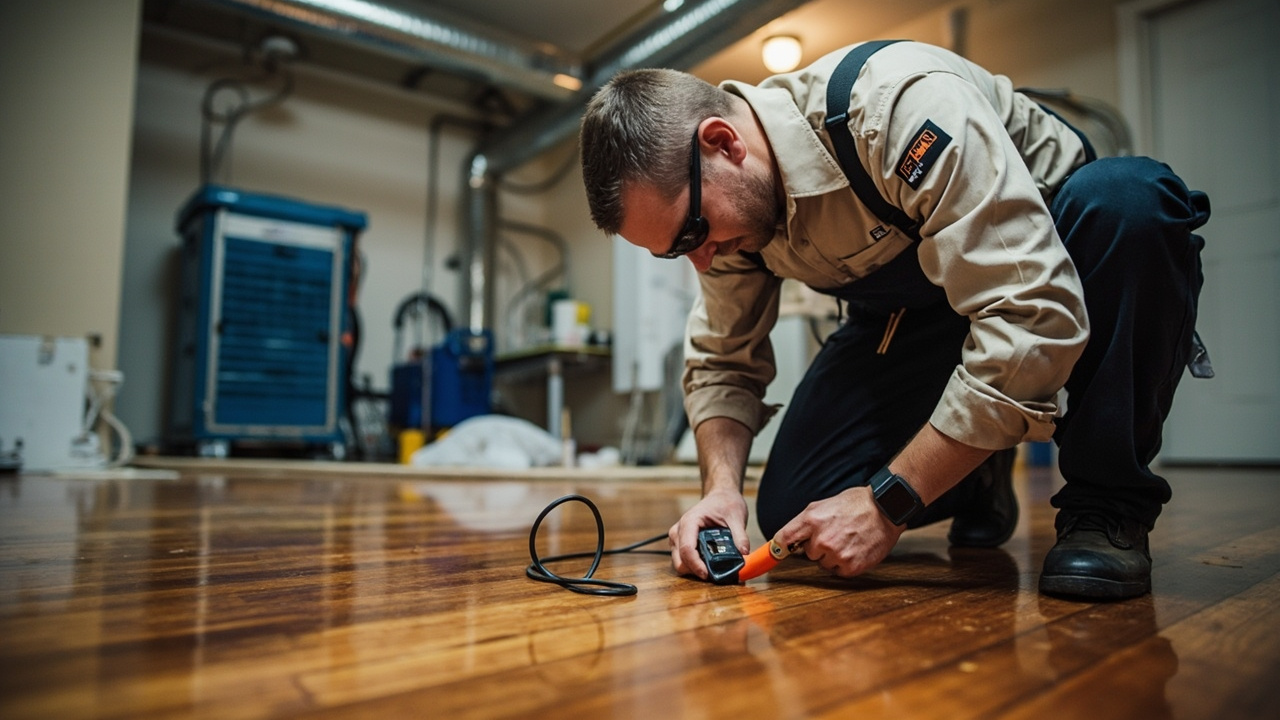
Technicians use moisture meters and thermal imaging cameras to read the actual moisture content inside walls, under flooring, and in ceiling cavities. The IICRC S500 Standard for Professional Water Damage Restoration provides the technical framework for acceptable dry standard readings by material type. Without this data, you cannot know when drying is truly complete.
For West Seattle and Renton homes where the AC air handler sits in a finished basement or lower level, water from a condensate overflow can travel across concrete slabs and wick into framing members, requiring drying times that often extend beyond five to seven days depending on ambient conditions.
Secondary Damage Specific to Seattle’s Housing Stock
Secondary damage is the structural and material harm that compounds after the initial leak. It is the core reason why a fast response matters so much. Evergreen Water Damage Restoration sees a consistent pattern of secondary damage in specific home types across the Seattle metro:
In historic Craftsman homes throughout Beacon Hill and Fremont, lath and plaster walls act like sponges. Water saturates the plaster, which swells and cracks. The wood lath behind it can develop mold colonies within 36 hours that are completely invisible from the surface. Removal is often the only remediation option by the time these are found.
In modern Seattle Box townhomes in South Lake Union and Capitol Hill, multi-story plumbing and HVAC stacks mean that a condensate overflow on the second floor can travel down through framing and appear as a water stain on the first floor ceiling. By the time the stain is visible, saturation has already occurred in the floor assembly between levels, including the subfloor, joists, and any insulation or soundproofing material.
For information on how water damage restoration company selection works in the Seattle area, see our guide on how to hire a water restoration company as a homeowner.

Insurance Coverage for AC-Related Water Damage
This is one of the most misunderstood areas of homeowner’s insurance, and the confusion costs homeowners money. Understanding the coverage boundary before you file matters.
| Scenario | Typically Covered by Homeowner’s Insurance | Typically Not Covered |
|---|---|---|
| Sudden condensate overflow from a clogged drain line | Water damage to floors, walls, ceilings | Repair of the AC unit itself |
| Cracked drain pan (slow leak over weeks) | Rarely covered. Considered gradual damage or neglect. | Both the unit and the resulting damage |
| Frozen evaporator coil causing overflow | Often covered if sudden and accidental | Refrigerant recharge and coil cleaning |
| Mold resulting from a covered water event | Mold remediation up to policy sublimit | Mold from long-term neglect or pre-existing conditions |
| Structural drying by a licensed restoration firm | Yes, when event is a covered peril | Not covered if claim is denied |
The key distinction insurers apply is sudden versus gradual. A sudden overflow is typically a covered peril. A slow drip that went undetected for months is almost always denied as a maintenance failure. Documentation from a professional restoration team, including moisture meter readings, thermal imaging reports, and material damage assessments, is what supports a successful claim. For detailed guidance on this process, read our article on how to handle a water damage insurance claim in the Seattle area.
Seattle Building Code Considerations for Condensate Systems
The Seattle Residential Code requires condensate drain lines to discharge to an approved location, not onto a roof surface or directly against a foundation. Air handlers installed in attics or upper floor utility spaces must have a secondary drain pan with an independent drain line or a float switch that shuts the system off when the primary pan reaches a high-water threshold.
Many older HVAC retrofits throughout the region pre-date these requirements. If your system does not have a secondary pan or a float switch, adding one is a low-cost upgrade that prevents the exact scenario described in this article. Ask your HVAC technician about compliance with current Washington State Energy Code moisture control requirements during your next service visit.
Dehumidification After an AC Leak in a PNW Home
Ambient indoor humidity in the Seattle metro during summer months can sit between 55 and 70 percent relative humidity during warm spells. This significantly slows structural drying compared to drier climates. A drying system that might complete a job in three days in a low-humidity environment can require five to eight days in a King County home during a warm, humid stretch.
Professional restoration teams adjust the psychrometric drying plan based on real-time readings from temperature and humidity data loggers placed throughout the affected area. The goal is to create a controlled environment where relative humidity inside the drying zone stays below 40 percent, accelerating moisture migration out of saturated materials.
If you are curious about how delays in starting the drying process compound the damage, the same principle applies here as it does with other water intrusion types. Our article on why waiting to dry water damage always makes it worse covers this in detail.
How to Tell if the Damage Goes Deeper Than It Looks
Surface water is only part of the story. In most water damage cases from AC condensation leaks, the visible damage understates the actual scope by a significant margin. Water follows the path of least resistance, which in a home means framing gaps, insulation, and subfloor assemblies.
Signs that damage extends beyond what you can see include floors that feel soft or springy when you walk on them, drywall that appears slightly discolored or bubbled without being visibly wet, paint that has begun to flake or peel in areas near the air handler, and a persistent musty smell that returns after the surface has dried. Our resource on identifying hidden mold behind drywall covers the specific warning signs in more depth.
A similar dynamic occurs with slow leaks from mechanical systems in lower levels of the home. Our piece on what a slow basement leak does to your home describes the pattern of concealed structural damage that develops before any visible sign appears.
When to Call Evergreen Water Damage Restoration
If you are in Kent, Renton, Bellevue, Shoreline, or anywhere in the Greater Seattle metro and your AC system has caused water to spread into your floors, walls, or ceiling, the time to call is now. Not after you wait to see if it dries on its own. Not after the weekend.
Evergreen Water Damage Restoration responds 24 hours a day, 7 days a week. The team brings moisture meters, thermal cameras, commercial extraction equipment, and drying systems sized for the PNW’s high ambient humidity. The goal is not just to dry the surface. It is to verify, with data, that your home’s structural materials have returned to safe moisture levels and that the conditions for mold growth have been eliminated.
One call starts the process. Your HVAC tech handles the machine. We handle your home.
Frequently Asked Questions
How much water can an AC system leak before it causes serious damage?
Even a small, steady leak of a cup or two per hour can saturate subfloor and drywall within 12 to 24 hours. It is not the volume at any moment that matters. It is the total saturation over time and whether the affected materials have a path to dry.
Can I run my AC again after fixing the clogged drain line?
Once an HVAC technician confirms the drain line is clear and the pan is intact, the unit is safe to operate. The separate question is whether the water damage to your home has been fully addressed. Running the AC does not dry your walls. That requires a professional drying setup.
Does homeowner’s insurance cover the cost of mold remediation after an AC leak?
Most standard homeowner’s policies include a mold sublimit, typically applicable when the mold results from a covered water event. If your AC overflow qualifies as a sudden and accidental loss, mold remediation costs are often partially or fully covered up to the policy limit. A documented restoration report from a professional team is essential for this claim.
How long does structural drying take after a condensate overflow?
In the Seattle metro, expect three to eight days for most residential drying projects, depending on the extent of saturation, the building materials involved, and ambient humidity conditions. Your restoration team will monitor readings daily and adjust equipment placement to meet the drying goal as efficiently as possible.