
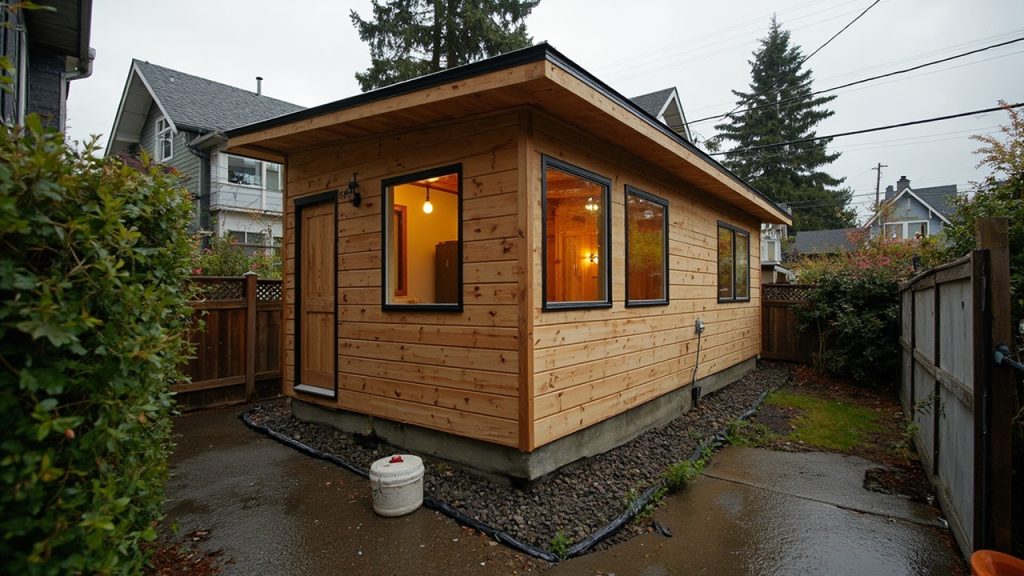
If you just finished building a backyard cottage or converted your basement into a rental unit in Ballard, water is already working against you. Seattle’s soil does not drain like soil in drier climates. The glacial till and clay-heavy ground that sits beneath most of Ballard, Magnolia, and Queen Anne holds moisture like a sponge, and that saturated soil pushes against your foundation walls with force. That force is hydrostatic pressure, and if your ADU was not built or retrofitted with the right drainage systems, you will see the damage within your first wet season.
This guide covers what every ADU owner in the Puget Sound area needs to know about waterproofing, Seattle building code compliance, and the drainage decisions that will determine whether your investment holds its value or starts rotting from the ground up.
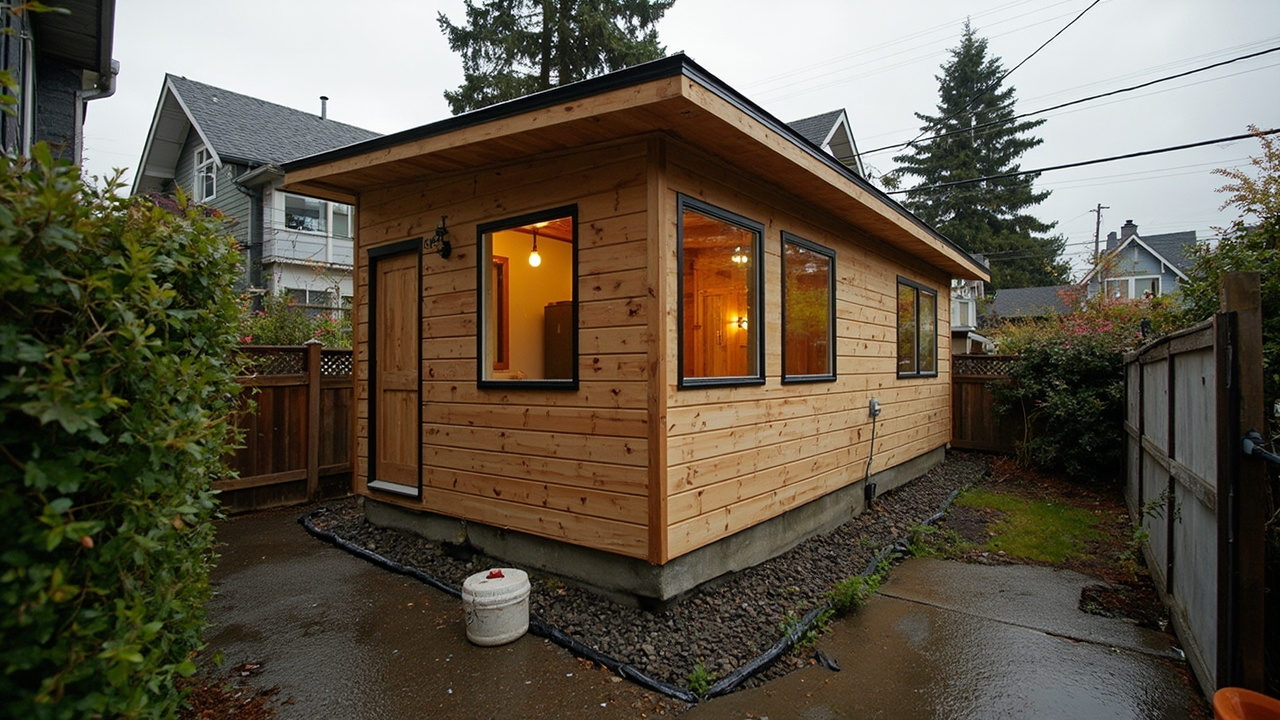
Why Ballard and the PNW Are Particularly Hard on ADU Foundations
Seattle averages over 37 inches of precipitation annually. That number does not capture the intensity. Atmospheric river events dump several inches of rain in 24 to 48 hours, overwhelming street drains and saturating soil faster than it can shed water. Ballard, sitting on relatively flat ground near Shilshole Bay and the Ship Canal, has a higher water table than neighborhoods like Capitol Hill or Beacon Hill.
The soil type makes everything worse. Glacial till, the dense mixture of clay, silt, sand, and gravel left behind by glaciers, has low permeability. Water cannot move through it quickly. Instead, it pools around your foundation, builds up pressure, and forces its way through any crack, seam, or porous concrete block it can find. Neighborhoods like Fremont, Wallingford, and Green Lake sit on similar geology.
Hydrostatic pressure is not a slow, gentle force. In a fully saturated glacial till layer, the lateral pressure against a foundation wall can exceed 30 pounds per square foot at depth. A basement conversion ADU with walls that were not designed to handle that load will show efflorescence, hairline cracks, and eventually active seepage within a few rain seasons.
DADU vs AADU — Why the Waterproofing Requirements Are Different
Seattle’s Seattle Department of Construction and Inspections (SDCI) treats Detached Accessory Dwelling Units and Attached Accessory Dwelling Units differently, and those distinctions carry real waterproofing implications.
A DADU is a new structure built in your backyard, usually on a concrete slab or stem wall foundation. Because it is a new build, you have full control over the drainage design from the start. SDCI requires a drainage review for any new impervious surface over 500 square feet, and your DADU footprint almost certainly triggers that threshold. Your site plan must show how stormwater runoff will be managed, and you will likely need a side sewer permit through Seattle Public Utilities if you are connecting to the municipal system.
An AADU is typically a basement conversion inside your existing home. Here, the foundation already exists, usually poured concrete or older masonry block, and it was built decades before ADU use was anticipated. Retrofitting these spaces for habitable use requires vapor barriers, sub-slab drainage, and often a sump system. The Seattle Residential Code sets minimum standards for moisture control in below-grade living spaces, and the Washington State Energy Code adds vapor barrier permeance requirements on top of that.
| Feature | DADU (Detached Backyard Cottage) | AADU (Basement Conversion) |
|---|---|---|
| Foundation Type | New slab or stem wall, full drainage design control | Existing poured concrete or masonry block |
| Primary Water Risk | Surface runoff, shallow groundwater, slab wicking | Hydrostatic pressure, wall seepage, sub-slab moisture |
| Required Waterproofing Approach | Exterior drainage plane, sub-slab vapor barrier, perimeter French drain | Interior drainage mat, sump pump, crack injection, vapor barrier |
| SDCI Permit Triggers | Drainage review, side sewer permit, grading permit if applicable | Building permit for habitable basement, mechanical permit for sump |
| Vapor Barrier Perm Rating (WSE Code) | 0.1 perms or less on slab underslab | 0.1 perms or less on walls and floor, Class II minimum |
The Waterproofing Systems That Actually Work in Seattle Soil
French Drains on Small ADU Footprints
Most backyard lots in Ballard, West Seattle, and Fremont are compact. You do not have the room for a sprawling drainage design. A properly sized perimeter French drain, a trench filled with washed gravel and a perforated pipe wrapped in filter fabric, can intercept groundwater before it ever contacts your foundation wall.
For a standard DADU footprint, the French drain runs along the exterior perimeter at footing depth. The pipe grades toward a collection point, either a dry well if your soil has any permeability deeper down, or a sump basin that discharges to daylight or the storm sewer with an SPU-approved connection. Given Ballard’s flat topography, gravity discharge is not always possible. That is where sump pumps come in.
Sump Pump Systems and Battery Backup
Seattle loses power during major wind events. The same storms that push atmospheric rivers into the region also knock out electricity. A sump pump without a battery backup is a liability during the exact conditions when you need it most.
A submersible sump pump in a sealed basin should be paired with a battery backup unit rated for at least 8 to 12 hours of continuous operation. Some property owners in South Lake Union and Shoreline are also installing water-powered backup pumps as a secondary failsafe, since they run off municipal water pressure rather than electricity. The investment in a backup system is a fraction of what you will spend on water damage remediation if the primary pump fails during a three-day rain event.
Vapor Barriers and Perm Ratings for Habitable ADU Spaces
The Washington State Energy Code classifies Seattle as a Marine Climate Zone 4C. In this zone, below-grade walls in habitable spaces require a vapor retarder with a permeance rating of 1.0 perm or less on the warm-in-winter side of the insulation. For practical purposes, most waterproofing contractors use HDPE dimple mat systems or modified bituminous membrane panels, both of which achieve ratings well below 0.1 perms when properly lapped and sealed.
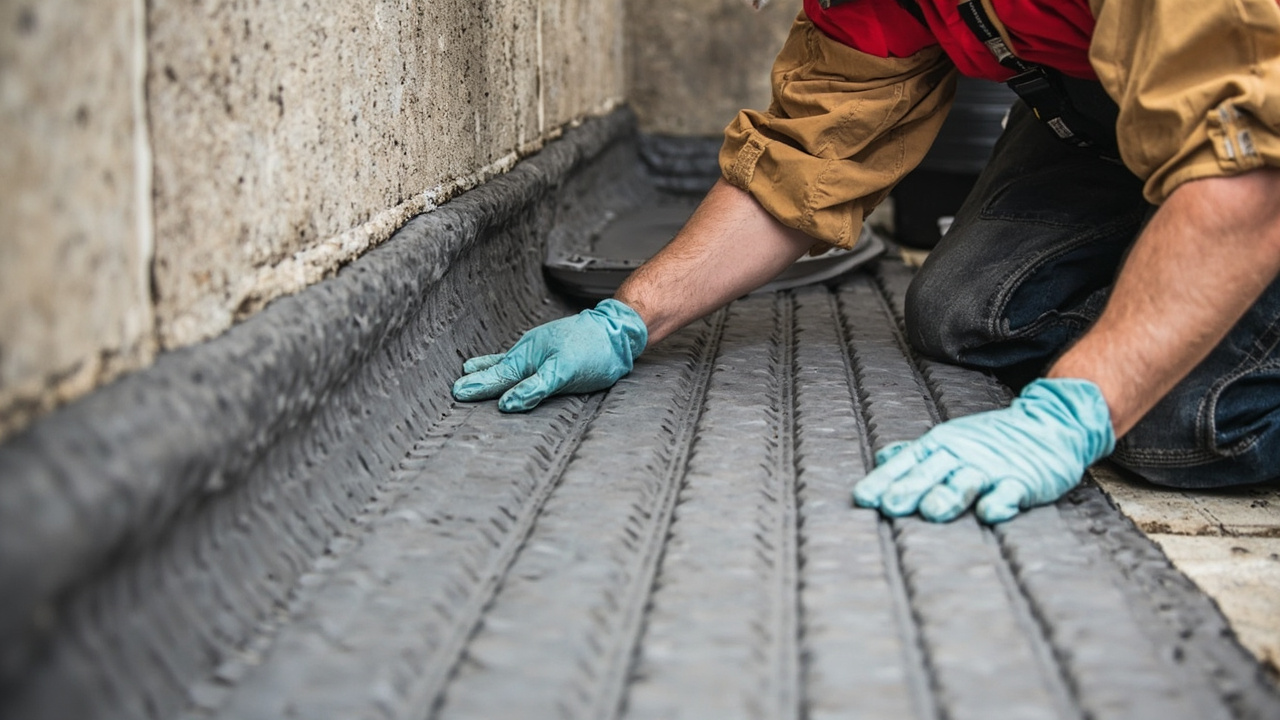
HDPE dimple mat creates a drainage plane between the foundation wall and the interior finish. Any moisture that gets past the exterior waterproofing migrates down the dimple channels into the sub-slab drain rather than wicking into your framing. Bituminous membranes bond directly to the concrete and provide a solid barrier, but they require a clean, dry surface for proper adhesion. In a retrofit situation where the concrete has existing efflorescence or previous moisture damage, HDPE systems tend to perform more reliably.
Foundation Crack Injection for Existing Basement ADUs
If you are converting an existing basement in Ballard or Queen Anne and you already see hairline cracks in the foundation walls, do not frame over them. Active cracks need to be addressed before any waterproofing membrane goes on. Polyurethane foam injection is the standard method for non-structural cracks. The two-part foam expands to fill the crack from the inside out, cutting off the water pathway. Epoxy injection is used for structural cracks where you need tensile strength restored. A qualified inspector can tell you which type applies to your specific walls.
If you discover slow, ongoing moisture damage in your Magnolia basement, the situation at your foundation is often more advanced than it appears. Read more about what slow moisture accumulation in a basement space is really doing to your structure.
Crawl Space Encapsulation vs Basement Tanking
Not every DADU sits on a full basement. Some backyard cottages in Wallingford, Kenmore, and Bothell are built over a vented crawl space. In Seattle’s climate, a vented crawl space under a living unit is a significant problem. The persistent humidity means outdoor air brings in more moisture than it removes, and that moisture condenses on the cool surfaces of the crawl space ceiling and structural members.
Crawl space encapsulation seals the space completely. A reinforced polyethylene liner covers the floor and walls, a dehumidifier maintains relative humidity below 60 percent, and all vents are sealed. This approach transforms the crawl space into a semi-conditioned space that stays dry year-round regardless of what the rain is doing outside.
Basement tanking, the application of a cementitious or crystalline waterproofing system to the interior face of foundation walls, is a different approach suited for solid below-grade walls. Crystalline compounds penetrate the concrete matrix and form insoluble crystals that block capillary water movement. Tanking works well in older Craftsman-era basements with solid poured walls. It does not work well on masonry block without significant prep work, since the block joints are the primary failure points.
| Method | Best Application | Effectiveness Against Hydrostatic Pressure | Typical Lifespan in Seattle Climate |
|---|---|---|---|
| HDPE Dimple Mat (Interior) | Basement retrofit, AADU conversion | High (manages rather than blocks pressure) | 20 to 30+ years |
| Modified Bituminous Membrane (Exterior) | New DADU construction, full excavation accessible | Very high (blocks pressure at source) | 15 to 25 years depending on backfill quality |
| Crystalline Tanking | Poured concrete walls, interior application | Moderate (self-heals minor cracks over time) | Permanent if applied correctly |
| Crawl Space Encapsulation | Vented crawl space under DADU or addition | Moderate (controls vapor, not bulk water) | 25+ years with dehumidifier maintenance |
| French Drain with Sump | Perimeter water collection, both DADU and AADU | High (intercepts groundwater before it reaches walls) | 20+ years with annual inspection |
SDCI Compliance and the Permit Process for ADU Waterproofing
Seattle’s SDCI drainage review process is not optional. When you submit your ADU building permit application, the site plan must include stormwater management documentation. For most residential ADU projects, this means demonstrating compliance with the Seattle Stormwater Code, which prioritizes infiltration, flow control, and water quality treatment.
If your lot cannot support infiltration due to glacial till or high clay content, which applies to a large percentage of Ballard and Magnolia properties, you will need an engineered alternative. That typically means a flow control structure or a connection to the public storm drain system with a side sewer permit. Your contractor or a licensed civil engineer can determine which path applies to your site.
The side sewer permit process goes through Seattle Public Utilities. Any new drainage connection to the public sewer requires a licensed side sewer contractor to perform the work and pull the permit. This is separate from your SDCI building permit. Failing to get this permit creates issues at final inspection and can complicate your title when you try to sell the property.
Understanding the permit and insurance side of water-related property work is equally important. If your ADU does experience flooding before or during construction, this guide on handling a water damage insurance claim walks you through what documentation you need and how the process works in King County.
Seasonal Timing for ADU Waterproofing Work in the Pacific Northwest
Exterior waterproofing membrane application requires dry conditions. Modified bituminous products need a surface temperature above 40 degrees Fahrenheit and no moisture on the substrate. In Seattle, that window is roughly late May through September. If your DADU construction finishes in October or November, exterior membrane work may need to wait, or you will need to use a product specifically rated for cold and damp application.
- Exterior excavation and membrane work is best scheduled between June and early September.
- Interior drainage installation and crack injection can be done year-round in existing structures.
- Crawl space encapsulation can proceed in fall or winter since it does not depend on exterior temperature.
- Sump pump installation should be completed before the first atmospheric river event of the wet season, typically October.
- Concrete curing for new DADU slabs takes longer in cold weather. Plan for extended cure times if pouring between November and March.
If you start a basement conversion project in fall and discover existing water damage or hidden mold behind framing, stopping work and calling a remediation specialist is the right move. Learn how to identify whether your existing basement walls already have mold growth before you frame over them.
What Happens When ADU Waterproofing Fails
When water gets in, it does not just sit there. In a habitable ADU, moisture behind drywall creates conditions for mold growth within 24 to 72 hours. The framing, insulation, and finish materials in a basement conversion absorb water quickly. By the time you see efflorescence on the wall or smell that musty odor, the damage behind the surface is usually significant.
In Bellevue and Renton, where newer ADU construction sits over high water table areas in valley soils, the remediation work after a failed sump pump during a storm event can involve complete gut-out of the below-grade living space. That means removing drywall, insulation, flooring, and baseboards down to the concrete, running commercial-grade drying equipment for several days, and then rebuilding. The cost of that work, the displacement of tenants if the ADU is a rental, and the permit implications of unpermitted waterproofing work make the upfront investment in proper systems look straightforward by comparison.
Speed matters once water has entered. Waiting even 12 hours to begin extraction and structural drying significantly increases the scope of mold remediation needed. The same principle that applies to surface flooding applies to any water intrusion event in an enclosed ADU space.
Choosing the Right Contractor for ADU Waterproofing in Seattle
Not every waterproofing contractor understands ADU-specific constraints. The small footprint, the proximity to property lines, and the SDCI drainage review process require experience with Seattle’s permitting system, not just general waterproofing knowledge. Look for contractors who can reference specific Seattle Public Utilities requirements, who understand the difference between Class I and Class II vapor retarders under the Washington State Energy Code, and who carry IICRC certification if the project involves any existing moisture damage remediation.
For water damage restoration work triggered by a failed waterproofing system, the Institute of Inspection Cleaning and Restoration Certification (IICRC) sets the industry standards for structural drying and mold remediation. An IICRC-certified firm brings documented protocols for moisture mapping, drying targets, and clearance testing, which matters significantly when filing an insurance claim or selling the property later.
If you are in the planning phase of your ADU project and want to understand what to look for when hiring restoration and waterproofing specialists in the greater Seattle area, this breakdown of what homeowners need to know before hiring a water restoration company covers the key questions to ask and the credentials to verify.
Frequently Asked Questions
Do I need a permit for ADU waterproofing work in Seattle?
It depends on the scope. Interior drainage systems and sump pump installations generally require a mechanical or building permit. Exterior work that involves excavation around the foundation may trigger a grading permit. Any new connection to the public storm sewer requires a side sewer permit through Seattle Public Utilities. Your SDCI permit application for the ADU itself will include a drainage plan review that covers much of this. Work with a licensed contractor who knows Seattle’s permit process to avoid stop-work orders and title complications.
Can I waterproof a Ballard basement ADU from the inside only?
Yes, interior waterproofing is a practical and effective approach for most AADU basement conversions where exterior excavation is not feasible. An interior drainage mat system paired with a sump pump and crack injection handles hydrostatic pressure by managing water rather than blocking it. It will not be as effective as exterior membrane waterproofing in extremely high-pressure situations, but for the typical Ballard basement, an interior system installed correctly will keep the space dry through Seattle’s wet season.
How does glacial till soil specifically affect ADU foundation waterproofing?
Glacial till’s low permeability means water pools around your foundation rather than draining away. This builds lateral hydrostatic pressure on walls and upward pressure on slabs. It also means infiltration-based stormwater management, like dry wells, often will not work, so you will need a positive discharge system. Any exterior waterproofing backfill needs to use washed crushed rock rather than the native soil, since putting glacial till back against the foundation negates the drainage design entirely.