

Every fall, Seattle homeowners across West Seattle, Fauntleroy, and beyond watch the sky darken and the rain gauge start climbing. The Pacific Northwest rainy season is not a gradual drizzle. Atmospheric river events can drop several inches of rain in 24 hours, saturating the glacial clay soils that make up much of Seattle’s hillside neighborhoods and pushing water against your foundation with serious force.
The homeowners who avoid expensive water damage calls are the ones who spend a few hours in September and October doing the right preventive work. This guide gives you the same checklist our restoration technicians wish every Fauntleroy homeowner had completed before we got the emergency call.

Why Seattle’s Rainy Season Hits Fauntleroy Hard
Fauntleroy sits on the western slope of West Seattle, draining toward Puget Sound and Fauntleroy Cove. The terrain is steep in places, and the underlying soils are a mix of glacial till and dense clay. Clay-heavy soil does not absorb water quickly. When rain falls faster than the soil can drain, water moves laterally and finds the path of least resistance. That path is often your foundation wall or crawl space.
Seattle receives an average of 37 or more inches of precipitation annually, but the distribution matters. The bulk falls between November and January. When an atmospheric river event pushes a plume of warm, moisture-heavy Pacific air into the region, rainfall totals can spike dramatically over a short window. The National Weather Service Seattle forecast office tracks these events closely, and their archived data shows how quickly runoff volumes exceed what aging urban drainage systems can handle in neighborhoods like Ballard, Beacon Hill, and West Seattle.
Homes in Fauntleroy also deal with a secondary issue. Many of the Craftsman bungalows and mid-century ranchers in this area have crawl spaces rather than full basements. Crawl spaces are directly exposed to ground moisture and are the first place water intrusion becomes visible after a heavy rain event.
Exterior Checklist for Hardening Your Home Before the Rain
Gutters and Downspout Extensions
Clogged gutters are the single most preventable cause of foundation water intrusion we see on West Seattle properties. When gutters overflow, water saturates the soil directly against your foundation wall. On a slope like you find in Fauntleroy or Magnolia, that saturated soil creates hydrostatic pressure that pushes water through any crack or gap in your concrete or block foundation.
Clean your gutters thoroughly in late September, before the heavy rains begin. After cleaning, run water through them with a hose and watch for pooling, leaks at seams, or gutters that sag away from the fascia board. Those issues indicate the gutter is not moving water away from the house efficiently.
Downspout extensions are equally important and frequently overlooked. A downspout that terminates six inches from the foundation is almost as bad as having no gutter at all. Extend downspouts a minimum of six feet from the foundation, and aim for ten feet on sloped lots. Flexible corrugated extensions work fine, but bury rigid PVC where you can to prevent trip hazards and ensure the water discharges at grade level away from the house.
Roof Flashing and Surface Inspection
Flashing failures at chimneys, skylights, dormers, and roof-to-wall transitions are responsible for a significant portion of the interior water damage calls we respond to across Shoreline, Burien, and West Seattle each winter. Inspect visible flashing from the ground using binoculars. Look for lifted edges, missing sections, or rust staining that indicates water is tracking behind the metal.
Mid-century flat-roof homes common in West Seattle are especially vulnerable to ponding. If your roof has any flat or low-slope sections, check that the drains and scuppers are clear of debris before October.
Foundation Crack Inspection and Hydrostatic Pressure
Hydrostatic pressure builds when saturated soil pushes against your foundation. Concrete is strong in compression but weak under lateral water pressure. Even small cracks in a poured concrete or concrete block foundation will allow water intrusion once the soil around them is fully saturated.
Walk your foundation perimeter on a dry day before the rains arrive. Look for horizontal cracks, which indicate lateral soil pressure and are structurally serious. Vertical or stair-step cracks in block foundations are often settlement-related and may or may not be active water pathways. Mark any cracks you find with a pencil line and a date. If a crack grows between inspections, it is active and needs professional evaluation.
Small surface cracks in poured concrete can be sealed with hydraulic cement or an epoxy injection kit from a hardware store. Larger structural cracks need a foundation contractor. Either way, sealing cracks before the soil saturates is far cheaper than extracting water from a flooded crawl space or basement.

Crawl Space and Basement Protection
Sump Pump Testing and Maintenance
If your Fauntleroy home has a sump pump, it is your last line of defense against a flooded crawl space or basement. A sump pump that fails during a Seattle windstorm in November is a worst-case scenario. Power often goes out during the same storm events that dump the most rain. That means your pump needs a tested battery backup unit before October.
- Locate the float switch
Find the float arm or ball float inside the sump pit. Make sure it moves freely and is not caught on the pump housing or debris.
- Pour water into the pit
Use a five-gallon bucket to fill the sump pit with water. The pump should activate automatically before the water reaches the top of the pit.
- Confirm the discharge line is clear
Follow the discharge pipe from the pump to where it exits the house. Make sure the outlet is not blocked by debris, frozen soil, or a buried end cap that has never been removed.
- Test the battery backup
Unplug the primary pump from the wall outlet and pour water into the pit again. The battery backup unit should activate within a few seconds. If it does not, the battery needs replacement.
- Inspect the check valve
The check valve on the discharge line prevents pumped water from flowing back into the pit. If you hear water gurgling back after the pump shuts off, the check valve is failing and needs replacement before the season starts.
Crawl Space Vapor Barriers and Encapsulation
The Washington State Energy Code and Seattle Residential Code both require vapor barriers in crawl spaces, and for good reason. Ground moisture evaporates upward constantly. Without a proper barrier, that moisture raises the relative humidity inside your crawl space to levels where wood rot and mold growth become inevitable over a Seattle winter.
A basic vapor barrier is a sheet of 6-mil polyethylene plastic laid across the ground. That is the minimum. A full crawl space encapsulation uses 20-mil reinforced liner, sealed seams, and a dehumidifier to maintain humidity below 60 percent. For homes on the steeper lots in Fauntleroy or properties near the water table in lower-lying areas like White Center or Tukwila, full encapsulation is worth the investment. The IICRC (Institute of Inspection Cleaning and Restoration Certification) sets the technical standards for moisture control and structural drying that our technicians follow, and their moisture management guidelines are clear that a failing vapor barrier is a precursor to mold contamination.
Check your existing vapor barrier before the rains start. Lift sections in the middle of the crawl space and look for standing water, visible mold on the underside of the subfloor, or insulation that has sagged and fallen from the joist bays. Any of these are signs that moisture is already winning.
| Method | Protection Level | Best For | Maintenance Required |
|---|---|---|---|
| 6-mil poly sheeting (basic) | Moderate | Low-moisture lots, dry neighborhoods | Annual inspection, re-tape seams |
| Full encapsulation (20-mil liner) | High | Sloped lots, clay soil areas, older homes | Dehumidifier servicing, annual inspection |
| Sump pump with encapsulation | Very High | High water table zones, winter flood risk areas | Sump pump test twice yearly, battery replacement |
| Interior French drain system | Very High | Active water intrusion, hydrostatic pressure problems | Annual inspection of drain outlets and pump |
Landscaping and Drainage Strategies for PNW Soils
Grading and Soil Slope Away from the Foundation
The ground around your home should slope away from the foundation at a rate of at least one inch per foot for the first six feet. After years of settling, planting, and mulch buildup, many Seattle homes have reversed this slope and are now directing water toward the house. Use a long board and a level to check your grading before it rains.
Adding topsoil to re-grade the immediate perimeter is a straightforward weekend project. Use a dense, low-organic soil mix rather than bark or compost, which hold water and retain moisture against the foundation wall.
French Drains for Seattle’s Clay Soils
Seattle’s glacial clay soils drain poorly. On a sloped property in Fauntleroy, rainwater that cannot soak in quickly runs until it finds a low point. If that low point is your foundation, you have a chronic problem that no amount of caulk will fix permanently.
A French drain intercepts that subsurface and surface water before it reaches the foundation. A perforated pipe wrapped in filter fabric is laid in a gravel-filled trench at a depth that catches lateral water movement, then redirected to daylight or a dry well. On Seattle lots with steep grades or significant clay content, a professionally installed French drain is one of the highest-return investments you can make in water damage prevention.
Rain Gardens as a Practical Option
Seattle Public Utilities actively encourages rain garden installation as part of its stormwater management strategy. A rain garden is a shallow, planted depression designed to collect roof runoff from downspouts and allow it to infiltrate slowly. Properly designed for PNW conditions, a rain garden uses amended soil and deep-rooted native plants to absorb water that would otherwise sheet across your yard toward the foundation or overwhelm the street drains.
Using Professional Moisture Detection Before Problems Start
Our technicians at Evergreen Water Damage Restoration Seattle use thermal imaging cameras and calibrated moisture meters on every job. These are not just emergency tools. They are diagnostic tools that show water intrusion and elevated moisture levels that are invisible to the naked eye.
If your home has a history of wet crawl spaces, musty odors after rain, or peeling paint on lower walls, a pre-season moisture inspection can locate the source before water damage sets in. Thermal imaging shows temperature differentials that indicate wet materials behind drywall or under flooring. A moisture meter reading above 19 percent in wood framing means active drying is needed. Catching these readings in October is far better than finding visible mold in January.
If you discover mold already present in your crawl space or basement, act quickly. Mold colonies can establish within 24 to 48 hours on wet organic materials in Pacific Northwest humidity levels. By the time you can see mold growth on a surface, the colony is already mature. Learn how to identify the signs of hidden mold growth early by reading how to tell if your Columbia City home has hidden mold behind the drywall.
| Time After Water Intrusion | What Is Happening | Damage Category | Professional Action Needed |
|---|---|---|---|
| 0 to 1 hour | Water wicks into drywall, insulation, and subfloor | Category 1 (clean water) | Extraction and air mover setup |
| 1 to 24 hours | Swelling begins in wood, drywall softens | Category 1 escalating | Structural drying, moisture mapping |
| 24 to 48 hours | Mold germination window opens | Category 2 risk | Drying plus antimicrobial treatment |
| 48 to 72 hours | Visible mold growth likely, structural weakening | Category 2 to 3 | Full remediation, possible demolition |
| 72 hours and beyond | Black water contamination risk, significant mold | Category 3 | Full remediation plus content restoration |
Emergency Steps If Water Intrusion Happens Anyway
Know Where Your Water Shut-Off Is Right Now
This is not something to figure out during a flood. Walk to your main water shut-off valve today and confirm it operates. In most Fauntleroy homes, it is in the crawl space near where the main supply line enters the house, or in a utility area near the water heater. In newer homes and townhomes common in Bellevue and South Lake Union, it may be behind a panel in a utility closet. Tag it clearly so anyone in your household can find it in the dark.
If water is entering through the foundation from ground saturation rather than a broken pipe, shutting off the main supply does nothing. But if you have a burst pipe event during one of Seattle’s occasional hard-freeze nights, every second before shut-off matters.
First Steps When You Find Water in Your Crawl Space or Basement
- Do not enter a flooded area if electrical outlets, panels, or appliances may be submerged. Turn off the circuit breaker to that zone first.
- Document everything with photos and video before moving any items. Your insurance adjuster needs this record.
- Move undamaged items and valuables out of the water’s path if it is safe to do so.
- Do not run forced-air heating across a wet area. It does not dry things faster. It moves mold spores through your ductwork.
- Call a certified water damage restoration company before you start pulling up flooring. Improper drying techniques invalidate the moisture mapping that guides a proper remediation.
If you are navigating an insurance claim after water intrusion, the process can be confusing and time-sensitive. Read through our detailed breakdown of how to handle a water damage insurance claim for your home in Beacon Hill to understand what documentation you need and how to work with your adjuster effectively.
One thing many homeowners do not realize is that waiting even a few extra hours to begin professional drying significantly increases total restoration costs. For context on why speed matters, see our article on why waiting to dry out your kitchen after a dishwasher overflow makes everything worse.
What Professional Restoration Actually Involves
When our crew arrives at a water-damaged Fauntleroy home, the process starts with moisture mapping. We use thermal imaging cameras and calibrated pin-type moisture meters to trace exactly where water has traveled inside the structure. Water in walls does not stay where it entered. It wicks upward through drywall paper, migrates through wall cavities, and can appear in a room adjacent to the actual intrusion point.
After mapping, we set industrial dehumidifiers and high-velocity air movers based on the moisture readings, not just in the wet room. The goal is to bring all structural materials to normal moisture content before mold establishes. We use psychrometric calculations to determine how many air changes per hour are needed and monitor readings daily until drying is complete.
If you are considering hiring outside help for a new restoration situation and want to understand what to look for in a qualified company, our guide on how to hire a water restoration company walks through the key questions to ask.
Slow leaks are often the most damaging because they go undetected for months. If you have a water heater in your basement or crawl space, read our article on what a slow water heater leak in your Magnolia basement is really doing to your home to understand the long-term structural consequences.
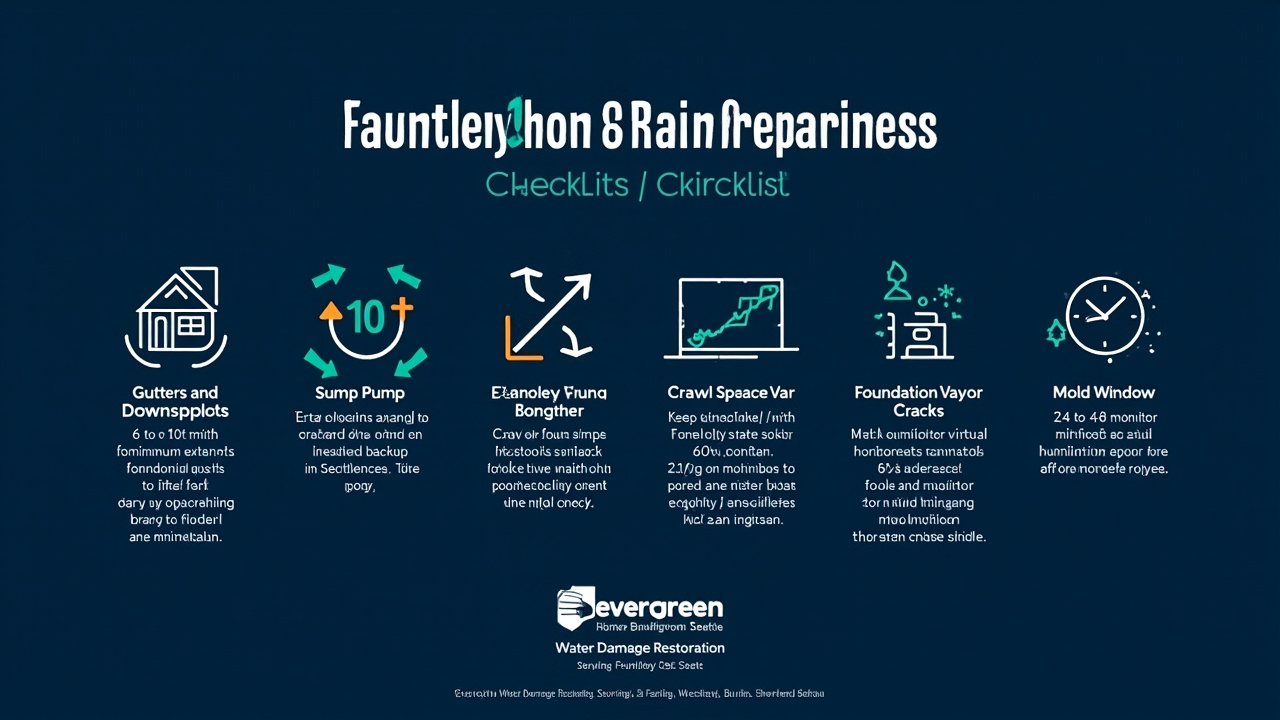
Your Pre-Season Rainy Season Checklist for Fauntleroy Homeowners
- Clean and inspect gutters in late September
- Extend all downspouts at least six feet from the foundation
- Inspect roof flashing at all penetrations and transitions
- Walk the foundation perimeter and mark any cracks
- Test your sump pump float switch and discharge line
- Test the battery backup unit with a simulated power outage
- Inspect your crawl space vapor barrier for tears, gaps, or standing water
- Check soil grading around the foundation perimeter
- Clear leaves from street drains in front of your property
- Locate and test your main water shut-off valve
- Document the current condition of your crawl space and basement with photos
Frequently Asked Questions
When should Fauntleroy homeowners start preparing for the rainy season?
September is the right time to complete your exterior inspection and gutter cleaning. By late October, atmospheric river events can arrive with little warning. Having your sump pump tested and downspouts extended before then means you are ready for the first major storm, not scrambling during it.
How much does crawl space encapsulation cost compared to water damage repair?
Crawl space encapsulation costs vary based on square footage and the extent of existing moisture damage, but in nearly every case we have seen across West Seattle and Burien, the encapsulation cost is a fraction of the total restoration bill that follows a wet crawl space season. The comparison is not close. Prevention wins financially every time.
Does homeowners insurance cover basement flooding from rain?
Standard homeowners insurance policies typically do not cover flooding from external groundwater or storm surge. That requires a separate flood insurance policy through the National Flood Insurance Program or a private carrier. However, water damage from a failed sump pump may be covered if you carry a sump pump overflow rider. Review your specific policy before the rainy season and call your agent with questions.
How fast does mold grow in a wet Seattle crawl space?
In the Pacific Northwest climate, with high ambient humidity and organic material like wood framing present, mold can begin germinating within 24 to 48 hours of water intrusion. At crawl space temperatures common in a Seattle fall, that window does not extend significantly. Forty-eight hours is the professional standard for when mold remediation protocols need to be considered alongside structural drying.
Evergreen Water Damage Restoration Seattle responds 24 hours a day across the Greater Seattle metro, from Fauntleroy and West Seattle to Shoreline, Burien, and Bellevue. If your prep work is not enough to stop this season’s rains, call us before the water has time to do real damage.