

Wallpaper and water are enemies. In a Madrona craftsman, a Queen Anne Victorian, or a mid-century home in Bellevue, the wrong drying approach can trap moisture for weeks, rot the gypsum board underneath, and create ideal conditions for black mold growth. This guide explains the physics behind what is actually happening inside your wall, and what it takes to dry it out without destroying the finish you paid good money for.
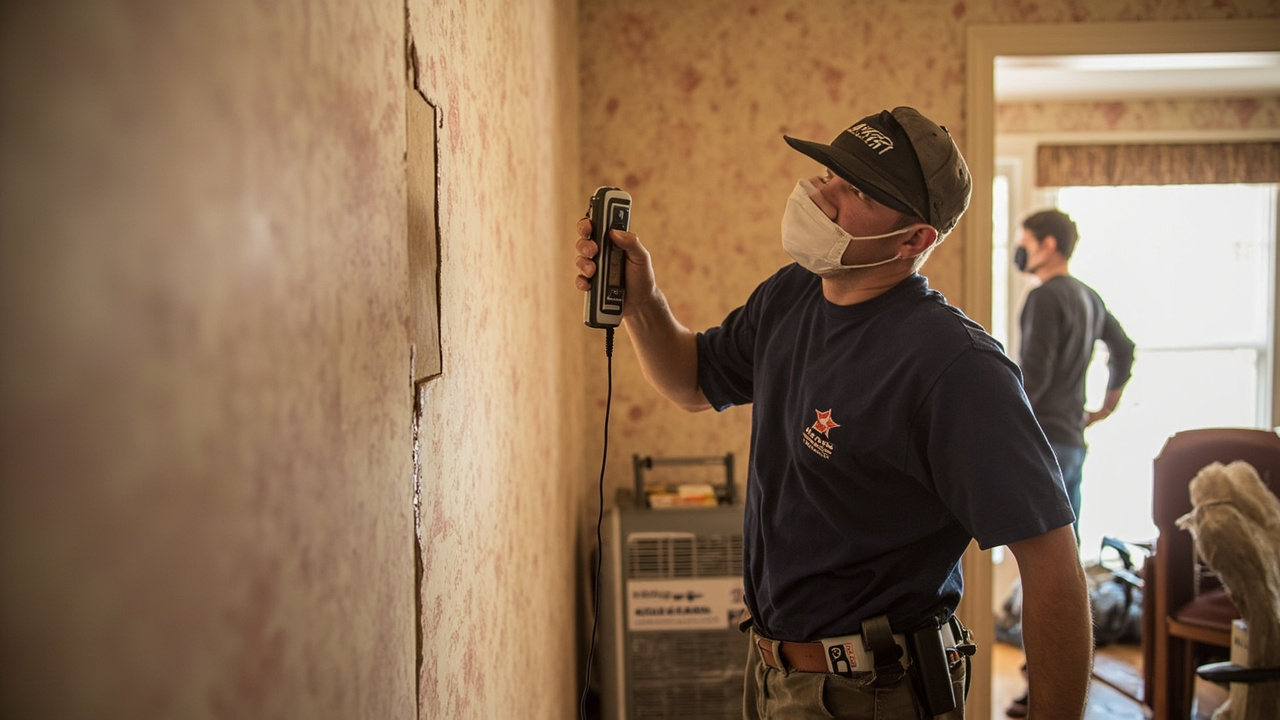
Why Wallpaper Changes Everything About Water Damage
Standard drywall is porous. Moisture can evaporate out through its face fairly quickly when you apply airflow and dehumidification. Wallpaper changes that equation entirely. The key concept here is permeability, measured in units called perms. The higher the perm rating, the more water vapor can pass through a material.
Breathable paper-backed wallpaper typically carries a perm rating between 3 and 10. Vinyl wallpaper, which covers the walls in a large percentage of Seattle-area homes built since the 1980s, often rates at 0.1 perms or lower. At that level, it acts as a vapor barrier. Air movers and dehumidifiers cannot pull moisture through it. The water just sits behind the adhesive, soaking into the gypsum substrate through a process called capillary action, wicking deeper into the board over time.
Seattle’s climate makes this worse. The region averages over 37 inches of annual precipitation, and the outdoor relative humidity during our rainy season routinely exceeds 80 percent. That high ambient moisture slows the natural vapor pressure differential that would otherwise help pull moisture toward the drier side of a wall. If vinyl wallpaper is sealing the face, there is essentially nowhere for the moisture to go.
Identifying Your Wallpaper Type Before You Do Anything Else
Walk up to the wall and look at a seam. Vinyl wallpaper has a plastic-like surface and will not tear cleanly. It tends to peel off in sheets, leaving the paper backing behind on the wall. Paper-backed wallpaper tears more like, well, paper. It is more matte in appearance and feels slightly textured under your fingertips.
You can also do a quick permeability test. Tape a small piece of plastic sheeting to the surface for 24 hours. If moisture condenses on the wall side of the plastic, you likely have a low-perm vinyl product trapping vapor. If the surface feels dry, you may have a more breathable material.
This identification step matters because it determines your entire restoration strategy. Breathable paper wallpaper allows some passive drying. Vinyl wallpaper traps moisture, and drying through it is not possible with standard equipment at practical timelines.
The Science of Moisture Entrapment and Mold Risk
Gypsum board is mostly calcium sulfate, but the paper face is cellulose. The wallpaper adhesive behind most residential wallpaper is also cellulose-based paste. Both are ideal food sources for Stachybotrys chartarum, commonly known as black mold. Under the EPA’s mold remediation guidelines, microbial growth can begin on damp organic materials within 24 to 48 hours, especially when temperatures sit between 60 and 80 degrees Fahrenheit, which describes most Seattle interiors year-round.
Here is the problem with vinyl wallpaper specifically. The surface looks fine. You might not see staining or bubbling for days. Meanwhile, Stachybotrys is colonizing the adhesive layer and the paper face of the drywall behind the covering. By the time you see dark spotting at a seam or smell a musty odor, the contamination is already established. Disturbing that wall surface without proper containment can aerosolize mold spores throughout your living space.
If you have noticed peeling or bubbling wallpaper and you are not sure how long moisture has been present, read through how to tell if your home has hidden mold behind the drywall before proceeding with any drying work.
The Keep or Strip Decision Matrix
This is the question every homeowner asks, and the honest answer depends on four factors. How long was the moisture present? What type of wallpaper is it? What does the moisture meter show at the substrate? And what do your eyes and nose tell you?
| Condition | Wallpaper Type | Moisture Exposure | Recommended Action |
|---|---|---|---|
| Slight dampness, no odor, no staining | Breathable paper (3+ perms) | Under 24 hours | Controlled drying may preserve wallpaper |
| Visible bubbling or lifting at seams | Vinyl (under 1 perm) | Under 48 hours | Strip vinyl to dry substrate, salvage may not be possible |
| Musty odor present | Any type | 48 to 72 hours | Strip, test for mold, remediate before drying |
| Visible dark staining at seams | Any type | Over 72 hours | Full strip, professional mold assessment required |
| Soft drywall when pressed | Any type | Unknown or prolonged | Remove drywall section, structural assessment needed |
Moisture meter readings tell the definitive story on the substrate. Standard gypsum board should read below 1 percent moisture content (MC%). Readings between 1 and 3 percent indicate elevated moisture that requires drying. Anything above 3 percent means saturated drywall, and at that point the board has likely begun to lose structural integrity. A reading above 5 percent in a plaster wall in an older Queen Anne or Ballard craftsman usually means the lath behind it has been wet long enough to begin deteriorating.
If you are dealing with what looks like a slow leak rather than a sudden event, the damage timeline is likely longer than it appears. A slow water heater leak, for instance, can saturate an entire wall section before you notice any surface signs. For that scenario, this article on what a slow water heater leak is really doing to your home outlines how gradual damage compounds over time.
Professional Equipment That Actually Dries Walls
A box fan from the hardware store moves air. It does not dry walls. There is a significant difference, and understanding it prevents homeowners from wasting critical days on ineffective DIY efforts.
Restoration professionals use Low Grain Refrigerant (LGR) dehumidifiers. Standard dehumidifiers stop performing efficiently once the relative humidity in the room drops below around 50 percent. LGR units continue extracting moisture at grain levels down into the 20s, which is what you need when you are trying to pull residual moisture out of a gypsum substrate. In Seattle’s high-humidity environment, a standard dehumidifier is fighting a losing battle against outdoor vapor pressure during rainy season. LGR equipment is not optional here, it is the baseline.
Axial air movers are the second critical tool. These are not fans. They deliver a high-velocity column of air at a specific angle across a surface, creating a laminar boundary layer of dry air against the wall face. This accelerates surface evaporation on breathable materials. On vinyl wallpaper, they are primarily useful for drying exposed substrate after the vinyl has been stripped.
For walls where wallpaper must stay intact, or when drying speed is critical, technicians use drying mats or injection-drying systems that force dry air directly into the wall cavity through small holes drilled at the baseboard. This bypasses the vapor barrier entirely. The holes are typically less than a quarter-inch diameter and are easily patched after drying is complete.
Step-by-Step Structural Drying Process for Wallpapered Walls
- Source Identification and Containment
Stop the water source before anything else. A pipe, a roof penetration, a failed window seal in a Bellevue townhome, a hydrostatic crack in a Fremont basement wall. Drying without stopping the source accomplishes nothing. Document everything with photos for your insurance file.
- Thermal Imaging Assessment
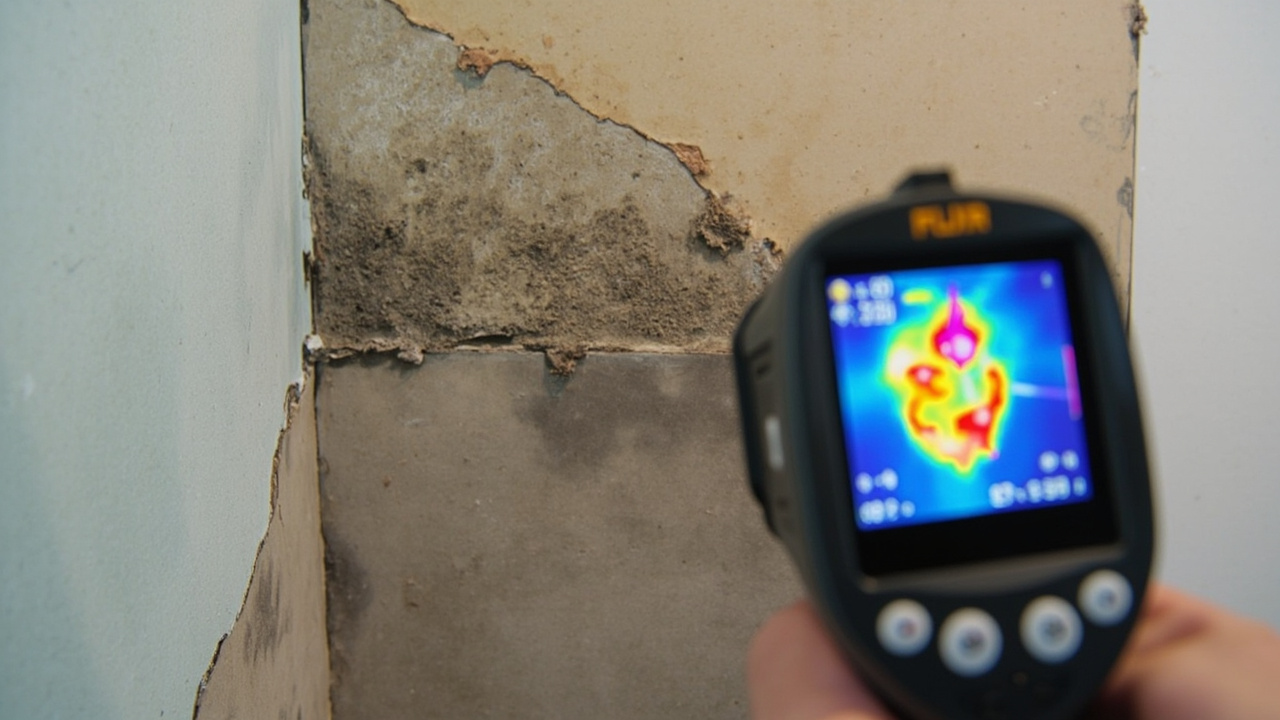
A FLIR thermal imaging camera shows temperature differentials in the wall surface. Wet areas read cooler than dry areas. This non-invasive scan maps the full extent of moisture migration without requiring you to open the wall. It also shows if moisture has wicked upward into ceiling assemblies, which is common in multi-story plumbing stack failures in newer South Lake Union and Capitol Hill townhomes.
- Moisture Meter Baseline Readings
Technicians take pin-type and non-penetrating meter readings across the wall surface on a grid pattern. These baseline numbers establish the drying goal and document conditions for the insurance adjuster. According to IICRC S500 standards, drywall must return to a moisture content comparable to unaffected materials in the same structure before drying is considered complete.
- Wallpaper Type Assessment and Strip Decision
Based on perm ratings, moisture readings, and elapsed time, the technician determines whether the wallpaper can stay or must be removed. Vinyl wallpaper covering a wall with readings above 2 percent MC almost always requires stripping. No amount of airflow through an impermeable surface will resolve that in a reasonable timeframe.
- Equipment Placement and Psychrometric Calculation
Psychrometry is the study of air-water vapor mixtures, and it is how professionals calculate exactly how much dehumidification capacity a given space requires. Technicians measure temperature, relative humidity, and grains per pound of moisture in the air. They then calculate the appropriate number of LGR dehumidifiers and air movers for the room volume and the material saturation levels they recorded.
- Daily Monitoring and Documentation
Moisture readings are taken daily. Equipment is repositioned as drying progresses. This is not a set-it-and-forget-it process. In Seattle’s rainy season, outdoor air infiltration can slow drying significantly if the structure is not well-sealed during the process. Technicians account for this in their psychrometric tracking.
- Final Clearance Testing
Drying is complete when moisture readings across the affected area match the unaffected reference readings taken at the start. This is the documented proof that protects you from future mold claims and satisfies your insurance carrier’s requirement for a complete dry-out.
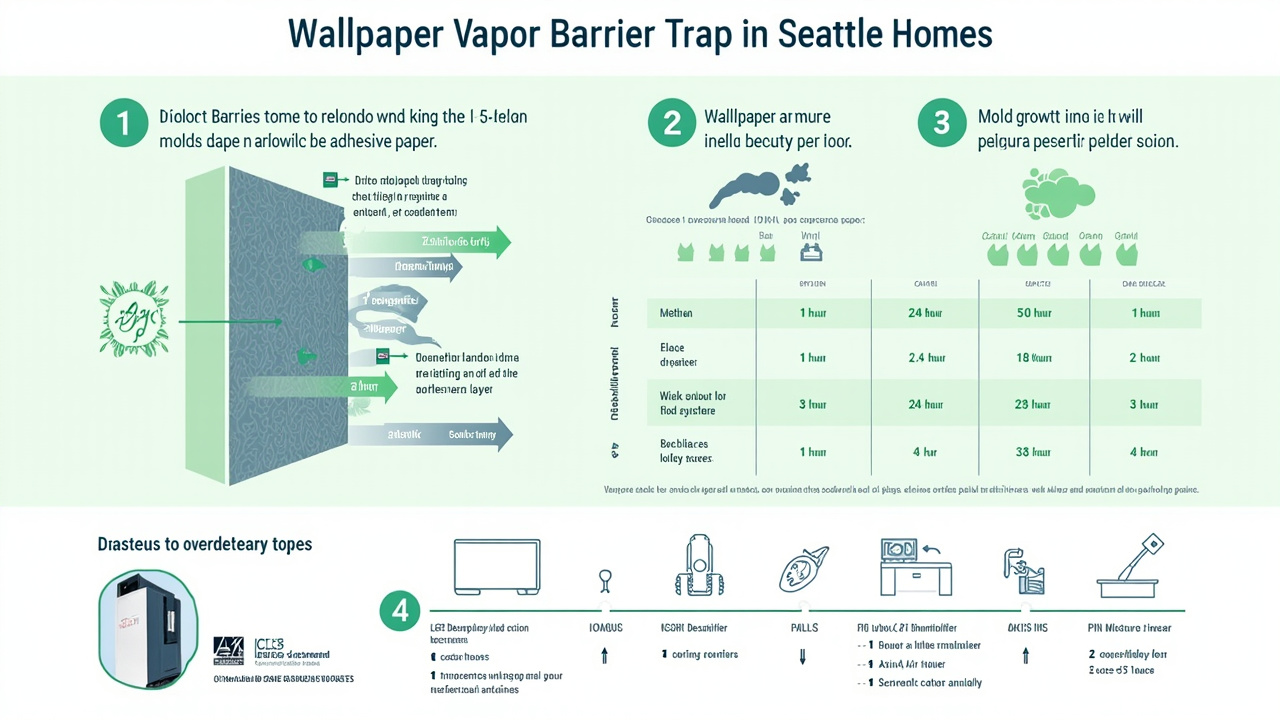
Seattle-Specific Factors That Change Your Drying Timeline
Homes in Madrona, Green Lake, and Wallingford are disproportionately affected by one particular factor that most generic water damage content never addresses. Glacial till and clay-heavy soils throughout much of Seattle’s older residential areas create persistent hydrostatic pressure against foundation walls. Water does not just enter through a failed sump pump. It seeps through the foundation under pressure during extended rain events, then wicks upward into first-floor wall assemblies. The source is underground, and vinyl wallpaper on those lower walls is quietly trapping that moisture for months before anyone notices.
This is also why homes on the steeper slopes of Queen Anne and Magnolia see repeated moisture issues in specific wall sections that face the hillside. The soil drainage never fully resolves, and moisture keeps migrating toward the structure.
King County’s older combined sewer overflow systems create a secondary risk during atmospheric river events. Drain backflow can introduce contaminated water that carries additional biological load into wall cavities. This changes the remediation protocol from Category 1 (clean water) to Category 3 (black water), requiring antimicrobial treatment of all affected surfaces before any restoration work begins.
| Water Category | Common Source in Seattle | Wallpaper Decision | Typical Drying Timeline |
|---|---|---|---|
| Category 1 (Clean) | Burst copper pipe, supply line failure | Preserve if breathable, strip if vinyl and over 48 hrs | 3 to 5 days |
| Category 2 (Gray) | Dishwasher overflow, washing machine drain | Strip strongly recommended | 4 to 7 days |
| Category 3 (Black) | CSO backflow, sewer backup, storm surge | Strip required, antimicrobial treatment mandatory | 7 to 14 days plus remediation |
Timeline also extends significantly in older craftsman-era homes with lath and plaster walls, which are common throughout Ballard, Fremont, and the older sections of Capitol Hill. Plaster does not behave like gypsum board. It takes moisture differently, holds it longer, and requires lower drying thresholds to prevent paint and finish failure on the exterior surface.
Insurance, DIY Drying, and Why the Documentation Matters
Your homeowner’s policy almost certainly covers sudden and accidental water damage. What it does not cover is damage that results from neglect or improper remediation. If you attempt to dry vinyl-wallpapered walls with household fans for a week, then discover mold behind the surface, your insurance carrier may classify the mold damage as the result of inadequate drying rather than the original water event. That reclassification can result in a partial or complete denial of your mold remediation claim.
Professional drying creates a paper trail. Baseline moisture readings, daily monitoring logs, psychrometric data, and final clearance documentation all demonstrate that the property was dried to IICRC S500 standards. That documentation protects your claim. If you are navigating the claims process right now, the steps outlined in how to handle a water damage insurance claim for your home walk through what adjusters look for and how to protect your payout.
One more point on timing. Water damage is not a situation where waiting 24 hours to see if things dry on their own makes sense. The wallpaper research and the mold growth science both point to the same window. After 48 hours of moisture exposure behind a low-perm surface, remediation costs escalate sharply. After 72 hours, you are almost certainly dealing with contamination that requires professional mold protocols, not just drying. Speed matters more than the cost of the initial service call, and that calculation rarely goes the other way. The principle holds whether you are dealing with a flooded kitchen or a damp wall behind decorative paper. Waiting on water damage always makes it worse.
Frequently Asked Questions
Can I use a hairdryer or heat gun to dry the wall behind my wallpaper?
No. Concentrated heat on wallpaper adhesive can cause the paper to delaminate, bubble, and shrink permanently. More importantly, a hairdryer moves warm air across the surface but does not reduce the humidity in the room or extract moisture from the substrate. You are creating surface heat without solving the underlying moisture problem.
How long does professional structural drying take for a wallpapered wall?
For a Category 1 water loss on a breathable wallpaper with readings caught early, three to five days is typical. Vinyl wallpaper that has been stripped and exposed substrate drying runs four to seven days depending on the saturation level and Seattle’s outdoor humidity during the drying window. Category 3 events with required mold remediation run seven to fourteen days or longer.
Will my insurance cover wallpaper replacement after water damage?
Most standard homeowner policies cover wallpaper replacement as part of the restore-to-original-condition coverage when the underlying water event is a covered peril. What they may not cover is wallpaper that was already failing due to gradual moisture exposure. Document the condition of the wallpaper before any work begins, and keep samples of the original material if stripping is required. Your adjuster will need this for the contents and finish estimate.
What does black mold actually look like behind wallpaper?
You usually cannot see Stachybotrys until you strip the wallpaper. What you may notice first is a musty, earthy odor, dark discoloration bleeding through seams, or a spongy texture when you press lightly on the wall surface. If you see or smell any of these signs, do not disturb the wallpaper surface without respiratory protection (N95 minimum) and do not attempt to scrub or dry the area yourself. Call a remediation professional.
Evergreen Water Damage Restoration serves Madrona and the greater Seattle metro, including Bellevue, Queen Anne, Fremont, Capitol Hill, and Ballard, with 24-hour emergency response. If you are looking at bubbling wallpaper or reading moisture on a wall right now, the window for a low-cost resolution is closing. Call for an assessment today.