
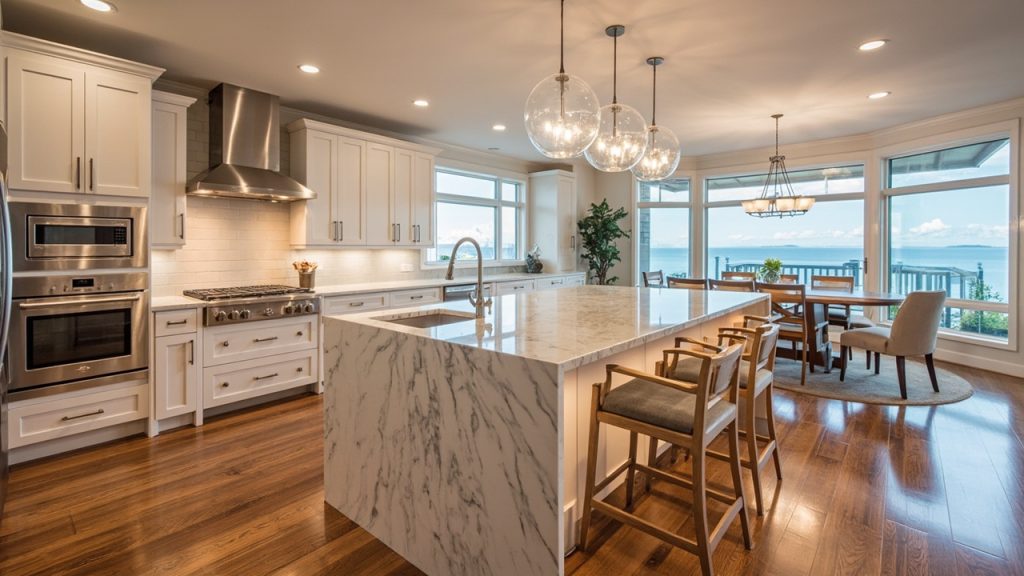
Water does not care how much your kitchen cost to build. A pinhole leak behind a custom Quartzite backsplash or a burst copper pipe beneath radiant-heated White Oak flooring can unravel months of construction work in a matter of hours. For homeowners in Medina, Mercer Island, and Bellevue’s estate corridors, the stakes are measurably higher than in a standard residential water loss.
Standard restoration companies are built to dry drywall and extract carpet. They are not equipped to make decisions about sub-floor desiccant drying beneath 5-inch hand-scraped Walnut planks, or to assess moisture intrusion in a Crestron-integrated home automation panel. That gap in capability is exactly where irreplaceable finishes get destroyed.
This guide covers what separates a white-glove restoration response from a generic one, and what you should demand from any firm you let into a property of this caliber.

Why Seattle’s Climate Puts Luxury Finishes at Unusual Risk
Greater Seattle receives over 37 inches of precipitation annually, and much of it arrives as persistent, low-intensity rain that saturates building envelopes slowly. The real damage in neighborhoods like Queen Anne and Magnolia comes not from dramatic flooding but from cumulative moisture load. Clay-heavy glacial till soils common throughout King County resist drainage, creating hydrostatic pressure against foundation walls. That pressure pushes moisture inward over time.
Medina sits along the western shore of Lake Washington. The water table is shallow. Atmospheric river events, which have grown more frequent and intense in the Pacific Northwest, can overwhelm even well-designed drainage systems on lakefront estates. King County drainage and wastewater management regulations require specific stormwater controls, but no regulation fully eliminates the risk when an atmospheric river drops several inches of rain in 24 hours.
Then there are “Big Freeze” events. Seattle’s aging plumbing stock, including copper supply lines installed decades ago in historic properties on Capitol Hill and the Highlands, is particularly vulnerable. When temperatures drop suddenly, these lines fail without warning. The result is often hundreds of gallons of water released inside a finished space before the homeowner or estate manager is even aware of the event.
High relative humidity in the Seattle region also slows natural evaporation dramatically. A wet sub-floor that might dry in four days in a drier climate can take three weeks here without mechanical drying intervention. That extended window is where mold colonization begins, typically within 48 to 72 hours of the initial saturation event.
The Real Cost of Using the Wrong Restoration Company
The instinct during a water emergency is to call whoever answers the phone first. In a luxury home, that decision has consequences that extend well beyond the immediate dry-out. Consider what is actually at risk.
| Finish or Asset Type | Risk if Improperly Handled | Correct Mitigation Approach |
|---|---|---|
| Imported Exotic Hardwoods (Teak, Sapele, White Oak) | Cupping, buckling, finish delamination, permanent crowning | Sub-floor desiccant drying with moisture mapping; no aggressive heat |
| Natural Stone (Carrara Marble, Quartzite, Onyx) | Grout failure, lippage, efflorescence, staining from cleaning agents | pH-neutral extraction only; controlled drying to prevent thermal shock |
| Custom Millwork and Cabinetry | Face frame warping, veneer delamination, finish clouding | Low-grain refrigerant (LGR) dehumidification; targeted drying chambers |
| Silk and Grasscloth Wall Coverings | Shrinkage, dye bleed, adhesion failure, permanent tide lines | Controlled airflow only; no direct heat; immediate documentation for insurance |
| Integrated Home Automation (Crestron, Lutron, Savant) | Corrosion of low-voltage terminals, firmware corruption, sensor failure | Immediate power isolation; manufacturer-protocol drying; AV specialist involvement |
| Wine Cellar Climate Systems | Temperature fluctuation destroying vintage inventory; mold on cork | Generator backup coordination; separate dehumidification zone management |
Each of these assets requires a technician who understands material science, not just water extraction. The difference between restoration and replacement often comes down to the first four hours of response.
What a White-Glove Water Restoration Response Actually Looks Like
Response time matters. For a water loss in a luxury estate, a qualified team should be on-site within 90 minutes of your call, at any hour. That window is not a marketing claim. It is the difference between saving a custom Sub-Zero refrigerator panel cabinet and ordering a replacement from a European supplier with a 14-week lead time.
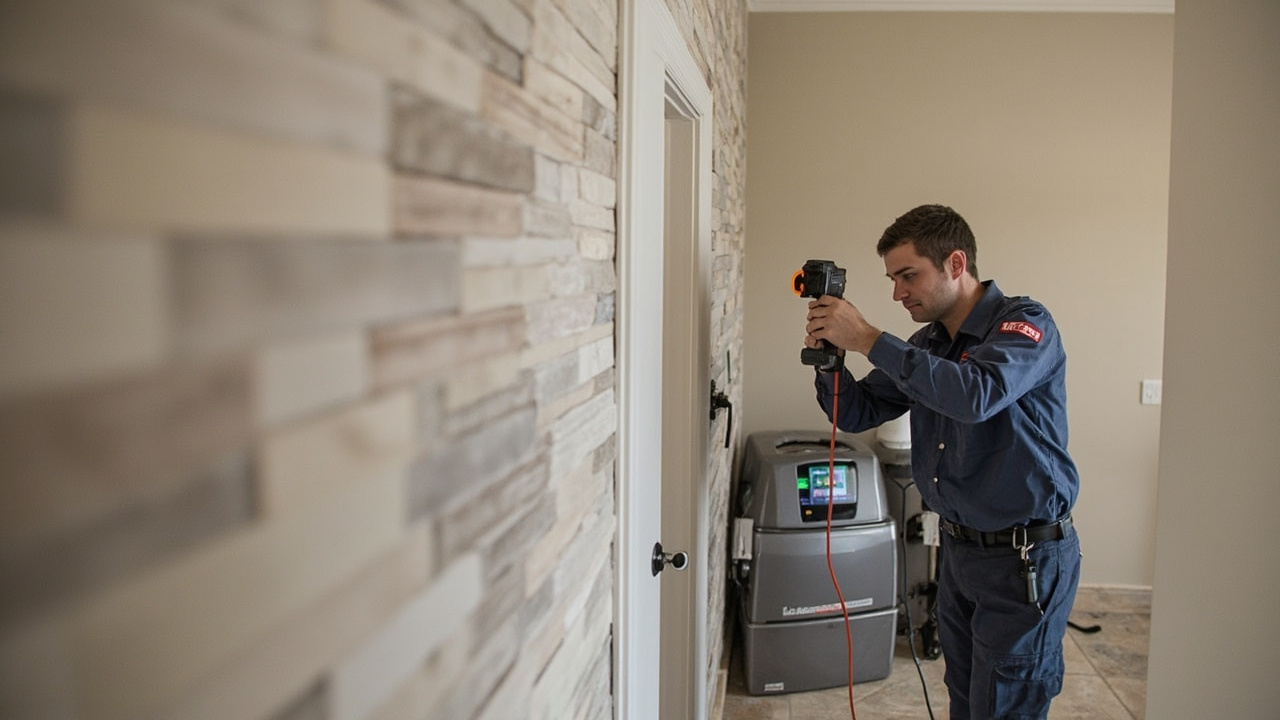
A proper luxury response begins with a full thermal imaging scan of the affected area using FLIR thermal cameras before a single piece of equipment is placed. This non-invasive step reveals hidden moisture pockets behind walls, under stone tile, and inside ceiling cavities without requiring destructive demolition. In a home with $400-per-square-foot custom plaster walls, avoiding unnecessary openings is not optional. It is the standard.
After moisture mapping is complete, the drying strategy is engineered around the specific materials present. This is called applied psychrometry. A technician calculates the vapor pressure differential, the material’s equilibrium moisture content, and the mechanical drying capacity needed to achieve target moisture levels within an acceptable timeframe. This is governed by IICRC S500 Standards, the industry benchmark for professional water damage restoration.
LGR Dehumidification and Desiccant Drying for Luxury Sub-Floors
Conventional dehumidifiers remove moisture efficiently in typical ambient conditions. LGR (Low Grain Refrigerant) dehumidifiers go further. They extract moisture at grain levels that standard equipment cannot reach, which is essential when drying beneath dense hardwood flooring without removing the boards.
For sub-floor saturation under floating or nailed exotic hardwood installations, desiccant drying systems are deployed in tandem. These units use silica-based media to pull moisture even at low temperatures and low relative humidity levels, conditions where refrigerant-based machines lose efficiency. Brands like Phoenix and Dri-Eaz manufacture the commercial-grade equipment used in high-end restoration work.
The goal is to bring structural materials back to their regional equilibrium moisture content, typically between 8 and 13 percent in the Pacific Northwest, without overshooting into conditions that cause wood to check or crack from excessive drying speed.
HEPA Filtration and Air Quality Management
Any water loss that has been present for more than 48 hours introduces mold risk. In Seattle’s persistently humid climate, that window is often shorter. HEPA filtration units run continuously during the drying phase to capture airborne spores and particulates. For occupied estates or those with immunocompromised residents, this step is non-negotiable.
Mold prevention in a Pacific Northwest luxury home is a proactive discipline. The Puget Sound’s average relative humidity sits well above the threshold where mold colonization accelerates. Any restoration process that does not include an air quality management component is incomplete.
If you are concerned about hidden mold growth behind finished surfaces in your home, the process for identification and assessment is detailed in this guide on how to tell if your home has hidden mold behind the drywall.
Discretion and Privacy Protocols for High-Net-Worth Households
This is rarely discussed openly, but it matters. High-profile Medina and Mercer Island residents have reasonable expectations of privacy. A restoration project that sends unmarked vans, uses unmarked equipment, and operates within agreed-upon scheduling windows is not a luxury. It is a professional baseline.
Technician background checks, non-disclosure protocols for estate managers and household staff, and a single point-of-contact project manager are all components of a correctly structured luxury restoration engagement. You should not have to coordinate a rotating cast of subcontractors. One senior project manager should own communication from initial assessment through final clearance testing.
For homeowners who travel frequently or own multiple properties across the region, an estate manager liaison service means decisions are made quickly and accurately without requiring the principal to be present on-site.
Navigating Insurance Claims for High-Limit Luxury Policies
Standard homeowner’s insurance and high-limit private client policies operate on fundamentally different terms. Carriers like Chubb, PURE, and AIG Private Client Group write policies that include replacement cost coverage for custom finishes, fine art riders, and agreed-value provisions for wine collections. But these policies also have specific documentation requirements that must be met from the first hour of a loss.
A restoration firm with luxury experience arrives on-site understanding that every action taken is also evidence for your claim. Photo documentation, moisture reading logs, equipment placement records, and material condition assessments are captured systematically from arrival. This documentation package is what your adjuster needs to authorize coverage for non-standard line items like custom millwork restoration, exotic stone cleaning, or home automation system assessment.
For a deeper look at how to manage the insurance process from the homeowner’s side, the process is outlined thoroughly in this guide on handling a water damage insurance claim for your home.
| Factor | Standard Homeowner Policy | High-Limit Private Client Policy (Chubb, PURE, AIG) |
|---|---|---|
| Coverage for Custom Millwork | Depreciated value, often capped | Full replacement cost with agreed-value provisions |
| Fine Art and Collections | Typically excluded or severely limited | Scheduled rider coverage with no-fault provisions |
| Wine Cellar Inventory | Generally excluded | Separate wine collection rider with market-value settlement |
| Contractor Flexibility | Preferred vendor networks with cost controls | Freedom to choose specialist restorers without network restrictions |
| Adjuster Response Time | Standard queue (48-72 hours) | Dedicated concierge adjuster with same-day or next-day response |
| Documentation Requirements | Basic estimate and photos | Detailed scope of loss, moisture logs, material provenance documentation |
If you have not reviewed your policy’s fine art, wine, or custom finish coverage provisions recently, a water loss is a poor time to discover the gaps. An experienced restoration firm will flag these issues immediately and help you communicate with your adjuster in terms that align with the policy language.
Smart Home System Recovery After a Water Event
Modern Medina and Bellevue estates are deeply integrated with home automation infrastructure. Crestron and Lutron control systems, distributed audio networks, in-ceiling HVAC zoning, and automated lighting panels are all vulnerable to moisture intrusion in ways that are not visually obvious.
Low-voltage wiring corrodes at the terminal level, often producing failures that appear days or weeks after the initial drying event. Any water loss that reaches mechanical or electrical rooms should trigger an immediate power isolation protocol followed by a manufacturer-coordinated drying assessment. Attempting to power-cycle automation hardware before moisture levels are confirmed within safe parameters risks permanent damage to components that carry replacement costs far exceeding the original water damage itself.
A restoration team working in a luxury smart home should have direct communication lines with your AV integrator and home automation installer so that equipment inspections happen in the correct sequence, not as an afterthought after the drying is complete.

The Drying Timeline for High-End Materials
Homeowners often underestimate how long a proper drying cycle takes for dense, layered materials. Rushing the process causes secondary damage that is sometimes worse than the original event. Here is what a realistic timeline looks like for a kitchen or main living area loss in a Medina or Mercer Island estate.
- Hours 1 to 4: Emergency water extraction, thermal imaging moisture mapping, power isolation if needed, documentation for insurance, initial equipment placement.
- Hours 4 to 24: LGR dehumidifiers and desiccant systems operating; HEPA air scrubbers running; first moisture reading baseline established in structural materials.
- Days 2 to 4: Daily moisture readings taken at each monitoring point; equipment adjusted based on psychrometric data; sub-floor cavity readings verified under hardwood.
- Days 4 to 7: Structural materials approaching target moisture content; wall cavity verification; stone tile and grout assessment for secondary moisture retention.
- Days 7 to 14: Final clearance readings; mold risk assessment; documentation package compiled for insurance adjuster; equipment demobilized.
- Days 14 and Beyond: Restoration phase begins, including stone cleaning, millwork touch-up, wall covering assessment, and finish restoration work.
Attempting to compress this timeline by removing equipment early is one of the most common mistakes in luxury home restoration. The visual surface of a material can appear dry while the sub-floor or wall cavity behind it holds moisture well above safe levels. This is exactly the scenario where mold establishes before anyone realizes there is a problem.
For situations where a slow, ongoing leak has been active for an extended period before discovery, the scope of damage is often broader than it appears. The process for understanding what long-term moisture exposure does to a home’s structure is covered in detail in this article on what a slow water heater leak is really doing to your home.
Choosing the Right Restoration Partner for a Property of This Value
Not every IICRC-certified firm is equipped for luxury restoration work. Certification establishes a baseline of technical competency. What separates a capable luxury partner from a standard contractor is the combination of technical training, material-specific experience, and the operational capacity to manage a complex, multi-week engagement at a high-value property.
When evaluating any restoration company for a Medina or Bellevue estate, ask directly about their experience with the specific materials in your home. Ask how they document moisture readings and how that data is formatted for private client insurance adjusters. Ask whether their technicians carry background checks. Ask who your single point of contact will be and what their availability looks like across a two-week engagement.
If you are in the earlier stages of evaluating restoration firms for a property in the region, this overview of how to hire a water restoration company covers the key questions and qualifications to look for.
Evergreen Water Damage Restoration Seattle serves Medina, Mercer Island, Bellevue, Queen Anne, and the broader Greater Seattle metro with 24/7 emergency response. Our teams are built around material-specific drying protocols, non-invasive moisture detection, and structured insurance documentation for high-limit private client policies. If you are managing a water event in a high-value property right now, call us directly for an immediate assessment.
Frequently Asked Questions
Can exotic hardwood floors be saved after a water loss without removing the boards?
In many cases, yes. If the response is fast and LGR dehumidification combined with sub-floor desiccant drying is deployed within the first few hours, hardwood boards can often be dried in place and brought back to their equilibrium moisture content without requiring removal. The key variables are wood species, plank thickness, installation method, and how quickly mechanical drying begins. Boards that have already begun cupping significantly may require selective removal, but this decision should be based on moisture data, not appearance alone.
What makes FLIR thermal imaging necessary in a luxury home water loss?
Thermal imaging reveals temperature differentials in walls, ceilings, and floors that indicate moisture presence without requiring physical access. In a home with custom plaster walls, handmade tile, or integrated cabinetry, opening walls to locate moisture is destructive and expensive. FLIR cameras allow a technician to map the full extent of moisture migration before any demolition decisions are made, which protects finishes and reduces overall restoration scope and cost.
How do private client insurance policies differ when handling a luxury home water claim?
Carriers like Chubb, PURE, and AIG Private Client Group structure policies around replacement cost and agreed value rather than depreciated value. This means custom millwork, imported stone, and high-end finishes are covered at the cost to restore or replace them to their original specification. These policies also typically offer more flexibility in choosing specialty restoration contractors rather than requiring work through a preferred vendor network. Proper documentation from the first hour of the loss is critical to a smooth claim settlement.