
The Real Reason Your Ceiling Is Wet in Victory Heights
Your roof looks intact. No missing shingles, no obvious gaps. But you keep finding damp spots or discoloration on your ceiling. Victory Heights homeowners run into this problem constantly, and the answer almost never starts on the roof. It starts in the attic.. Read more about Finding the Best Emergency Water Restoration Near Roosevelt (And What to Expect).
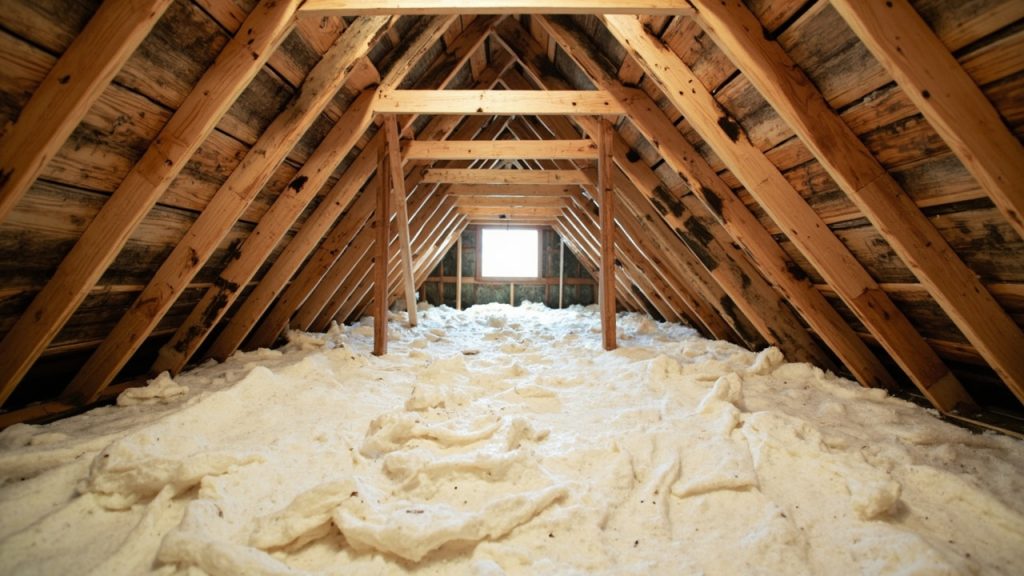
Seattle’s climate creates a specific trap. The city averages over 37 inches of precipitation per year, and the sky stays overcast for months at a stretch. That persistent cloud cover slows natural evaporation, which means moisture that enters your attic has nowhere to go. When warm interior air rises through small gaps in your ceiling, it hits the cold attic sheathing and condenses. That condensation then soaks your insulation, drips onto your ceiling framing, and eventually shows up as a stain or damp patch on the drywall below.. Read more about What to Do When a Skylight Leak Ruins the Ceiling in Your Washington Park Home.
This is not a leak. This is physics. And it is one of the most misdiagnosed moisture problems in King County.

How Seattle’s Climate Stacks the Odds Against Your Attic
Victory Heights sits in a neighborhood built largely on mid-century housing stock. Builders constructed these homes before modern vapor barrier standards existed. Builders left these attics under-ventilated, and the insulation has compressed and settled, with air sealing that remains minimal throughout. That combination creates what building scientists call the stack effect.. Read more about Why Attic Mold in Olympic Hills is Often Caused by Poor Bathroom Venting.
Warm indoor air rises and escapes upward through ceiling penetrations like recessed lights, attic hatches, and plumbing chases. That warm, moisture-laden air enters the cold attic space and deposits its moisture load on every surface it touches. In a Seattle winter, attic air temperatures can drop low enough to push relative humidity in the attic above 80 percent. The EPA confirms that relative humidity above 60 percent creates conditions where mold colonies establish within 24 to 48 hours.
Victory Heights also sits under a dense residential tree canopy that lines streets like 15th Avenue NE and the blocks approaching the neighborhood’s northern edge near NE 105th Street. That canopy keeps north-facing roof surfaces shaded for the majority of daylight hours from October through March. Shaded sheathing dries far more slowly than exposed sheathing, and north-side roof panels in Victory Heights can retain moisture content above the safe threshold for weeks after a rain event that would dry out a fully exposed roof within days.
Homes with crawlspace foundations in Victory Heights also experience more severe stack-effect pressure than the neighborhood’s slab-on-grade homes, because a crawlspace creates an additional cold air reservoir beneath the floor that drives warm indoor air upward more aggressively toward the attic. That difference in stack-effect intensity means two neighboring Victory Heights homes can show dramatically different attic moisture profiles even when their roof assemblies are identical.
Victory Heights occupies ground that drains toward the Lake City drainage basin to the east. That drainage basin sits at a lower elevation than the neighborhood’s western blocks, and the elevation difference creates a consistent dew point gradient across the neighborhood. Attic dew point calculations for homes on the eastern blocks closest to the Lake City Way corridor must account for ambient outdoor relative humidity that runs measurably higher than readings on the western side of the neighborhood, a condition that King County’s updated residential ventilation guidance addresses but that generic ventilation calculators ignore entirely.
That eastern-block moisture load also means the standard 1-to-150 soffit-to-ridge ventilation ratio, while meeting state minimums, may not provide adequate drying capacity for those addresses during peak rainy season. A restoration contractor familiar with Victory Heights geography will factor the drainage basin elevation differential into the ventilation design rather than applying a one-size calculation.
What the Neighboring Neighborhoods Reveal About Victory Heights
Fremont and Wallingford share the same mid-century housing stock as Victory Heights, and moisture mapping in those neighborhoods consistently shows wet zones spreading three to four feet beyond the ceiling stain that prompted the call. That pattern confirms how far condensation-driven moisture travels before anyone notices it from below.
Crown Hill homes to the northwest sit on more exposed lots with fewer mature trees shading north-facing roof surfaces, so those homes dry faster after rain events and accumulate less persistent moisture in the sheathing. Victory Heights homeowners should not benchmark their attic drying expectations against Crown Hill neighbors because the tree canopy fundamentally changes the microclimate for north-facing roof assemblies in this neighborhood.
What Wet Attic Insulation Actually Does to Your Home
Fiberglass batt insulation loses roughly 40 percent of its thermal resistance when wet. That means a properly installed R-38 batt, which falls short of current Washington State Energy Code requirements anyway, might perform at R-23 or lower once moisture saturates the fibers. The Washington State Energy Code currently mandates R-49 to R-60 for attic assemblies in climate zone 4C, which covers Seattle and King County.
When insulation loses its R-value, thermal bridging accelerates. Cold surfaces form inside the assembly. More condensation follows. The cycle feeds itself.
Cellulose insulation absorbs moisture even more aggressively than fiberglass, and once saturated it compresses, which reduces both its depth and its effective R-value. Spray polyurethane foam is the most mold-resistant option because closed-cell foam creates a vapor barrier as part of its structure, preventing moisture from entering the insulation layer at all. Open-cell foam, which some contractors use in attics, is vapor-permeable and can still support mold growth if the attic has poor ventilation.
| Insulation Type | Mold Resistance | Moisture Absorption | PNW Performance |
|---|---|---|---|
| Fiberglass Batt | Moderate | High when faced batts fail | Poor without vapor barrier |
| Blown Cellulose | Low to Moderate | Very High | Poor in damp attics |
| Open-Cell Spray Foam | Moderate | Moderate | Acceptable with proper venting |
| Closed-Cell Spray Foam | High | Very Low | Best option for PNW conditions |

What Mold Grows in Seattle Attics and Why It Matters
The most common attic molds in King County homes are Cladosporium and Penicillium/Aspergillus species. These thrive in the 55 to 70 degree Fahrenheit range that Seattle attics maintain for much of the year. Cladosporium appears as dark green or black clusters on roof sheathing and produces mycotoxins that cause respiratory irritation even at low spore counts.
Stachybotrys chartarum, which most people call black mold, needs a sustained high-moisture source like an active roof leak or chronic condensation. Victory Heights homes with older felt underlayment and inadequate ridge venting can develop Stachybotrys colonies on the north-facing roof sheathing, where the neighborhood’s tree canopy prevents direct sunlight from reaching and drying the wood.
Wood-decay fungi are a separate but equally serious concern. Unlike mold, which grows on surfaces, wood-decay fungi digest the cellulose and lignin in your rafters and sheathing. Wood-decay fungi compromise rafter integrity and can strip 80 percent of structural strength before any visible surface change appears.
If you want to understand what hidden mold behind finished surfaces looks like in another context, our guide on how to tell if your Columbia City home has hidden mold behind the drywall covers the diagnostic process in detail.
Signs Your Attic Insulation Has a Moisture Problem
- Ceiling stains that appear in cold weather but dry out in summer without any apparent leak source
- A musty smell that intensifies near the attic hatch or upper-floor hallways
- Compressed or matted insulation visible through the attic hatch
- Dark staining on roof sheathing boards, especially on the north side of the roof peak
- Frost on the underside of the roof deck during winter mornings
- Peeling paint or bubbling drywall tape on upper-floor ceilings
- Elevated indoor humidity readings above 55 percent during rainy season
Why Attic Mold Remediation Requires Professional Equipment
Disturbing mold colonies without containment releases millions of spores into the air. Those spores travel through your HVAC system, settle on furniture, and colonize new areas within hours. The IICRC S520 Standard for Professional Mold Remediation establishes the baseline protocol that qualified contractors follow. The S520 requires negative air pressure containment, personal protective equipment at a minimum of an N95 respirator and Tyvek suit, and HEPA air scrubbing throughout the work zone.
HEPA vacuums capture particles down to 0.3 microns. Mold spores range from 1 to 100 microns, so a standard shop vacuum will not capture them. It will blow them into the rest of your attic space. Antimicrobial encapsulation products applied after mechanical removal seal any residual fungal material in the wood grain of the sheathing, preventing regrowth without requiring full sheathing replacement in many cases.
A technician performing professional attic mold remediation sets up poly sheeting barriers at the attic hatch, runs a HEPA air scrubber to create negative pressure, mechanically removes all contaminated insulation into sealed bags, HEPA vacuums all framing surfaces, treats affected wood with an EPA-registered antimicrobial solution, and only then installs new insulation that meets current R-value code minimums.
- Complete a Moisture Assessment with Thermal Imaging
A certified technician uses a thermal imaging camera and calibrated moisture meter to map all wet zones across the attic floor, insulation, and sheathing. This step identifies secondary moisture pathways that thermal contrast makes visible where no surface discoloration yet exists.
- Set Up Containment Before Touching Any Mold
The crew seals the attic hatch with poly sheeting and tape, establishes a decontamination zone, and positions a HEPA air scrubber to draw air from the work zone outward through a duct that exits through a window or roof vent.
- Remove All Contaminated Insulation Down to the Joists
All contaminated insulation goes into double-bagged, labeled waste bags for disposal in compliance with King County solid waste regulations. The crew removes everything down to the ceiling joists so no contaminated material remains.
- HEPA Vacuum Every Surface and Apply Antimicrobial Treatment
Technicians HEPA vacuum all joist and rafter surfaces, then apply an EPA-registered antimicrobial solution to all affected wood. Encapsulation coating follows in areas where staining persists in the wood grain.
- Install Ventilation Baffles in Every Rafter Bay
The crew installs ventilation baffles between each rafter bay to maintain a clear airflow channel from the soffit vents to the ridge vent. Baffles prevent new insulation from blocking soffit intake points, which is the most common cause of recurring attic mold in Seattle homes.
- Install New Insulation to Washington State Code Minimums
New insulation installs to a minimum of R-49, per Washington State Energy Code requirements for zone 4C. The technician verifies depth at multiple points with a depth ruler and documents the final R-value for the homeowner’s records.

What Proper Attic Ventilation Looks Like in a Victory Heights Home
The building science standard calls for one square foot of net free ventilation area per 150 square feet of attic floor space, split evenly between soffit intake and ridge exhaust. Most Victory Heights homes fall well short of this ratio. Paint layers have sealed the original soffit vents shut over successive renovation cycles, insulation has migrated forward to block the remaining openings, and undersized vent cutouts mean the attic never reaches the minimum free area the standard requires even when the vents themselves stay clear.
Baffle installation is the fix that restoration contractors perform alongside new insulation. A baffle is a rigid channel that runs from the soffit vent opening up to the ridge, maintaining an air gap between the insulation surface and the roof deck. Without baffles, blown insulation piles up against the soffit and blocks intake airflow entirely. No intake airflow means the ridge vent cannot function, and moisture accumulates at the cold roof deck surface.
Victory Heights drains toward the Lake City Way corridor to the east, and the low-lying ground along that drainage basin sustains consistently elevated ambient moisture levels that push into the neighborhood during heavy rain events. Homes on the eastern blocks of Victory Heights closest to that corridor show persistently higher outdoor relative humidity readings than homes on the western side of the neighborhood, and that ambient moisture load makes balanced soffit-to-ridge ventilation even more critical for those addresses. King County’s residential mechanical code requires ventilation calculations to use local climate data rather than statewide averages, and a contractor who applies a generic Seattle-wide dew point figure to an eastern Victory Heights address will undersize the ventilation system for that specific site condition.
The IICRC publishes the standards that govern professional remediation work, including moisture control requirements that align directly with Washington State building code expectations for attic assemblies.
| Ventilation Problem | Symptom | Recommended Fix |
|---|---|---|
| Blocked soffit vents | Frost on north-facing sheathing | Clear obstructions, install baffles |
| No ridge vent | Hot spots in summer, condensation in winter | Install continuous ridge vent |
| Insulation over soffit | Uniform moisture across sheathing | Remove and re-install with baffles |
| Insufficient vent ratio | Persistent high attic humidity | Add intake area per 1-to-150 ratio |
| Unbalanced intake vs. exhaust | Negative pressure pulling moist indoor air in | Balance soffit and ridge areas |
How Insurance Claims Work for Attic Mold in Seattle
Washington State homeowners insurance policies draw a hard line between sudden water damage and ongoing maintenance failures. A roof leak caused by an atmospheric river event, a tree limb puncturing the deck during a windstorm, or a flashing failure from a single storm event typically qualifies as a covered sudden loss. Mold that developed over months from chronic condensation due to poor ventilation typically does not qualify.. Read more about Fixing Water Damaged Drywall and Plaster in Your Historic Ravenna Bungalow.
The documentation your restoration company produces during moisture mapping and thermal imaging is critical. When a certified water damage restoration company generates a moisture report showing that the insulation failure followed a specific intrusion event rather than years of neglect, adjusters have a clear record to process the claim. Without that documentation, the insurance company treats the damage as a maintenance issue and denies the claim.
Our team walks homeowners through the claim process from the initial moisture assessment through the final documentation submission. If you want a broader picture of how water damage insurance claims work in this region, our article on how to handle a water damage insurance claim for your home in Beacon Hill covers the key steps that affect payout outcomes.
The Professional Moisture Mapping Process Explained
Moisture mapping combines two instruments. A thermal imaging camera shows temperature differentials across surfaces. Wet materials hold heat differently than dry materials, so wet insulation or wet sheathing appears as a distinct color zone on the thermal image. A calibrated pin or pinless moisture meter then gives the technician a numerical moisture content reading at each flagged location.
Together, these two tools create a map of the entire moisture load in the attic. The map tells the restoration team which areas need full insulation removal, which areas need antimicrobial treatment only, and which structural members may need replacement rather than remediation. Skipping this step means guessing, and guessing means either leaving mold behind or removing and replacing material that was still structurally sound.
For eastern Victory Heights addresses specifically, technicians factor the Lake City drainage basin elevation differential into the moisture map interpretation. An attic moisture reading that would indicate a borderline-safe condition for a home on the neighborhood’s western edge may indicate an active problem for a home on the eastern blocks, because the higher ambient outdoor humidity at those addresses slows evaporative drying and means the wood requires longer to return to safe moisture content on its own.
When a Slow Leak Is the Root Cause
Sometimes condensation is not the culprit. A slow drip from a deteriorated boot seal around a plumbing vent pipe, a cracked ridge cap, or failed step flashing at a dormer can introduce liquid water that soaks insulation over weeks before anyone notices a ceiling stain. The drip rate may be low enough that the roof deck never shows obvious exterior damage, but the insulation underneath absorbs water continuously.
A slow leak like this differs from condensation in one key way. Moisture readings cluster tightly around the penetration point rather than spreading broadly across the sheathing. Thermal imaging makes this distinction clear within minutes of starting the assessment.
Slow leaks share the same gradual damage profile as a slow water heater leak. If you have had any water source dripping undetected in your home, the guide on what a slow water heater leak in your Magnolia basement is really doing to your home explains how hidden moisture builds structural damage over time.
Frequently Asked Questions
Does attic mold always cause a smell inside the living space?
Mold in a well-sealed attic can grow to a large colony size before any odor reaches the living space. Odor enters the living area only when the colony grows large enough to push spore-laden air through ceiling gaps, or when an HVAC system draws attic air into the ductwork. Many Victory Heights homeowners discover attic mold during a visual inspection rather than from an odor. A musty smell near the attic hatch is a strong indicator, but the absence of smell does not rule out mold growth. Homes on the eastern blocks near the Lake City drainage basin corridor face higher ambient moisture pressure, which means mold colonies in those attics reach the odor-threshold size faster than comparable colonies in lower-ambient-humidity attics on the western side of the neighborhood.
How long does professional attic mold remediation take?
A single-family home in Victory Heights with moderate attic mold typically takes one to two days for the remediation phase. Re-insulation to current code requires an additional half to full day depending on attic access and square footage. Homes with structural wood damage or full sheathing replacement may take longer. Your restoration contractor gives you a specific timeline after completing the moisture assessment.
Can I install a vapor barrier myself to fix the condensation problem?
Installing a vapor barrier without first removing existing mold-contaminated insulation traps active mold colonies beneath the barrier and accelerates structural damage. Vapor barrier installation in an attic assembly also requires placement at a specific location within the assembly to function correctly. King County building permits require inspection of insulation work that changes the vapor control layer in an assembly, and the Seattle Department of Construction and Inspections enforces those permit requirements separately from state minimums, meaning a contractor must pull a local permit rather than relying on state code compliance alone. A certified restoration contractor handles both the remediation and the permitted re-insulation.
Get a Moisture Assessment Before the Damage Goes Deeper
Wet insulation and attic mold rarely improve on their own in a Seattle climate. The rainy season runs long, the cloud cover keeps attic temperatures low, and each passing week gives existing mold colonies more surface area to colonize.
Evergreen Water Damage Restoration Seattle provides certified attic moisture assessments, IICRC S520-compliant mold remediation, and full re-insulation to current Washington State Energy Code standards for Victory Heights homeowners and throughout King County. Every week of inaction adds insulation replacement square footage and structural remediation scope. Call Evergreen Water Damage Restoration Seattle and have a certified technician at your Victory Heights home within hours.