
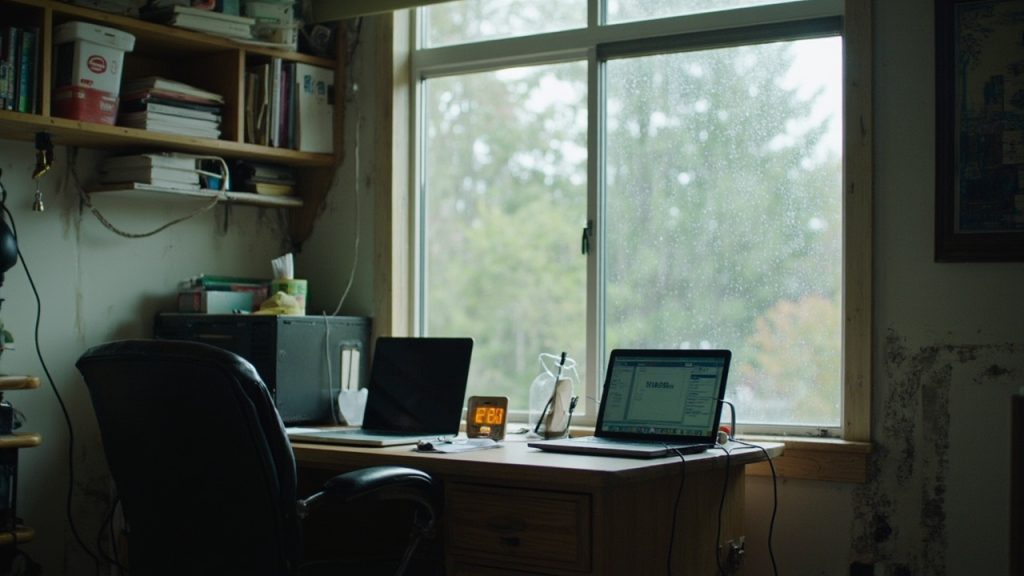
Seattle’s Humidity Problem Is Sitting Right Inside Your Home Office
If you work from home in South Park, Beacon Hill, or anywhere across the Seattle metro, your biggest equipment threat probably isn’t a power surge. It’s the air around your desk. Seattle’s marine climate pushes outdoor relative humidity (RH) above 80% for months at a stretch, and that moisture finds its way inside every building, especially older homes without central air conditioning.
Electronics, paper documents, ergonomic furniture, and even the wall framing behind your monitor are all sensitive to sustained moisture exposure. Understanding what’s happening and how to stop it can save you thousands of dollars in equipment replacements and a far larger bill if mold takes hold.
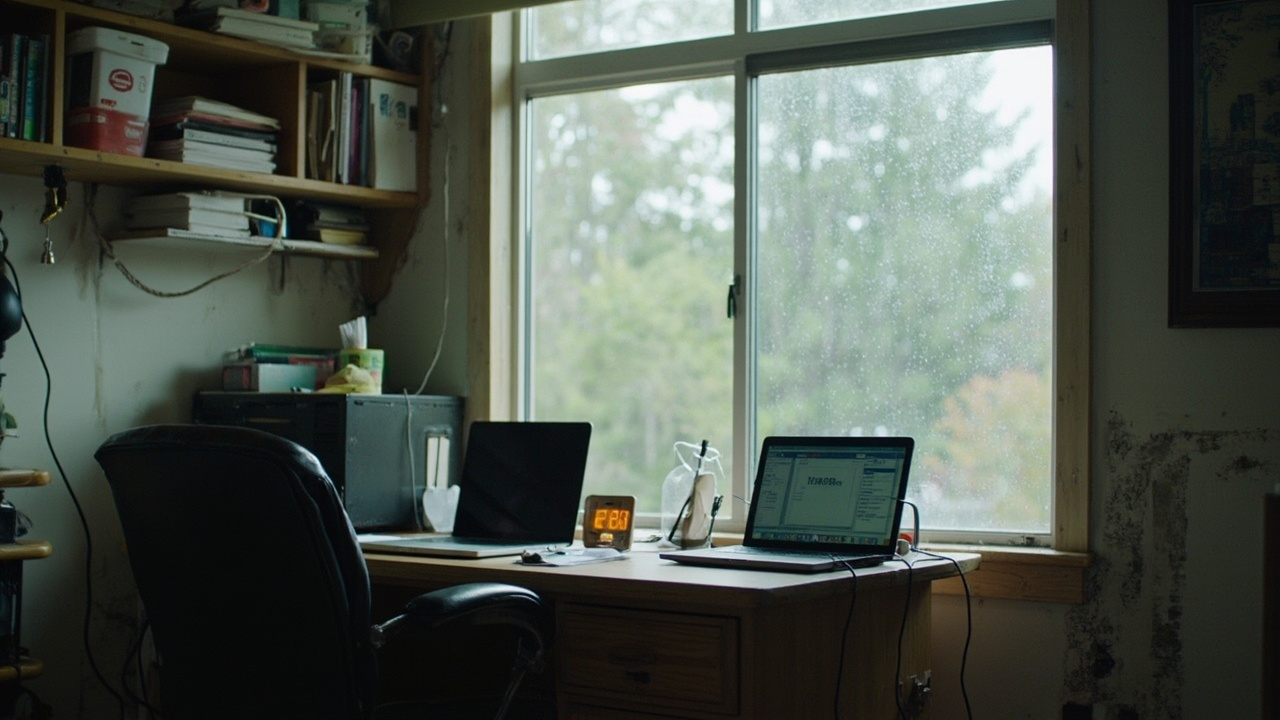
What Relative Humidity Actually Means for Your Home Office
Relative humidity is the percentage of water vapor in the air compared to the maximum it can hold at a given temperature. When RH climbs above 60% consistently, materials absorb moisture. When it drops below 30%, static electricity builds up and wood dries and cracks. The sweet spot for a home workspace is 30% to 50% RH.
Seattle’s ambient outdoor RH sits between 70% and 90% during fall and winter. That gap between outdoor and indoor conditions is your problem. Without active moisture control, your home office gravitates toward outdoor conditions, especially in rooms with poor ventilation or limited sun exposure.
Psychrometrics and Dew Point — What Homeowners Need to Know
Psychrometrics is the science of air and water vapor mixtures. One concept from this field that matters directly for your workspace is the dew point. The dew point is the temperature at which air becomes saturated and moisture condenses on surfaces. In Seattle winters, outdoor dew points frequently sit in the 40°F to 50°F range.
When warm air from your heated office contacts a cold surface, like a single-pane window or an exterior wall in a Craftsman bungalow with minimal insulation, condensation forms. That moisture then wicks into wood, drywall, and any electronics sitting nearby. This is called thermal bridging, and it’s extremely common in Seattle’s older residential stock.
According to the U.S. Environmental Protection Agency’s mold guidance, keeping indoor RH below 60% is the primary defense against mold colonization. The IICRC (Institute of Inspection Cleaning and Restoration Certification) sets the professional remediation threshold even lower, recommending sustained levels below 50% for occupied living spaces.
Why Your Electronics Are at Risk Right Now
Modern electronics generate heat during operation, which creates micro-convection currents that pull ambient air across circuit boards, hard drives, and capacitors. In a high-humidity environment, that means drawing moist air directly across sensitive components.
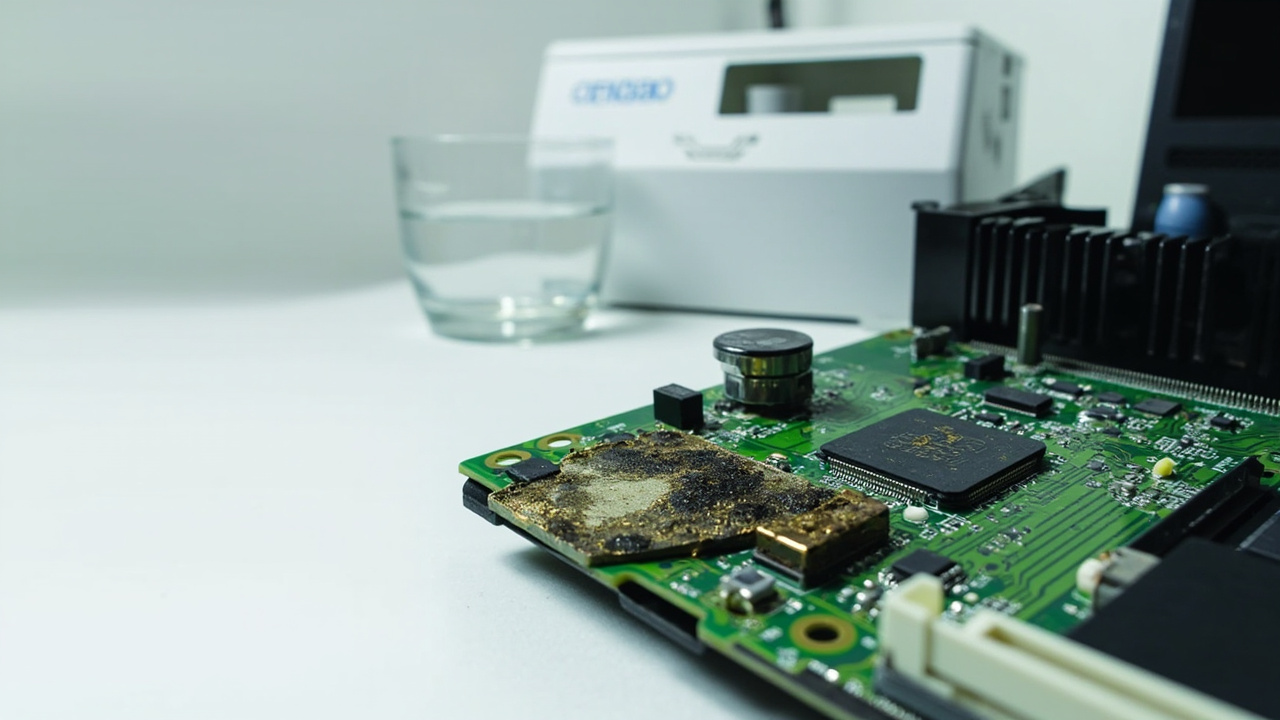
Here’s what happens at the component level. Moisture promotes electrochemical migration, where metal ions from copper traces on circuit boards dissolve into condensed water and deposit on neighboring traces. This creates short circuits. It also accelerates corrosion on connector pins, USB ports, and power jacks. A laptop running in 70%+ RH conditions will fail far sooner than the same machine running in a 45% RH environment.
Paper Documents Are Even More Vulnerable
If you store contracts, client files, tax records, or personal documents in your home office, humidity is silently degrading them. Paper absorbs moisture and swells, causing ink to bleed and pages to cockle. Sustained high RH creates ideal conditions for foxing, the brown spotting caused by mold on paper. Once foxing sets in, document recovery requires professional intervention.
Evergreen Water Damage Restoration Seattle handles professional document drying for exactly this scenario, including records for legal firms and medical offices where irreplaceable files are at stake. If your filing cabinet sits in a basement office with no dehumidification, this isn’t a hypothetical risk.
Signs That Humidity Is Already Damaging Your South Park Workspace
These are the physical indicators that moisture levels in your home office have exceeded safe thresholds.
- Condensation forming on the interior surface of windows, especially single-pane or older double-pane units
- A musty or earthy odor that’s most noticeable when you first enter the room in the morning
- Peeling wallpaper or paint bubbling along exterior walls or around window frames
- Warping or swelling of wood desk surfaces, shelving, or laminate flooring
- Increased allergy symptoms, nasal congestion, or respiratory irritation during work hours
- Keyboard keys that feel sticky or have lost tactile response
- Rust forming on metal file cabinet rails or desk hardware
Window condensation is the most reliable early warning sign in Seattle homes. If you see fog or water droplets on the interior glass during morning work hours, your indoor RH is almost certainly above 60%. That’s above the mold growth threshold. You can learn more about what long-term moisture exposure does to wall systems in our guide on how to tell if your home has hidden mold behind the drywall.
Seattle’s Seasonal Humidity Patterns and Your Home Office Calendar
| Season | Typical Outdoor RH | Primary Risk | Recommended Action |
|---|---|---|---|
| October to February (Big Dark) | 80% to 92% | Condensation, mold spore activation, document damage | Run dehumidifier daily, check hygrometer readings morning and evening |
| March to May (Shoulder Season) | 65% to 78% | Residual moisture in walls drying unevenly, wood swelling | Increase ventilation, open windows during dry afternoon hours |
| June to August (Dry Season) | 45% to 62% | Static electricity buildup at lower end, sudden RH spikes during marine pushes | Monitor and maintain 40% to 50%, no dehumidifier typically needed |
| September (Transition) | 58% to 75% | Rapid RH increase as temperatures drop, catching homeowners off-guard | Restart dehumidification protocol, inspect for new condensation points |
The period from October through February is what locals call the Big Dark, and it’s the most dangerous stretch for home office moisture management. Seattle averages over 37 inches of annual precipitation, with the bulk falling during these months. Homes in South Park, White Center, and Burien that sit on clay-heavy soils also face hydrostatic pressure from saturated ground pushing moisture through foundation walls and crawlspaces.
Converted Spaces Carry Extra Risk
A significant portion of Seattle’s remote workforce converted a basement, attic, or garage into a home office over the past few years. These spaces present moisture challenges that a standard bedroom or living room does not.
Basement offices sit below grade, where soil moisture migrates through concrete slabs and block walls. Without a proper vapor barrier installed per Washington State Energy Code requirements, a basement office can maintain 75% to 85% RH even with a dehumidifier running. If you’re working in a finished basement and haven’t confirmed there’s a continuous vapor barrier beneath the slab and on the exterior face of the foundation, you’re fighting moisture without addressing the source.
Attic conversions face a different problem. Heat rises and creates stack effect pressure that pulls humid air from lower floors upward. Attic spaces also have significant temperature swings between day and night, meaning dew point thresholds get crossed repeatedly. That’s thermal bridging at its most damaging.
For Magnolia homeowners dealing with moisture in below-grade spaces, the connection between slow leaks and structural damage is direct. Read more about what a slow water heater leak in your Magnolia basement is really doing to your home.
How to Control Humidity in Your Home Office (Practical Steps)
- Get a Hygrometer First
Buy a digital hygrometer and place it at desk level, not near windows or vents. You need an accurate reading of the air your electronics are actually breathing. Aim to check it morning and evening for the first week to understand your baseline.
- Choose the Right Dehumidifier for Your Room Size
Match the dehumidifier capacity (measured in pints per day) to your room’s square footage and conditions. A 30-pint unit works for a small office under 500 square feet with moderate humidity. A 50-pint or 70-pint unit is necessary for a basement office or any space above 700 square feet with persistent condensation.
- Position Electronics Away from Exterior Walls
Exterior walls in Seattle’s older Craftsman and mid-century homes are thermal bridges. Moving your workstation even 12 inches away from an exterior wall reduces direct condensation exposure significantly.
- Seal Crawlspace and Foundation Moisture Sources
For basement offices, install or confirm a 6-mil polyethylene vapor barrier on exposed soil in the crawlspace. This is required under Washington State Energy Code and dramatically reduces ground moisture migration into living spaces above.
- Improve Mechanical Ventilation
Older Seattle homes without central AC rely on natural ventilation, which becomes a liability in winter. An energy recovery ventilator (ERV) exchanges stale, moist indoor air with drier outdoor air while retaining heat. This is the most effective single upgrade for a closed home office with persistent humidity issues.
- Monitor and Adjust Seasonally
Set a calendar reminder each September to restart your humidity management protocol. Catching the seasonal shift early prevents the moisture accumulation that compounds through the Big Dark.
Desiccant vs. Refrigerant Dehumidifiers — Which One Works in Seattle
| Feature | Refrigerant (Compressor) Dehumidifier | Desiccant Dehumidifier |
|---|---|---|
| Best Operating Temperature | 65°F and above | 40°F to 70°F |
| Effectiveness in Seattle Winters | Moderate (loses efficiency below 60°F) | High (works well in cool, damp conditions) |
| Energy Consumption | Lower in warm conditions | Higher but consistent year-round |
| Noise Level | Moderate (compressor cycles on and off) | Low (no compressor, quieter for video calls) |
| Best For | Heated basement offices, summer use | Unheated garages, attics, cooler spaces |
| Maintenance | Clean coils seasonally, empty reservoir or drain continuously | Replace or regenerate desiccant element periodically |
For most South Park and Capitol Hill home offices that maintain room temperature around 68°F to 72°F year-round, a refrigerant dehumidifier is sufficient. For garage conversions, attics, or any space that drops below 60°F during winter, a desiccant unit outperforms refrigerant-based models significantly because the cooling coils in refrigerant units frost over at low temperatures and stop removing moisture entirely.
The ASHRAE Fundamentals Handbook provides the technical baseline for indoor environmental quality standards that IICRC-certified professionals use when assessing moisture conditions in residential and commercial spaces. It’s worth understanding that ASHRAE’s recommended comfort range aligns exactly with the 30% to 50% RH target for your workspace.
The Cost of Waiting — When Humidity Becomes a Restoration Emergency
Here’s where humidity control stops being a comfort issue and becomes a financial one. Mold requires four conditions to grow on surfaces: organic material, moisture, warmth, and time. In a Seattle home office with RH above 60%, three of those four conditions exist constantly. All mold needs is 24 to 48 hours of sustained surface moisture to establish a colony.
Black mold, Stachybotrys chartarum, is the species most associated with chronic water damage in Pacific Northwest homes. It grows on cellulose-rich materials including drywall paper, wood studs, and cardboard file boxes. Once established, it requires professional mold remediation, which involves containment, HEPA filtration, removal of affected materials, and antimicrobial treatment. This is not a DIY project.
Compare that investment to the cost of a quality dehumidifier and a digital hygrometer. Preventing the problem is dramatically more cost-effective than addressing it after mold has colonized your home office walls.
If you’re concerned about waiting too long to address moisture issues in any part of your home, the principle applies broadly. Our article on why waiting to dry out after water intrusion makes everything worse explains the progression of damage in concrete terms.
Indoor Plants Are Not Helping (In a High-Humidity Office)
Many home office setups include houseplants for aesthetics and air quality. In a dry climate, plants can add beneficial moisture. In Seattle, they add moisture to an already moisture-saturated environment. Each plant releases water vapor through transpiration continuously. A cluster of six to eight medium plants in a 200-square-foot office can add meaningful RH points to the ambient air.
If your hygrometer consistently reads above 55% RH and you have plants in the room, moving them to a drier part of the house during fall and winter is a simple and free moisture reduction step.
When to Call a Professional for Your Seattle Home Office
You’ve crossed from DIY humidity control into restoration territory if any of the following are true.
- You see visible mold growth on walls, ceiling tiles, or furniture surfaces
- A musty odor persists even after running a dehumidifier for two or more weeks
- Your hygrometer reads above 65% RH consistently despite mechanical dehumidification
- Paint or wallpaper is actively peeling or bubbling on multiple walls
- You’ve identified a prior or ongoing water intrusion source (roof leak, plumbing drip, crawlspace flooding)
- Multiple household members are experiencing respiratory symptoms that improve when they leave the house
These signs indicate that surface-level humidity management won’t resolve the underlying moisture source. A certified restoration professional can perform moisture mapping using thermal imaging and moisture meters to locate exactly where water is entering or accumulating in the building structure.
If you’re navigating an insurance claim related to water intrusion or mold damage in your home office, understanding the claim process early matters. Our guide on how to handle a water damage insurance claim in Beacon Hill covers the documentation and process steps that help homeowners get fair coverage.
Evergreen Water Damage Restoration Seattle operates 24 hours a day across the greater Seattle metro, from Ballard and Fremont to Bellevue and Renton. If your home office moisture problem has moved beyond what a dehumidifier can handle, contact us for a professional assessment. We identify the source, quantify the damage, and restore the space to a safe and functional condition.
Frequently Asked Questions
What humidity level is safe for a home office with electronics?
Keep your home office between 40% and 50% relative humidity for optimal electronics performance and personal comfort. Below 30% increases static electricity risk. Above 60% creates conditions where condensation forms on components and mold growth becomes probable within 24 to 48 hours.
How do I know if my home office has a mold problem from humidity?
The clearest indicators are a persistent musty smell, visible dark spotting on walls or ceiling, and allergy or respiratory symptoms that improve when you work outside the room. A professional moisture assessment using thermal imaging can identify mold behind walls before it becomes visible.
Do I need a dehumidifier if I run a heating system in my home office?
Yes. Heating air raises its temperature but does not remove moisture. Warm air at 70% RH and 70°F still carries enough water vapor to cause condensation on cooler surfaces and sustain mold growth. A dehumidifier actively removes water from the air, which heating cannot do.
Can Seattle’s humidity damage electronics that are turned off?
Yes. Powered-off electronics are not generating heat, which means they equilibrate to room temperature faster and become more susceptible to condensation. If your office cools overnight and RH rises, moisture can form on circuit boards inside sleeping laptops, monitors, and external drives.