
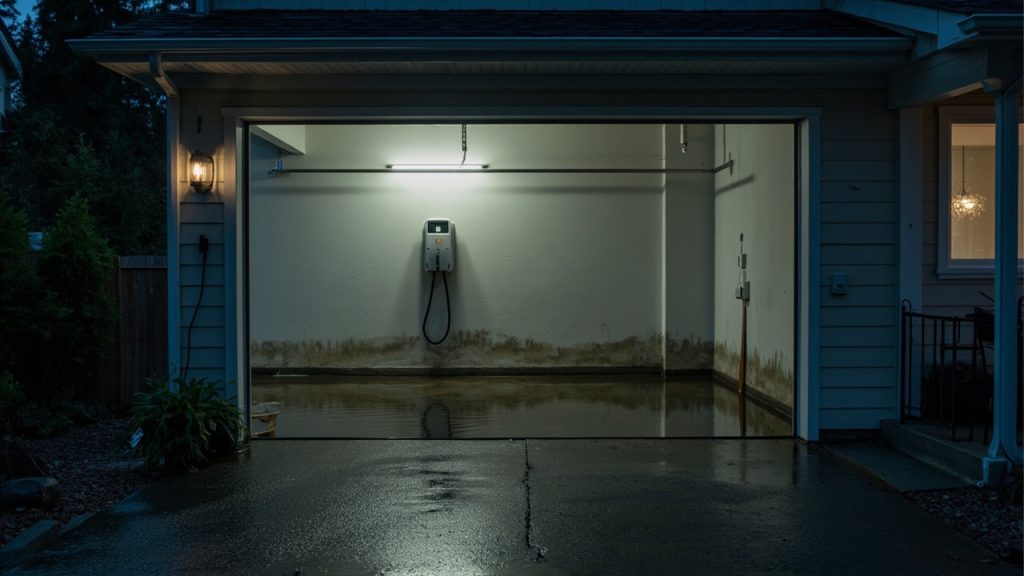
Flooded EV Charging Stations in Your Delridge Garage A Seattle Homeowner Safety Guide
A flooded garage with an active EV charging station is one of the most dangerous situations a Seattle homeowner can face. Do not touch the charger. Do not approach standing water near the unit. Your first move is to shut off power at the main breaker panel before anything else happens. This article gives you the exact steps to stay safe, assess the damage, and decide what comes next.. Read more about Fast Flood Cleanup for Server Rooms and Tech Offices in SODO.
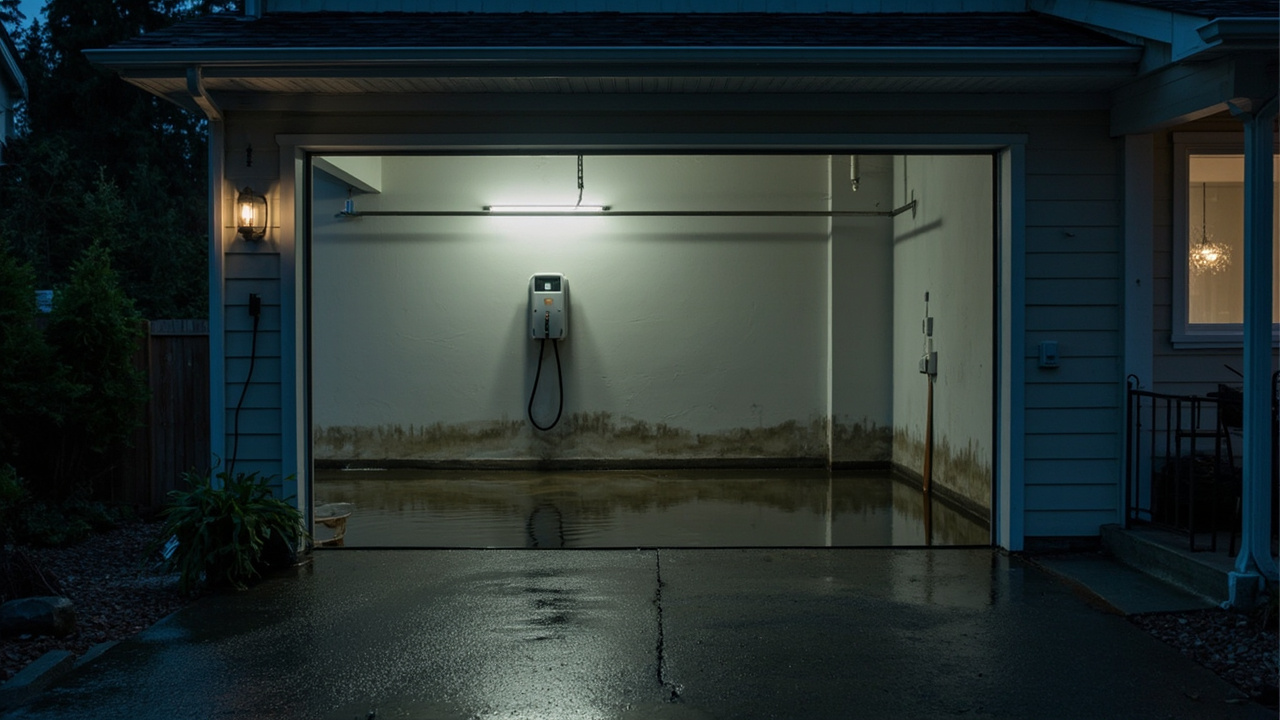
Immediate Shutdown Steps When Your EV Charger Gets Submerged
A live 240-volt circuit submerged in standing water can kill before you reach the charger. Water and a live 240-volt Level 2 EVSE (Electric Vehicle Supply Equipment) in the same space creates a lethal combination. Follow these steps in order, and do not skip ahead.
- Stay Out of the Garage
If water covers the floor, standing water near any energized outlet or charging unit can carry a fatal electrical charge. Keep everyone, including pets, out of the space until power is confirmed off.
- Locate Your Main Breaker Panel
In most Delridge, White Center, and West Seattle homes, the main breaker panel sits in a dry utility room, hallway, or on an exterior wall away from the garage. Find it before you need it so you are not searching in an emergency.
- Shut Off the Dedicated EVSE Circuit First
Most Level 2 home chargers run on a dedicated 40-amp or 50-amp double-pole breaker. Flip that breaker to the OFF position. Label it now if you have not already.
- Kill the Main Breaker If You Are Unsure
If you cannot identify the dedicated EVSE circuit, shut off the main breaker entirely. A temporary power outage is far less costly than an electrocution or a garage fire.
- Call Seattle City Light
Seattle City Light operates a 24-hour outage and safety line. If your flooding came from an external source and you suspect utility line involvement, report it immediately. They can confirm whether utility-side power is still feeding your panel.
- Do Not Reset the GFCI
Your EVSE circuit should include a GFCI (Ground Fault Circuit Interrupter) breaker or outlet. If it tripped during the flood, that is the system working correctly. Do not reset it until a licensed electrician inspects the unit.
Why Level 2 Chargers Carry Far Greater Risk Than a Standard Outlet
A standard Level 1 charger plugs into a 120-volt outlet and draws around 12 amps. Dangerous? Yes. But a Level 2 EVSE operates at 240 volts and draws 32 to 50 amps, delivering roughly four times the energy of a standard outlet into your garage wall. That voltage level causes ventricular fibrillation at contact currents well below what most people assume.
The EVSE unit itself contains several vulnerable components. The control board, the contactors, the relay circuits, and the cable connection point all sit inside a housing rated for outdoor exposure, but that rating does not mean the unit survives submersion. Most residential units carry a NEMA 3R or NEMA 4 rating, which covers rain and splashing. Neither rating covers prolonged immersion in floodwater.
| Charger Type | Voltage | Typical Amperage | NEMA Enclosure Common Rating | Flood Risk Level |
|---|---|---|---|---|
| Level 1 (standard plug) | 120V | 12A | NEMA 1 or 3R | High. No submersion protection. |
| Level 2 (hardwired EVSE) | 240V | 32A to 50A | NEMA 3R or 4 | Extreme. Internal components exposed to moisture intrusion after submersion. |
| Level 2 (outdoor-rated EVSE) | 240V | 40A to 50A | NEMA 4X | Severe. 4X resists hose-directed water but not flood-depth immersion. |
A NEMA 4X enclosure, which many premium EVSE manufacturers use, resists corrosion and directed water spray. But a King Tide event pushing water into a Delridge or Beacon Hill garage for two hours exceeds what any residential EVSE enclosure certification covers. The unit must be treated as compromised.
Saltwater vs. Freshwater Flooding and Why the Difference Changes Everything
Seattle sits at the intersection of Puget Sound tidal influence and heavy freshwater rainfall from atmospheric river events. The type of water that hit your garage determines the severity of damage to your EVSE and garage structure.
Freshwater flooding from a heavy rain event or a burst pipe causes serious damage. But the minerals and chlorides in saltwater flooding, which can occur during King Tide events in low-lying Delridge or along the Duwamish waterway corridor, accelerate galvanic corrosion inside metal components at a rate many times faster than freshwater. A copper bus bar inside your EVSE that survives a freshwater flood for a week might show measurable pitting after just 24 hours in saltwater intrusion.
Galvanic corrosion attacks dissimilar metals in contact, which is exactly what you find inside charging station electronics. Aluminum housings, copper wiring, and steel mounting hardware all sit together. Saltwater acts as an electrolyte and drives that corrosion process aggressively. Even after the water dries, residual chloride salts continue pulling moisture from the air and extending the corrosive reaction.
| Flood Source | Conductivity | Corrosion Risk | Drying Timeline | EVSE Salvage Likelihood |
|---|---|---|---|---|
| Rainwater or roof runoff | Low | Moderate. Causes oxidation over time. | 3 to 5 days with professional drying | Moderate. Inspection required before re-energizing. |
| Groundwater or basement seepage | Moderate | High. Contains soil minerals and bacteria. | 5 to 7 days depending on depth | Low to moderate. Internal contamination likely. |
| Tidal or Puget Sound saltwater | Very High | Extreme. Chloride-driven galvanic corrosion. | 7 to 10 days, requires chloride neutralization | Very Low. Replacement usually more cost-effective. |
| Sewer backflow | High | Extreme. Biohazard compounds attack components. | Requires full decontamination before drying | Near zero. Full replacement and biohazard remediation required. |
Seattle’s aging combined sewer overflow (CSO) systems in older Ballard and Queen Anne districts create a real risk of sewer backflow during heavy rain events. If your garage flooded with dark or foul-smelling water, treat it as a Category 3 biohazard situation and call a professional restoration team immediately. This is not a DIY situation.
Why You Must Never Power On a Flooded EVSE
Homeowners sometimes assume that if the water dried out and the unit looks fine externally, it is safe to restore power. This assumption causes house fires and fatalities.
Water infiltrates the EVSE enclosure through cable entry points, gasket seams, and conduit runs. Once inside, it settles in the lowest points of the circuit board and relay housing. Even after visible drying, moisture remains trapped in capacitors, behind conformal coatings, and in the mineral deposits left by evaporated water. When you restore power, that residual moisture causes arcing across circuit board traces. That arcing generates heat. That heat can trigger a garage fire or, in worst-case scenarios involving lithium-ion battery vehicle charging, contribute to thermal runaway in the vehicle battery management system.
Lithium-ion battery thermal runaway is a chain reaction where cell temperature rises beyond the battery’s ability to dissipate heat, causing rapid uncontrolled energy release. A compromised EVSE delivering irregular current spikes to a vehicle battery management system creates the conditions for that reaction. The NFPA 70B Standard for Electrical Equipment Maintenance addresses exactly this scenario. NFPA 70B requires licensed technicians to document inspection and testing before re-energizing flood-exposed electrical equipment, making professional evaluation a code-level obligation rather than an optional precaution.
An IICRC-certified restoration technician uses moisture mapping equipment to detect trapped moisture inside wall cavities, floor slabs, and within equipment housing. Your eyes cannot see what a thermal camera and moisture meter can detect. This is why professional assessment matters before you touch that breaker.
Identifying Hidden Water Damage Inside Your Charging Unit
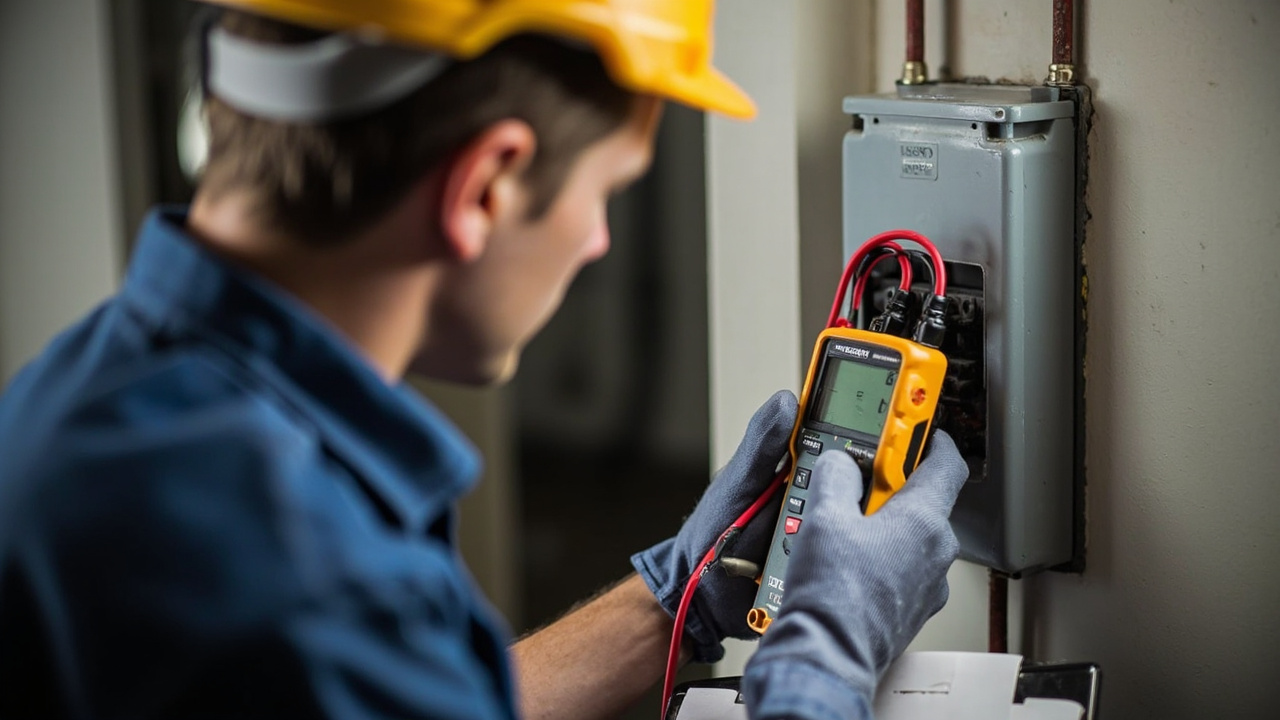
A flooded EVSE carries warning signs that most homeowners overlook when the water recedes. Watch for these indicators before calling an electrician or replacement technician.
- Visible white or gray mineral deposits on the exterior housing seams or cable entry points
- Rust streaking or orange-brown staining around mounting hardware or conduit connections
- A burning or metallic odor near the unit even when it is de-energized
- Warping or discoloration of the plastic housing, indicating heat exposure from prior arcing
- Corrosion visible at the J1772 connector port or cable strain relief point
- The GFCI breaker tripping immediately or refusing to reset after power restoration attempts
- Condensation visible inside any transparent status indicator windows on the unit
Any one of these signs means the unit needs professional inspection before re-use. Multiple signs present together almost always mean replacement is the right call.
Professional Structural Drying for Garages Changes the Outcome
Your EVSE sits inside a garage with concrete floors, drywall partitions, and wood framing. All of those materials absorb water and hold it long after the visible flooding recedes. Seattle’s average relative humidity, which runs high for most of the year due to persistent cloud cover and our 37-plus inches of annual rainfall, slows natural evaporation dramatically. A garage that looks dry to the eye can hold moisture levels inside the wall cavities that feed mold growth for weeks.
Professional structural drying uses commercial-grade desiccant or refrigerant dehumidifiers, high-velocity air movers, and thermal imaging to reduce the moisture content of structural materials to safe levels. An IICRC-certified team measures the moisture content of concrete, drywall, and wood framing at multiple points and documents the drying progress daily. This documentation matters for your insurance claim.
The glacial till and clay-heavy soils common across the greater Seattle area, particularly in valley areas and along the Duwamish corridor near Delridge, create hydrostatic pressure against garage slabs and foundation walls. That pressure drives moisture up through the slab even after surface water clears. Professional moisture mapping detects this sub-slab moisture so the drying plan addresses the actual source rather than just the surface.
For more detail on handling the insurance side of a flood event, the team at Evergreen Water Damage Restoration put together a practical resource on handling a water damage insurance claim for your Seattle home that walks through documentation requirements in detail. That documentation process applies directly to EVSE replacement claims as well.
Seattle Electrical Codes and What They Require Before Re-Energizing
Washington State’s electrical code, aligned with the National Electrical Code (NEC), requires that flood-damaged electrical equipment receive inspection and testing before re-energization. Seattle DCI (Department of Construction and Inspections) can require a permit and inspection for EVSE reinstallation after flood damage, particularly if any wiring, conduit, or panel connections need replacement.
Seattle City Light also maintains guidelines for customers restoring power after flood events. Homeowners in Delridge, Burien, and South Seattle neighborhoods within King County flood-prone areas should confirm with Seattle City Light that the utility service entrance is unaffected before their electrician restores power at the panel. A licensed Master Electrician familiar with Seattle residential code requirements should sign off on the EVSE circuit before the unit goes back online.
The EVSE manufacturer’s warranty almost universally voids coverage for flood-exposed units, so replacement cost typically falls to your homeowner’s insurance policy. Document everything. Photograph the water line on the wall, the unit’s exterior and any visible corrosion, the circuit breaker position, and the conduit condition before anything gets cleaned or touched. This photo documentation is your insurance adjuster’s primary evidence for approving a replacement claim.
Restoration vs. Replacement How to Make the Right Call
Not every flooded EVSE demands immediate replacement. The decision depends on flood type, submersion depth, duration of exposure, and unit age. Use these factors to frame your conversation with a licensed electrician and your insurance adjuster.
Freshwater flooding with less than two inches of standing water, a short exposure window under four hours, and a unit less than two years old presents the best case for professional inspection and possible restoration. An electrician opens the unit, dries the internal components, tests insulation resistance with a megohmmeter, and clears the unit for reinstallation if values pass. Popular units in this category include the ChargePoint Home Flex and the Wallbox Pulsar Plus, both of which use modular internal designs that give a licensed electrician reasonable access to dry and inspect circuit board surfaces.
Saltwater intrusion of any depth, sewer backflow contact, submersion exceeding six inches, or exposure lasting more than 12 hours almost always justifies full replacement. The cost of repeated electrician visits, the ongoing risk of arcing, and the potential liability of re-energizing a compromised 240-volt circuit in a garage attached to your home makes replacement the straightforward financial and safety choice. Currently active units such as the Tesla Wall Connector and the Grizzl-E carry mid-to-upper tier pricing for residential EVSE units before installation costs, and most insurance adjusters approve replacement rather than repeated repair attempts once saltwater or sewer contact is documented.
Delaying drying of the surrounding garage structure, even while you sort out the EVSE question, creates a secondary problem. Mold growth in a damp garage begins within 24 to 48 hours in Seattle’s climate. The moisture that soaks into your garage drywall, ceiling insulation, and wall framing does not wait for your insurance adjuster to call back. Speed matters for the structure regardless of which path you choose for the charger itself.
Insurance Documentation Checklist for EVSE Flood Claims
Most standard homeowner’s policies cover sudden and accidental water damage, which includes garage flooding from storm-related events. Most homeowner policies treat a hardwired EVSE installed by a licensed electrician as a structural improvement or attached equipment. Here is what your adjuster needs to approve a full claim.
- Photographs of the flood water level, ideally with a measuring tape visible against the wall
- Photos of the EVSE unit showing serial number, model label, and any visible damage or corrosion
- The original installation permit and electrician invoice if available
- Documentation of the flood source, a plumber’s report for burst pipe events or a weather service record for storm events
- A written assessment from a licensed electrician stating the unit is unsafe for re-energization
- Professional moisture readings from the restoration company showing water intrusion in the surrounding structure
- Receipts or model documentation showing the replacement unit’s specifications match or exceed the flooded unit
Insurance adjusters respond to thorough documentation packages. A licensed electrician’s written finding that flood exposure compromised the unit, paired with professional moisture readings from a certified restoration team, gives your adjuster the evidence needed to approve a full replacement claim without pushback. The EPA’s flood and water safety guidance also supports the position that flood-exposed electrical equipment requires professional evaluation before re-use, which adds further weight to your claim file.
Frequently Asked Questions
Can I dry out my Level 2 charger with fans and use it again?
No. Surface drying with fans does not remove moisture from inside the control board, relay housing, or conduit runs. An electrician must test insulation resistance with a megohmmeter and confirm the unit meets manufacturer specifications before re-energizing. Skipping this step risks arcing, fire, and voiding any remaining warranty coverage.
Does homeowner’s insurance cover a flooded EV charger?
Most standard policies cover sudden and accidental damage to permanently installed equipment like a hardwired Level 2 EVSE. The key is documentation. Get a written electrician assessment, document the damage with photographs, and confirm with your adjuster whether the unit classifies as a structural improvement or personal property, since that distinction affects your deductible.
How long does professional garage drying take after a Seattle flood?
For a typical attached garage with concrete slab and drywall walls, professional drying with commercial dehumidifiers and air movers takes three to seven days depending on the water source and Seattle’s ambient humidity at the time of the event. Clay-heavy soils common across the Delridge and South Seattle area increase drying time due to sub-slab moisture migration.
Should I move my EV out of the flooded garage?
Yes, if you can do so without walking through standing water near the charging station. Move the vehicle only after confirming the EVSE is de-energized and the cable is disconnected from the vehicle. Do not drive a vehicle whose battery management system may have been exposed to floodwater until a dealership technician performs an inspection.
Your garage is the last place you want an undetected electrical hazard. Evergreen Water Damage Restoration serves Delridge, West Seattle, Burien, Ballard, and the surrounding Seattle metro with 24-hour emergency response. Call our team right now to get a moisture assessment of your garage, proper drying started, and documentation in place before your insurance window closes.