
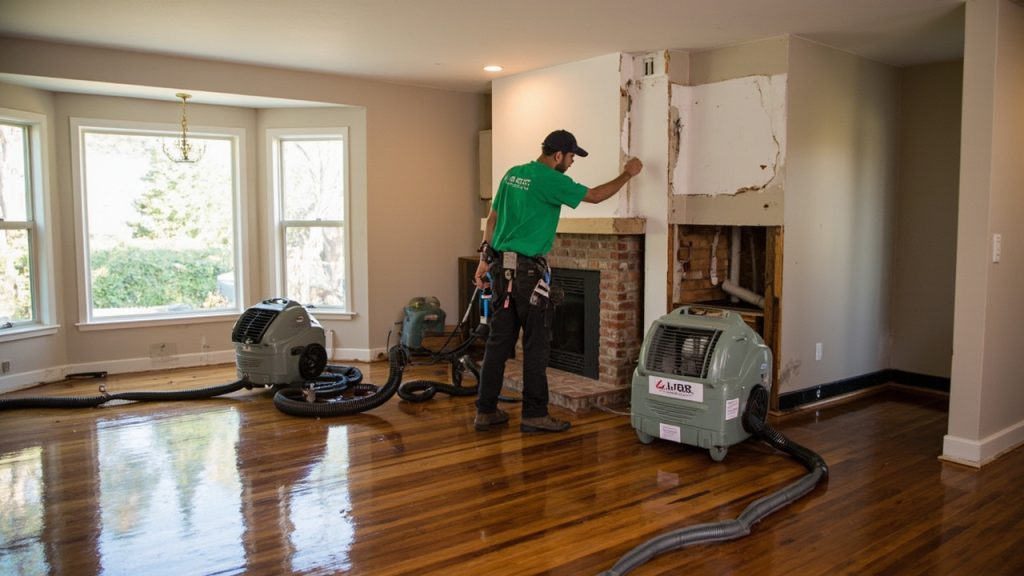
24/7 Frozen Pipe Cleanup and Water Damage Restoration in Shoreline, WA
A burst pipe does not wait for business hours. When temperatures drop in Shoreline and a copper supply line fails behind your wall, you can lose dozens of gallons per minute. The flooding starts fast, and the structural damage compounds with every passing hour. Evergreen Water Damage Restoration serves Shoreline residents around the clock, with technicians who specialize in the cleanup and structural drying that follows a pipe failure — not just the plumbing repair itself.
If water is actively flowing, call us now. If the pipe has already been shut off and water is standing or soaking into your subfloor, read on to understand what happens next and what you need to do right away.

What to Do the Moment a Pipe Bursts in Your Shoreline Home
Your first action is to stop the water at the source. Locate your main shutoff valve — in most Shoreline homes it sits near the water meter, often in a crawl space, utility closet, or along the front foundation wall. Turn it fully clockwise to stop the flow.
- Shut Off the Water Supply
Turn the main shutoff valve clockwise until the flow stops completely. Do not leave it partially open.
- Kill the Electricity to Affected Zones
Go to your breaker panel and cut power to any room where water is present or directly below the break. Water conducts electricity, and wet subfloors above electrical outlets are a real hazard.
- Document Everything Before Touching It
Use your phone to photograph and video the standing water, the pipe, and all affected surfaces before you move a single item. Your insurance adjuster needs this documentation.
- Move Valuables Off the Floor
Lift furniture onto blocks, remove rugs, and relocate anything irreplaceable from the wet zone. Wet documents and photographs require specialized drying and should be separated immediately.
- Call a Water Damage Restoration Professional
Contact a certified restoration company — not just a plumber. The plumber fixes the pipe. The restoration crew handles the water, the structure, and the mold prevention that follows.
Why Shoreline, WA Is Especially Vulnerable to Burst Pipes
Shoreline sits in the northern Seattle metro, where cold air from the Cascades funnels through the corridor along Aurora Ave N during freeze events. Most winters, the area sees brief but damaging temperature drops that catch older homes off guard.
Neighborhoods like Richmond Beach and Ridgecrest carry a significant inventory of mid-century ranch-style homes and 1960s bungalows. These homes often have copper piping in exterior wall cavities with minimal insulation — exactly the configuration that fails first during a hard freeze. The Washington State Energy Code now requires vapor barriers and insulated pipe chases, but homes built before current standards were adopted are widely out of compliance.
The real danger in the Puget Sound region is the freeze-thaw cycle. Temperatures hover near 32°F for days, causing water inside pipes to freeze and expand, then thaw just enough to fracture the pipe wall before refreezing. By the time you notice water, the failure has already propagated through several inches of pipe. Homes near Echo Lake and the Ballinger neighborhood can see this cycle repeat multiple times in a single cold week.
High annual precipitation — averaging over 37 inches — means the soil around Shoreline foundations is often already saturated when a freeze event hits. The clay-heavy glacial till common throughout King County creates hydrostatic pressure against foundation walls, so any water released by a burst pipe finds every crack and low point in the structure quickly.

The Difference Between a Plumber and a Water Damage Restoration Company
This distinction matters and competitors in the restoration space rarely explain it clearly. A licensed plumber repairs or replaces the broken pipe. That is their job, and you need them. But once the pipe is fixed, their work is done.
Water damage restoration is a separate technical discipline governed by the IICRC S500 Standard for Professional Water Damage Restoration. It covers the extraction, structural drying, psychrometric monitoring, and sanitization required to return a building to a dry standard and prevent mold colonization. A plumber does not carry industrial extractors, desiccant dehumidifiers, or thermal imaging cameras. A restoration crew does.
Calling only a plumber after a burst pipe is like calling a mechanic after a car fire and asking them to only fix the engine. The pipe is the ignition point. The water damage is the structural emergency.
The Frozen Pipe Cleanup Process We Use in Shoreline
Step 1 — Moisture Mapping with Thermal Imaging
Before we extract a drop, we scan the affected area with thermal imaging cameras. Cold water behind drywall shows up as a temperature differential against the surrounding surface. This lets us map the full extent of saturation without tearing open walls blindly. Hidden moisture detection is one of the most undervalued steps in the process — skip it, and you will miss saturated wall cavities that become mold growth zones within 48 to 72 hours.
Step 2 — Emergency Water Extraction
We deploy truck-mounted and portable extractors to pull standing water from floors, carpeting, and subfloor assemblies. Carpet and pad retain water like a sponge — carpet water extraction requires weighted wand tools and multiple passes to reach acceptable moisture content levels. In many Shoreline homes with hardwood floors, we make the call early on whether the floor can be saved through in-place drying or needs to come up. Hardwood floor water damage requires fast action — cupping and buckling begin within hours on real wood plank floors.
Step 3 — Structural Drying and Dehumidification
This is where restoration science separates from a shop-vac and a box fan. We set industrial low-grain refrigerant (LGR) dehumidifiers and high-velocity air movers in a configuration calculated by psychrometric principles — the relationship between temperature, humidity, and airflow that governs how fast a structure dries. Relative humidity above 60% supports mold growth. We target indoor RH below 45% and use moisture meters to log readings in every affected material daily.
Structural drying in a Shoreline home typically runs three to five days for a standard burst pipe scenario. Persistent cloud cover and the naturally high ambient humidity of the Puget Sound region slow evaporation compared to drier climates. That is why industrial-grade dehumidifier capacity matters here more than in Phoenix or Denver.
Step 4 — Category Assessment and Sanitization
Not all water damage is the same. Water is classified by contamination level. A clean supply line break is Category 1 — relatively safe until it sits long enough to pick up contamination from building materials. A toilet supply line or dishwasher drain is Category 2 (gray water). Sewage or flood water is Category 3 (black water), which requires full PPE and antimicrobial treatment of every affected surface. We assess the category on arrival and adjust our protocol accordingly. Most frozen pipe bursts start as Category 1 but can degrade quickly if the water touches subfloor materials or has been standing for more than 24 hours.
Step 5 — Mold Prevention and Monitoring
The Pacific Northwest climate is ideal for mold. Shoreline’s ambient humidity levels mean spores are always present in the air. After a water intrusion event, those spores need only 48 to 72 hours and a wet surface to begin colonizing. We apply EPA-registered antimicrobial agents to at-risk surfaces and continue moisture monitoring throughout the drying phase. If mold is already present, mold remediation follows immediately as part of the restoration scope.
Water Damage Category and Response Time Reference
| Water Category | Source Examples | Contamination Level | Response Window |
|---|---|---|---|
| Category 1 (Clean Water) | Supply line, copper pipe burst, faucet overflow | No biological threat at origin | Act within 24 hours |
| Category 2 (Gray Water) | Washing machine, dishwasher, toilet tank | Biological and chemical contaminants | Act within 12 hours |
| Category 3 (Black Water) | Sewage backup, rising floodwater, groundwater | Severe pathogenic contamination | Immediate response required |
Typical Structural Drying Timeline for Shoreline Homes
| Drying Phase | Timeframe | What We Measure | Target Outcome |
|---|---|---|---|
| Initial Extraction | Hours 0 to 4 | Standing water volume, subfloor saturation | Zero standing water |
| Rapid Drying Phase | Days 1 to 2 | Relative humidity, material moisture content | RH below 50%, surface moisture dropping |
| Structural Drying Phase | Days 2 to 4 | Wall cavity moisture, subfloor readings | Materials at or near pre-loss moisture content |
| Final Clearance Inspection | Day 4 or 5 | Full moisture mapping, mold spore air test if needed | Certified dry standard per IICRC S500 |

Filing an Insurance Claim for a Burst Pipe in King County
Homeowners insurance in Washington State generally covers sudden and accidental water damage from a burst pipe. Gradual leaks — a slow drip behind a wall that went unaddressed for months — are typically excluded. Frozen pipe damage falls in the covered category for most policies, including those held with State Farm, Liberty Mutual, and PEMCO, as long as the home was adequately heated and the damage was not the result of neglect.
Here is where your documentation from Step 3 of the emergency response becomes critical. Your adjuster will want photos of the origin point, the extent of saturation, and all damaged contents before any work begins. We provide moisture mapping reports, thermal imaging documentation, and daily drying logs as part of our service — the exact format most King County adjusters require to process a structural drying claim. Learn more about how to handle insurance claims for water damage effectively.
We work directly with insurance companies and can communicate scope of work on your behalf. We do not inflate scopes to maximize claims — we document what is wet, dry what needs drying, and provide an accurate record. That approach protects your claim from disputes. For a full breakdown of what restoration work typically costs and what insurance covers, see our water damage restoration cost guide for 2026.
What Your Insurance Adjuster Will Ask For
- Date and time of discovery
- Photographs and video of the pipe failure location
- Documentation of standing water before extraction
- Moisture meter readings logged across all affected materials
- Thermal imaging report showing moisture migration in walls and floors
- An itemized scope of work from a certified restoration contractor
- Contents inventory if personal property was damaged
Preventing the Next Freeze Event in Older Shoreline Homes
Once the drying is complete and your home is back to a dry standard, the next conversation is prevention. Many Shoreline homes built in the 1950s through 1970s have supply lines running through exterior wall cavities with no insulation between the pipe and the sheathing. That is a design that predates current Washington State Energy Code requirements, and it is only a matter of time before another hard freeze finds it.
The two most effective interventions for these homes are heat tape (also called pipe freeze cable) applied to exposed sections in crawl spaces and unheated utility chases, and open-cell foam insulation added to the exterior side of pipe locations in wall cavities. Heat tape is low cost, uses minimal electricity, and can be self-regulating — it only activates when pipe temperatures approach freezing. Insulation upgrades in crawl spaces also directly address crawl space moisture issues that compound over time in high-precipitation areas like Shoreline.
For homes in Richmond Beach with raised foundations and exposed underfloor plumbing, skirting with insulated panels and adding crawl space vapor barriers can drop crawl space temperatures significantly during a freeze event. These are not expensive upgrades, and they prevent a loss event that averages thousands of dollars in restoration costs.
Beyond the Pipe — Full Restoration After Water Damage
A burst pipe does not just wet your floor. It saturates drywall, soaks insulation in wall cavities, wicks up into wood framing, and leaves cosmetic damage behind even after the structure is dry. Wet insulation loses all R-value and must be replaced. Drywall that has been saturated usually needs to be cut out from the wet zone to allow the stud cavity to dry from the inside. After structural drying is complete, the restoration phase covers rebuilding those assemblies.
In older Shoreline homes with original lath and plaster walls, the drying and rebuild scope is more complex. Plaster is dense and holds moisture longer than modern drywall. We adjust our drying equipment configuration and drying timelines accordingly, and we log the data to support the extended scope in your insurance claim.
Water stains on painted surfaces, peeling paint and wallpaper, and swollen baseboards and trim are all downstream effects of water intrusion that we address as part of the full restoration scope. The goal is not just a dry building — it is a building that looks and functions the way it did before the pipe failed.
We also serve homeowners and property managers across the broader Seattle metro. Whether you need water damage restoration in Bothell, Kirkland, or Bellevue, our crews respond with the same urgency and technical standard we bring to every Shoreline job.
Frequently Asked Questions
How fast can a restoration crew reach my Shoreline home after a burst pipe?
Evergreen Water Damage Restoration targets on-site arrival in 60 minutes or less for Shoreline and the surrounding King County area. Response time is critical — water migrates into wall cavities and under flooring within the first hour after a pipe failure.
Do I need to call a plumber before calling a restoration company?
You need both, and the order matters. Shut off the main water supply first. Then call a restoration company to begin water extraction and damage documentation. Your restoration company can coordinate with your plumber and ensure the pipe repair is complete before drying equipment is set. Do not wait for the plumber to finish before calling restoration — every hour of delay increases structural saturation.
Will my homeowners insurance cover frozen pipe damage in Shoreline?
Most standard homeowners policies in Washington State cover sudden and accidental damage from burst pipes, including frozen pipe failures, as long as the home was adequately heated. Your insurer will want documentation of the pipe failure location, the extent of water damage, and a certified restoration scope of work. We provide all of that documentation as part of our process.
How long does structural drying take after a burst pipe?
Typical structural drying in a Shoreline home takes three to five days, depending on the volume of water released, the materials affected, and ambient conditions. Shoreline’s high ambient humidity slows the drying process compared to drier climates, which is why industrial-grade LGR dehumidifiers are essential rather than optional. For a detailed breakdown, see how long water damage drying takes.
Can a burst pipe cause mold in a Shoreline home?
Yes. Mold colonization can begin within 48 to 72 hours of a water intrusion event, especially in the humid Puget Sound climate. Wet framing, drywall, and insulation are ideal mold substrates. Professional structural drying and antimicrobial treatment after a pipe burst are the primary prevention measures. If mold is already visible, separate mold remediation is required before reconstruction begins.
If you are dealing with an active burst pipe or standing water in Shoreline right now, contact Evergreen Water Damage Restoration Shoreline immediately. We are on call 24 hours a day, every day of the year. The faster extraction begins, the less structure you lose — and the simpler your insurance claim becomes.