
Emergency Ceiling Leak Repair in Fremont, Seattle
Water is coming through your ceiling right now. Maybe it started as a brown stain on the drywall. Maybe you heard the drip before you saw it. Either way, you need answers fast, because in Fremont’s mix of older Seattle bungalows and newer multi-story townhomes, a ceiling leak can go from a nuisance to a structural problem in 24 to 48 hours.
Evergreen Water Damage Restoration responds to the 98103 zip code in under 60 minutes. We carry IICRC-certified technicians, thermal imaging cameras, and industrial drying equipment on every truck. This page tells you exactly what to do right now, what we do when we arrive, and what the full repair process looks like for Fremont properties specifically.
What to Do Immediately Before We Arrive
Speed matters more than anything in the first hour. Standing water in ceiling cavities soaks into insulation, saturates drywall, and wicks into floor joists within minutes. Do not wait to act.
- Shut off the water source
If the leak is coming from a plumbing failure above, find your main shutoff valve and turn it off. In most Fremont townhomes, this is near the utility meter or in the garage. If you cannot locate it, call us and we will walk you through it.
- Place buckets and protect your floors
Hardwood floors and laminate are vulnerable to water damage within the first 30 minutes. Hardwood floor water damage can mean cupping, buckling, and full replacement if the water sits. Cover floors with towels or plastic sheeting immediately.
- Relieve ceiling pressure if safe
If the drywall is bulging and you can see water pooling behind it, use a screwdriver to poke a small hole at the lowest point of the bulge. This controls where the water exits and prevents a full ceiling collapse. Do not do this near light fixtures.
- Turn off electricity to affected rooms
Water and live circuits are a lethal combination. Flip the breaker for any room with an active ceiling leak before you touch anything. If you are unsure which breaker controls the space, shut off the main.
- Document everything with photos and video
Walk through the space and record all visible damage before any cleanup. This documentation is critical for your homeowners insurance claim. Capture the stain, the source point if visible, any damaged belongings, and any visible mold or discoloration.
- Call Evergreen Water Damage Restoration
We dispatch to Fremont and the surrounding 98103 area around the clock. The sooner we arrive, the more of your structure we can save.
Common Causes of Ceiling Leaks in Fremont Homes
Fremont sits between Green Lake and Lake Union, and the neighborhood’s housing stock runs the full spectrum from 1920s Craftsman bungalows to recently built skinny townhomes stacked three stories high. Each building type carries its own leak vulnerabilities.
Roof and Flashing Failures on Older Bungalows
Seattle averages more than 37 inches of rain annually, and Fremont gets its full share. The older homes near Gas Works Park and along Aurora Ave N often have aging composition shingles, deteriorated step flashing around chimneys, and clogged gutters that force water back under the roofline. Leaf clog is a major issue here. Seattle’s urban drainage systems, including leaf-clogged street drains and overloaded gutters, redirect water into fascia boards and soffit cavities before it ever reaches the interior.
When flashing fails on a Craftsman bungalow, water typically enters at a valley or penetration point, travels horizontally along a rafter, and drips down in a spot that looks unrelated to the actual entry point. This is why ceiling stains rarely appear directly below the roof breach.
Our team handles emergency roof leak tarping to stop the water source while permanent roof repairs are scheduled. This step is critical in preventing additional water from entering during the drying process.
Plumbing Stack Failures in Modern Townhomes
Fremont’s newer townhomes, particularly the three-story Seattle Box style construction common along the neighborhood’s eastern edges, concentrate all plumbing in a central stack. A supply line failure, a failed wax ring on an upper-floor toilet, or a washing machine overflow on the second level can send water cascading through all three floors.
These events move fast. A washing machine that overflows during a spin cycle can discharge several gallons per minute. By the time you notice the ceiling stain on the ground floor, the wall cavities between floors may already be saturated. See our detailed guide on washing machine overflow cleanup for what this type of event typically involves.
Condensation and Vapor Barrier Failures in Attic Spaces
Seattle’s persistent cloud cover and high relative humidity slow natural evaporation dramatically. In poorly ventilated attic spaces, warm interior air meets cold roof decking and condenses. Over time, this moisture saturates insulation and begins to degrade the drywall ceiling below. This is not a dramatic event. It is a slow-building failure that looks like an old roof leak but has no external water source.
Washington State Energy Code mandates vapor barriers and minimum attic ventilation ratios, but many pre-code and improperly renovated Fremont homes skip these requirements. If your attic insulation looks matted, dark, or compressed, it may be holding significant moisture. Our soggy insulation service addresses this directly.
Our Fremont Ceiling Leak Repair Process

When our crew arrives at your Fremont property, we do not start by guessing. We use data.
Thermal Imaging and Moisture Mapping
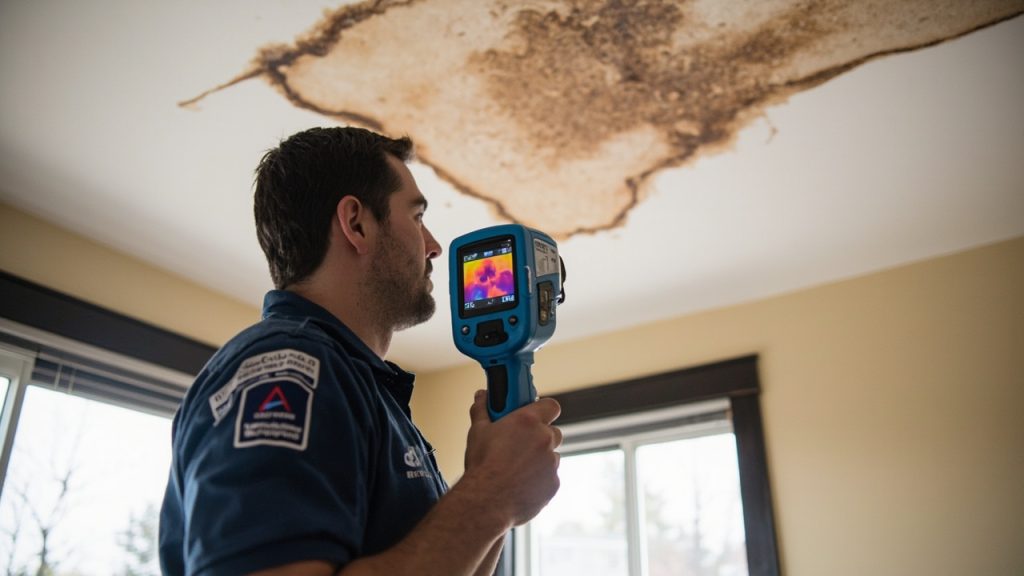
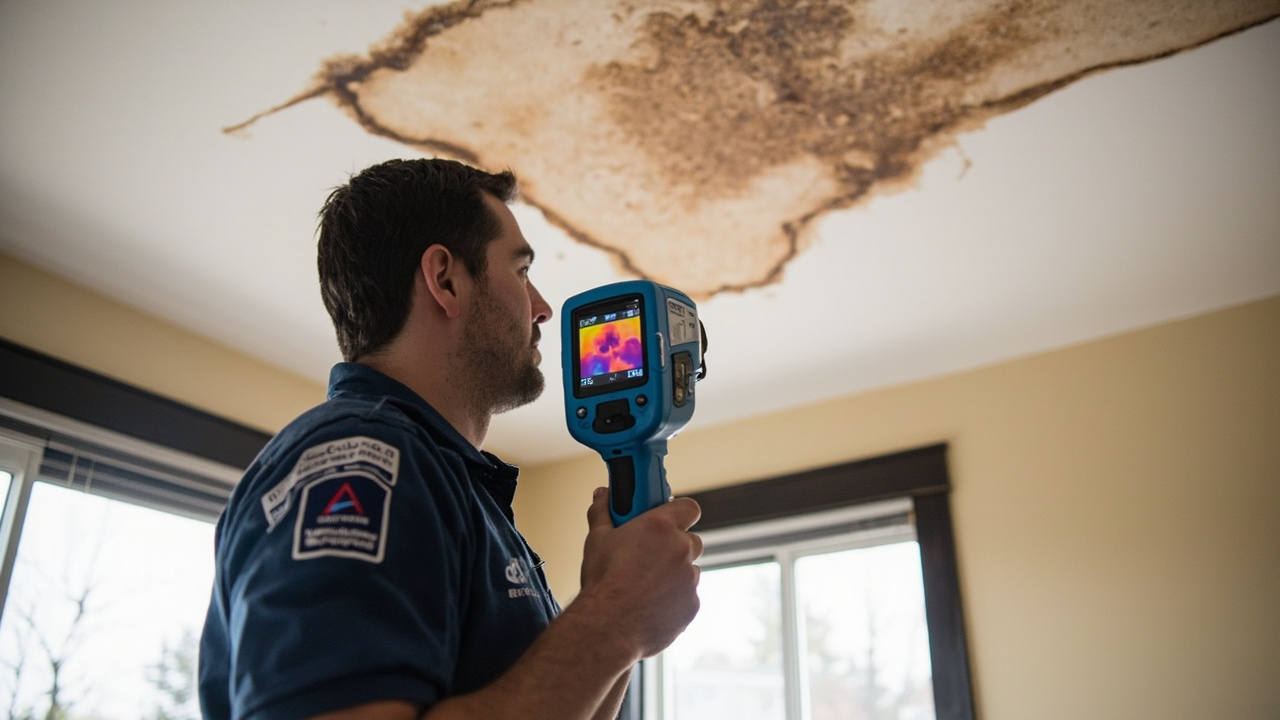
Thermal imaging cameras detect temperature differentials in wall and ceiling surfaces caused by evaporating moisture. We use this to find water that has migrated beyond the visible damage area. In multi-story townhomes, this is critical because water travels along framing members and can pool in unexpected cavities.
We follow thermal scans with calibrated moisture meters to get exact readings at specific points. This creates a moisture map of your property, documenting which materials are wet, how wet they are, and which fall outside acceptable moisture content thresholds. You can learn more about this process on our hidden moisture detection page.
Water Category Assessment
Not all ceiling leaks carry the same risk. The category of water determines the required drying protocol and whether antimicrobial treatment is necessary.
| Water Category | Source Example | Health Risk | Typical Protocol |
|---|---|---|---|
| Category 1 (Clean) | Supply line break, rain intrusion | Low | Extract, dry, monitor |
| Category 2 (Gray) | Washing machine overflow, dishwasher leak | Moderate | Extract, antimicrobial treatment, structural drying |
| Category 3 (Black) | Sewage backup, floodwater | High | Full PPE, antimicrobial, material removal, air scrubbing |
Structural Drying and Dehumidification
After extraction, we set up a drying system calibrated to the affected area. This typically involves high-velocity air movers positioned to create a vortex of airflow across wet surfaces, combined with commercial-grade refrigerant or desiccant dehumidifiers to pull moisture from the air and accelerated evaporation from materials.
Fremont’s ambient humidity, which is consistently high due to its proximity to Lake Union and the general Puget Sound climate, makes this step especially important. Standard residential dehumidifiers are insufficient for structural drying. Our equipment pulls significant volumes of moisture per day from affected spaces. See our structural drying services page for more technical details on equipment and placement strategy.
Drying timelines vary by material and severity. The IICRC S500 Standard for Water Damage Restoration provides the industry benchmark for drying goals, and our technicians follow these standards on every job.
| Material | Typical Drying Time (Days) | Acceptable Moisture Content | Notes |
|---|---|---|---|
| Standard drywall (1/2 inch) | 3 to 5 | Below 1% WME | Often requires replacement if heavily saturated |
| Ceiling insulation (fiberglass batt) | N/A | Must be replaced when saturated | Cannot be dried in place reliably |
| Dimensional lumber (framing) | 7 to 14 | Below 19% MC | Above 19% MC risks mold and structural degradation |
| Subfloor (OSB) | 5 to 10 | Below 15% MC | OSB swells and delaminates; may require replacement |
| Plaster over lath (historic bungalows) | 10 to 21 | Below 1% WME | Thick substrate holds moisture much longer than modern drywall |
Ceiling Drywall Removal and Replacement
When drywall has been saturated beyond recoverable moisture levels, or when it has been wet long enough for mold to begin growing on the paper facing, removal is the correct call. We do not leave compromised drywall in place. Leaving wet drywall creates a persistent mold food source even after the structure appears dry.
For Fremont’s historic Craftsman bungalows, this sometimes means working with original plaster and lath construction rather than modern drywall. Plaster holds moisture for significantly longer periods. It also has much higher moisture capacity before it fails structurally, meaning it can look fine while harboring significant saturation inside. Our moisture meters are calibrated for both gypsum board and plaster substrates.
After structural drying is verified with final moisture readings, new drywall is hung, taped, mudded, and textured to match the existing ceiling. Water stains from the original leak that bled through to adjacent areas are treated as well. Read more about water stains on drywall and what drives that specific type of damage.
Mold Risk After a Ceiling Leak in the Puget Sound Climate
Mold spores are present in every Seattle home. Under normal conditions, they do not grow because the moisture content of building materials stays below the threshold mold needs to colonize. A ceiling leak changes that equation fast.
In the Pacific Northwest, mold can begin establishing colonies on wet drywall paper within 24 to 48 hours when temperatures are above 50 degrees Fahrenheit and relative humidity stays above 60 percent. Fremont’s indoor environments during the rainy season check all those boxes.
If your ceiling has been leaking for days or weeks before discovery, assume mold is present in the ceiling cavity. The EPA’s mold remediation guidelines are clear that porous materials like drywall and insulation with visible mold growth should be removed and replaced rather than cleaned in place.
Our technicians inspect for mold during the initial assessment. When mold is confirmed, we contain the work area with poly sheeting and negative air pressure to prevent spore migration to unaffected rooms. This matters especially in townhomes where open stairwells create direct airflow pathways between floors. For more on what mold after water damage looks like and involves, see our mold remediation and removal service page.
Paint blistering and peeling wallpaper are often early warning signs that moisture has been present in your walls longer than you realized. If you see these signs in rooms adjacent to the active leak, flag them for our technicians. Our team addresses peeling paint and wallpaper as part of the full restoration scope.
Filing Your Homeowners Insurance Claim for a Ceiling Leak
Most standard homeowners insurance policies in Washington state cover sudden and accidental water damage. A burst pipe, a roof puncture from a falling branch during a windstorm, or a failed supply line all typically qualify. What policies do not cover is water damage from deferred maintenance, slow leaks you knew about, or gradual deterioration.
The documentation you create in the first hour matters enormously. Insurance adjusters look for evidence that the event was sudden, not chronic. Here is what to prepare before your adjuster visits:
- Timestamped photos and video of all visible damage taken before any cleanup begins
- A written description of when you first noticed the leak and what you did immediately
- Moisture readings from a professional assessment, which establish a baseline for adjuster review
- A list of all damaged personal property with estimated values
- Your policy number and your agent’s direct contact information
- Receipts for any emergency mitigation expenses you paid out of pocket
We work directly with major carriers including State Farm, Liberty Mutual, Farmers, and PEMCO on claims in King County. Our job documentation, moisture logs, and drying reports are formatted to meet adjuster requirements, which reduces delays in claim approval. For a full walkthrough of the process, read our guide on how to handle insurance claims after water damage.
If your attic or ceiling damage is part of a larger storm event, also review our storm damage mitigation services, which cover the full scope of wind and rain-driven water intrusion across Seattle properties.

Why Fast Local Response to Fremont Makes a Difference
Fremont sits about three miles north of downtown Seattle. From our nearest staging area, we reach most Fremont addresses, including properties near Gas Works Park, along the Ship Canal, and up into the residential blocks toward Wallingford and Green Lake, in under 60 minutes at any hour.
That response time is not a marketing number. It is the difference between saving your ceiling framing and replacing it. It is the difference between a three-day drying project and a three-week mold remediation job. Water does not pause while you research contractors.
We serve the full greater Seattle metro, including Queen Anne, Ballard, South Lake Union, and beyond. If you are in a neighboring area, our Seattle water damage restoration hub page covers the full service footprint. For properties further east or south, we also handle water damage restoration in Bellevue and Kirkland with the same response commitments.
Frequently Asked Questions
How do I know if my ceiling leak is from the roof or a plumbing pipe?
Roof leaks typically worsen during or immediately after rain events and produce stains with irregular brown edges. Plumbing leaks happen regardless of weather and often appear with consistent dripping from a specific point. Thermal imaging makes the distinction clear by identifying the path of moisture movement in your ceiling cavity.
Can I wait to call a restoration company if the leak has stopped?
No. A leak that appears to have stopped may have simply redistributed water into wall cavities or below floor systems. Moisture content in structural materials stays elevated for days after a visible leak event. Mold begins growing within 24 to 48 hours. Calling immediately while materials are still wet gives us the best chance to dry in place rather than remove and replace.
Will my homeowners insurance cover ceiling water damage in my Fremont townhome?
If the damage was caused by a sudden event like a burst pipe, roof breach from a storm, or appliance failure, most standard Washington state homeowners policies cover it subject to your deductible. Damage from slow leaks or lack of maintenance is typically excluded. Document everything immediately and call your carrier to open a claim before any restoration work begins.
How long does the full ceiling repair process take?
For a moderate ceiling leak in a Fremont townhome, the structural drying phase typically takes three to seven days depending on material saturation levels. Drywall replacement, finishing, and painting add another two to four days after drying goals are confirmed. Total project time from emergency call to fully restored ceiling is typically one to two weeks for most residential cases.