
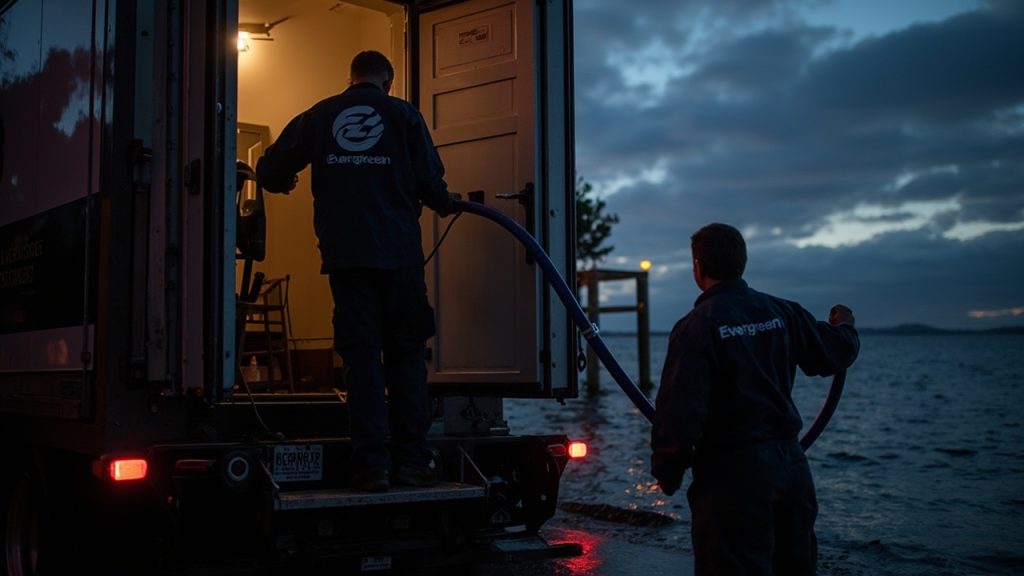
Standing water in your West Seattle home is not a situation where you wait and see. Every hour that water sits on your subfloor, soaks into your drywall, and wicks up into your wall cavities multiplies the structural damage and the mold risk. You need fast extraction, not a plumber who shows up with a shop vac.
Evergreen Water Damage Restoration Seattle dispatches IICRC-certified technicians to West Seattle zip codes 98116, 98126, 98136, and 98106 with industrial extraction equipment loaded and ready. We know the peninsula. We know the routes. And we know exactly what atmospheric river events do to homes built on clay-heavy glacial till soil with nowhere for the water to go.

Why West Seattle Flooding Is a Different Problem
West Seattle sits on a peninsula bordered by Elliott Bay to the north and the Duwamish Waterway to the east. When a Pacific storm system stalls over Puget Sound, the geography funnels water directly into the lowest points of neighborhoods like Delridge, High Point, and White Center. The hillside runoff from the steeper sections near Morgan Junction and Admiral can overwhelm street drains in under an hour.
The soils here compound the problem. West Seattle sits on a mix of glacial till and compacted clay that drains poorly under any conditions. During a heavy rain event, hydrostatic pressure builds against foundation walls fast. Basements that stayed dry for ten years can take on water in a single night when an atmospheric river parks over King County.
The West Seattle Bridge also matters for your response time. Any crew coming from central Seattle faces real bottlenecks during peak hours or post-storm traffic. Our staging and dispatch for the West Seattle peninsula accounts for this. We plan our routes around the Lower Bridge and the Spokane Street Swing Bridge to get to you faster than any crew that doesn’t know the area.
If your home sits closer to Alki Beach or the Fauntleroy Ferry terminal, coastal surge events add an extra layer of risk that inland neighborhoods don’t face. Salt-laden floodwater is classified as Category 3 water (black water), which requires a completely different extraction and decontamination protocol than a burst supply line.
What Happens When We Arrive at Your West Seattle Home
The first thing we do is not start pulling up carpet. We assess the water category and the source. We use thermal imaging cameras to map moisture intrusion behind walls and under floors before we move a single piece of equipment. This step prevents us from missing hidden saturation that will fuel mold growth inside your wall cavities within 48 to 72 hours.
According to the Institute of Inspection, Cleaning and Restoration Certification (IICRC), proper water damage remediation follows a defined science of psychrometry, the relationship between temperature, humidity, and the rate of evaporation. Getting this wrong means your home may appear dry while structural members and insulation stay wet for weeks.
Here is the sequence we follow on every West Seattle extraction call.
- Source Control and Safety Assessment
We confirm the water entry point is stopped or contained, check for electrical hazards, and identify the contamination category. Coastal surge water and sewer backups require full PPE and biohazard protocols before extraction begins.
- Thermal Imaging and Moisture Mapping
Using infrared thermal imaging cameras, we scan all affected surfaces to identify where water has migrated beyond the visible flood zone. This produces a moisture map that guides equipment placement and documents the scope for your insurance adjuster.
- Bulk Water Extraction
Truck-mounted extractors pull thousands of gallons per hour from flooded basements and main floors. For tighter spaces or multi-story homes, we deploy high-powered portable extractors. This phase removes the standing water that is actively wicking into your building materials.
- Deep Material Extraction
After bulk removal, we use weighted extraction tools and flood extractors to pull water from carpet padding, subfloor seams, and hardwood flooring. This step is what separates professional extraction from a shop vac job.
- Structural Drying Setup
We place LGR (Low Grain Refrigerant) dehumidifiers and high-velocity air movers in a calculated configuration based on the cubic footage and material types in each affected room. We set monitoring targets and return to log psychrometric readings daily.
- HEPA Air Scrubbing
For Category 2 or Category 3 water events, HEPA air scrubbers run continuously to capture airborne particulates and begin odor control. This is standard for any basement flood near the Duwamish or any event involving sewer backups.
- Documentation for Insurance
Every step is photographed, and moisture readings are logged. We document everything your adjuster needs, and we work directly with your insurance carrier to streamline the claims process.

Truck-Mounted vs. Portable Extraction Equipment
Not all extraction equipment performs equally, and the difference matters when your basement has two feet of standing water. Here is a direct comparison of what professional crews use versus what you will find at a rental counter or in a basic plumber’s van.
| Equipment Type | Extraction Rate | Best Application | Limitation |
|---|---|---|---|
| Truck-Mounted Extractor | Up to 25,000 sq ft/hr effective coverage | Large floor areas, heavy flooding, basement pump-outs | Requires vehicle access, less flexible for upper floors |
| Portable High-Flow Extractor | 150 to 300 CFM airflow | Multi-story homes, tight spaces, West Seattle Box townhomes | Slower on large volumes than truck-mount |
| Weighted Flood Extractor (Drywall Wand) | Targets material saturation, not standing water | Carpet, hardwood, and subfloor deep extraction | Used after bulk water is removed, not for standing water |
| Submersible Pump | Up to 1,800 gallons per hour | Basement flooding with more than 2 inches of standing water | Does not extract from materials, only removes bulk water |
| Consumer Wet/Dry Vac | 5 to 15 gallons tank capacity | Minor spills only | Completely inadequate for storm surge or basement flooding |
If you have an older Craftsman bungalow in Admiral with original lath-and-plaster walls, the extraction approach changes. Plaster absorbs and holds moisture differently than modern drywall, and over-aggressive drying can cause plaster to crack and separate. Our crews know this distinction. Read more about the risks of DIY water cleanup before you attempt any of this yourself.
West Seattle Neighborhood Service Areas and Response Times
We serve every neighborhood on the West Seattle peninsula. Response times below reflect typical dispatch under normal post-storm traffic conditions. Bridge closure scenarios add time, and we will always communicate our estimated arrival by phone the moment we dispatch.
| Neighborhood | ZIP Code | Typical Arrival Window | Common Water Damage Cause |
|---|---|---|---|
| Alki Beach | 98116 | 30 to 50 minutes | Coastal surge, storm drain backup |
| Admiral District | 98116 | 30 to 50 minutes | Hillside runoff, burst pipes in older homes |
| Morgan Junction | 98116 | 30 to 50 minutes | Hillside seepage, sump pump failure |
| Delridge | 98106 | 35 to 55 minutes | Basement flooding, clay soil hydrostatic pressure |
| High Point | 98126 | 35 to 55 minutes | Stormwater overflow, crawl space saturation |
| White Center | 98106 | 30 to 45 minutes | Sewer backups, aging combined sewer overflow infrastructure |
| Fauntleroy | 98136 | 40 to 60 minutes | Coastal flooding, storm surge from Puget Sound |
| West Seattle Junction | 98116 | 30 to 50 minutes | Roof leaks in flat-roof mid-century homes, burst pipes |
We also serve adjacent neighborhoods including Burien and White Center. If your property sits just south of the peninsula, our Water Damage Restoration Burien team operates with the same dispatch protocol and equipment inventory.
Sewage Backup Cleanup in West Seattle
West Seattle and White Center sit on aging combined sewer overflow (CSO) infrastructure. During heavy rain events, stormwater volumes overwhelm the system and sewage can back up into basement floor drains and laundry sinks. This is not uncommon along Delridge Way or in the lower-lying sections near the Duwamish.
Sewage backup is Category 3 water by IICRC standards. It contains pathogens, bacteria, and contaminants that make any DIY cleanup a genuine health risk. Our emergency sewage cleanup protocol includes full containment, extraction, and antimicrobial treatment before any drying equipment is placed.
Do not run your HVAC system after a sewage backup. Forced-air circulation will spread contaminated particles through every duct in your home. Turn it off and call us first.
What to Do in the First 60 Minutes (West Seattle Homeowner Checklist)
Before we arrive, there are actions you can take that will reduce damage and keep you safe. There are also actions that will make things worse. Here is a clear list.
- Shut off the main water supply if the source is a burst pipe or failed appliance. Your shutoff is usually in the crawl space access panel or utility room.
- Kill the electrical circuit breaker to any flooded room before entering. Do not walk into standing water with live outlets.
- Do not use a standard vacuum, hair dryer, or household fan. These tools cannot achieve the airflow needed for structural drying and may create electrical hazards.
- Move valuables, documents, and electronics to a dry upper floor if you can do so safely. For irreplaceable documents, our document drying and restoration service can recover water-damaged files and records.
- Do not pull up saturated carpet yourself. Improper removal spreads contamination and destroys evidence that your insurance adjuster needs to see.
- Take photos and short videos of the flooding before touching anything. Capture visible waterlines on walls, damaged contents, and the source of entry if visible.
- Call Evergreen Water Damage Restoration. Give us your address, the approximate depth of standing water, and whether you suspect sewage involvement.
- Call your insurance company to open a claim. We work with direct billing to all major carriers and can provide your adjuster with a detailed moisture map and scope of work.
For a more complete guide, read our steps to take after a flood.

Structural Drying After Extraction
Extraction removes the water you can see. Structural drying removes the water your home absorbed. These are two completely different phases, and skipping or rushing the second one is how you end up with a mold problem three weeks after the flood.
We use LGR dehumidifiers, which pull moisture from the air at a significantly higher rate than standard refrigerant dehumidifiers when the grain depression in the air is low. This matters in West Seattle, where ambient outdoor humidity during storm season makes passive drying essentially useless. Our structural drying services use psychrometric calculations to set target vapor pressure differentials and log readings at every visit.
For West Seattle homes with crawl spaces, we also deploy drying systems below the subfloor. Crawl space saturation after a storm surge is one of the most missed moisture sources in this region. Left untreated, it leads to soggy insulation, wood rot, and eventual structural compromise. Our crawl space cleanup and encapsulation service addresses this completely.
After visible damage is addressed, some homeowners discover secondary issues like peeling paint and wallpaper or cupping or buckling wood floors that emerge days after drying. We handle these as part of full restoration, not as separate jobs you have to manage with a different contractor.
Insurance Claims Assistance for West Seattle Homeowners
One of the most common questions we get on-site is whether insurance will cover the damage. The honest answer is that it depends on the cause, not the extent of the damage. Standard homeowners policies in Washington State typically cover sudden and accidental water damage from burst pipes or appliance failures. They typically exclude gradual seepage and most forms of surface flooding unless you carry separate flood insurance through the FEMA National Flood Insurance Program (NFIP).
For West Seattle homeowners in FEMA-designated flood zones near Alki or the Duwamish corridor, NFIP coverage is worth reviewing before storm season. If a storm surge event caused your flooding, the insurance category that applies may be different from what your adjuster initially assumes.
We provide direct billing to all major carriers. Our documentation package includes moisture maps, psychrometric logs, category assessments, and before-and-after photos. Our insurance claims guide walks you through the process if this is your first time filing a water damage claim.
We also see situations where basement flooding stems from a failed sump pump rather than surface flooding. Sump pump failure is treated differently in most policies. Our sump pump failure cleanup team can assess whether a sewer backup rider applies and document the failure as part of the claim file.
Mold Prevention Starts During Extraction, Not After
Mold can begin colonizing within 48 hours of a water event in a humid Pacific Northwest environment. West Seattle’s climate, with high relative humidity and limited sunlight in storm season, creates ideal conditions for rapid mold growth once building materials get wet.
We apply EPA-registered antimicrobial treatments during the extraction phase, not as an afterthought. This inhibits mold development in wall cavities, under subflooring, and in crawl spaces while structural drying runs its course. If we detect active mold growth during a water damage response, we transition directly into mold remediation and removal without requiring you to hire a second company.
For homeowners who want to understand the health implications of delayed action, our guide on black mold symptoms explains what to watch for in the days after a flood event.
Frequently Asked Questions
How fast can you get to Alki or Admiral after a storm surge?
For West Seattle zip codes 98116, 98126, 98136, and 98106, our standard dispatch window is 30 to 60 minutes under normal post-storm traffic conditions. We account for West Seattle Bridge status on every dispatch call and route accordingly via the Lower Bridge or Spokane Street Swing Bridge.
My basement flooded and the water smells bad. Is that a sewage backup?
A strong sewage odor combined with dark or discolored water is a strong indicator of a Category 3 sewer backup. Do not attempt cleanup. This requires full protective equipment and antimicrobial treatment before any drying can begin. Our emergency sewage cleanup team handles this from initial extraction through disinfection and final clearance testing.
Will my homeowner’s insurance cover storm surge flooding in West Seattle?
Standard homeowners policies typically exclude surface flooding from storms. Coverage for storm surge usually requires a separate flood insurance policy through the NFIP or a private flood endorsement. We document everything needed for your adjuster and can help you identify which parts of the damage may fall under your existing policy’s sudden water damage provision.
How long does structural drying take after water extraction?
For most West Seattle residential water damage events, structural drying takes 3 to 5 days with commercial-grade LGR dehumidifiers and air movers running continuously. Older homes with plaster walls, thick subfloors, or wet crawl spaces may require 5 to 7 days. We take daily psychrometric readings and do not remove equipment until moisture levels in all materials reach IICRC standard drying goals.