
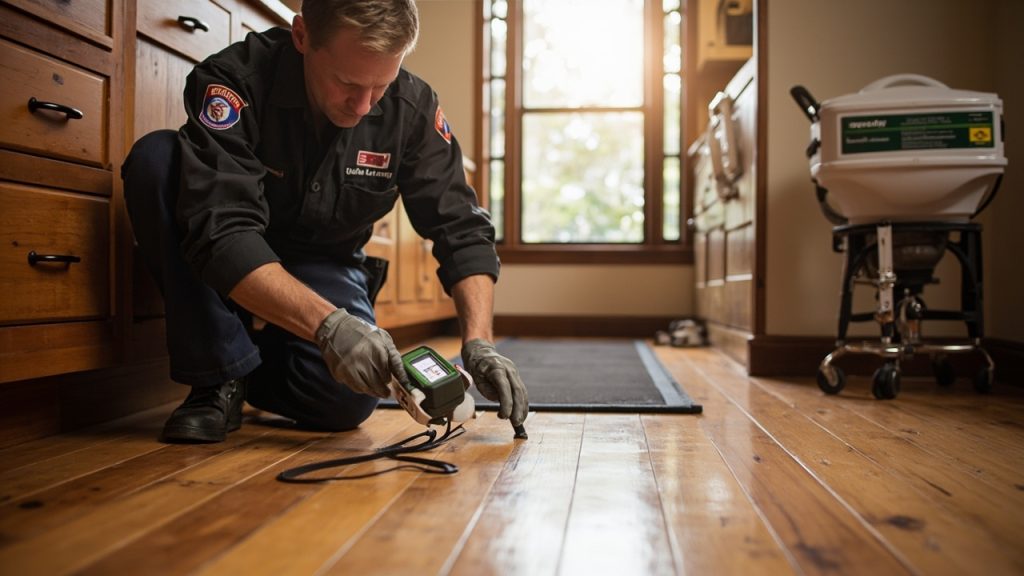
Wallingford Hardwood Floor Water Damage Restoration — 24/7 Emergency Service
Your dishwasher failed overnight. By morning, the water has wicked under your original Douglas fir floors — the same ones that came with your 1920s Craftsman bungalow near N 45th Street. Now the planks are starting to cup. You have a narrow window to save them. The answer to whether your floors can be saved is almost always yes, but only if you act fast and call a crew that knows what they are doing with historic wood flooring.
At Evergreen Water Damage Restoration Seattle, we are on-site in 60 minutes or less anywhere in the 98103 ZIP code. We carry the equipment and certifications to dry your hardwoods from the inside out, not just the surface.

Why Wallingford Homes Face a Higher Risk of Permanent Floor Damage
Wallingford sits in one of Seattle’s most concentrated pockets of pre-war housing stock. The bungalows and Craftsman homes between Tangletown and the southern edge of Green Lake were built when fir and oak were milled thick and laid directly over subfloor boards with no vapor barrier beneath. Those floors are beautiful. They are also porous and extremely reactive to moisture.
Seattle’s average annual precipitation runs above 37 inches, and the Puget Sound climate keeps relative humidity elevated for most of the year. That ambient moisture means your subfloor is never truly dry to begin with. When a dishwasher leak adds standing water on top of an already-damp subfloor, saturation happens fast. The clay-heavy glacial soils under much of Seattle’s older neighborhoods also restrict drainage, so water has nowhere to go but up.
If your home has a crawl space, which most Wallingford Craftsmans do, water from a kitchen leak can migrate down through the subfloor and pool in the crawl space within hours. That creates a secondary moisture reservoir that feeds the flooring from below even after you mop the surface dry. This is why surface drying alone never works on these homes.
What Actually Happens to Your Hardwood When It Gets Wet
Wood absorbs water into its cell walls. As the cells expand unevenly — faster on the bottom face than the top — individual planks deform. You will see two primary failure modes in Wallingford homes.
Cupping happens when the bottom of the plank absorbs more moisture than the top. The edges rise and the center sinks. You can see and feel the washboard effect across the floor. Cupping is the first sign of water intrusion and, if caught early, is often reversible.
Crowning is the opposite. It typically occurs after someone dries the top surface too aggressively — using fans pointed straight down — while the bottom remains wet. The top face swells faster than the bottom, pushing the center of the plank upward. Crowning is harder to reverse and sometimes requires sanding after full drying.
Beyond deformation, saturated wood creates the conditions for mold colonization. Mold spores already present in Seattle’s damp air can begin germinating on wet wood in as little as 24 to 48 hours. Learn more about what cupping and buckling mean for your specific floor type. Once mold establishes under the planks or in the subfloor, remediation cost increases significantly and full replacement becomes more likely.

What to Do Before the Crew Arrives
- Stop the Source
Shut off the water supply valve under the sink or at the main shutoff. A dishwasher typically connects to the hot water supply line. No drying process works if water is still flowing.
- Remove Standing Water with Towels or a Wet Vac
Do not use a regular household fan yet — directing airflow over wet wood before moisture mapping can cause crowning. Just remove the bulk liquid from the surface.
- Move Furniture Off the Floor
Heavy furniture sitting on wet hardwood creates pressure points and accelerates warping. Move pieces to a dry room or place them on plastic sheeting.
- Open Cabinet Doors Under the Sink
The cabinet base directly under the dishwasher and adjacent sink area is often soaked through. Opening those doors increases airflow while you wait and helps the crew assess saturation depth faster on arrival.
- Document Everything for Insurance
Take photos and short videos of all visible water, the affected floor area, and the dishwasher itself. Time-stamp them. This documentation is critical when you file your claim.
- Do Not Use a Hair Dryer or Space Heater
Rapid surface heat dries the top face of the plank without touching the subfloor moisture. This causes crowning and can lock moisture in place rather than extracting it.
Our 5-Step Wood Floor Recovery Process
Our IICRC-certified technicians follow a structured protocol based on the S500 Standard for Professional Water Damage Restoration and the S520 Standard for Mold Remediation. Here is what that looks like in your Wallingford kitchen.
- Moisture Mapping and Assessment. We use calibrated pin and pinless moisture meters along with a thermal imaging camera to map the exact spread of moisture — both above and below the subfloor. Normal equilibrium moisture content (EMC) for interior wood in Seattle typically runs between 9 and 13 percent. Saturated planks after a dishwasher leak often read 25 to 40 percent or higher. We document every reading.
- Emergency Water Extraction. Truck-mounted and portable extractors pull bulk water from the surface and between plank seams. For older Wallingford floors with wider gaps between boards, this step alone removes a significant volume of water that would otherwise continue wicking downward. Read more about our rapid response flood extraction process.
- Injectidry System Installation. This is the step that separates professional hardwood drying from any DIY attempt. The Injectidry system uses a network of floor mats and negative-pressure hoses to draw warm, dry air directly between the planks and under them. It dries the wood from the inside out, which prevents crowning. Standard box fans do not do this.
- LGR Dehumidification. Low-grain refrigerant (LGR) dehumidifiers are placed strategically throughout the affected zone. LGR units can pull moisture from air with relative humidity as low as 20 percent — far more effective than consumer-grade units, especially in Seattle’s persistently damp climate. We also run air movers in a vortex pattern to accelerate evaporation and channel humid air directly into the dehumidifier intake.
- Daily Monitoring and Drying Validation. We return daily to take moisture readings and adjust equipment placement. Drying a hardwood floor in a Wallingford home typically takes 3 to 7 days depending on plank thickness, species, and subfloor saturation depth. We do not pull equipment until the wood reads at or near its baseline EMC for your specific home. The EPA’s guidance on moisture and mold confirms that wood must reach dry standard before any remediation work is considered complete.
Subfloor Assessment and Mold Prevention in Seattle’s Climate
The subfloor beneath your Wallingford kitchen floor deserves as much attention as the surface planks. Older homes in the 98103 ZIP code often have layered subfloors — original board sheathing from the 1920s topped with plywood added during a mid-century remodel. Water can become trapped between those layers and stay there for weeks even after the surface appears dry.
We probe the subfloor at multiple points and, when necessary, create small inspection access points to assess moisture levels beneath the layers. If saturation is significant, we may recommend crawl space cleanup and encapsulation as part of a complete drying plan.
Mold prevention is not optional in Seattle. The combination of organic material (wood), moisture, and ambient temperatures between 55 and 70 degrees creates near-perfect germination conditions for Stachybotrys, Cladosporium, and Penicillium species. We apply EPA-registered antimicrobial treatments to exposed subfloor surfaces after extraction as a preventive measure. If we find existing mold growth, we shift to a full mold remediation protocol.
For more on what hidden mold looks like before it becomes visible, see our resource on signs of hidden mold.

Restoration vs. Replacement — What the Data Actually Shows
One of the most common questions we hear from Wallingford homeowners is whether to save the floor or replace it. The answer depends on species, plank thickness, saturation duration, and whether the subfloor is compromised. Here is how we frame the decision.
| Condition at Time of Call | Likely Outcome | Process |
|---|---|---|
| Cupping present, no mold, called within 24 hours | High probability of full restoration | Injectidry drying, monitor, sand and refinish if needed |
| Cupping present, minor cupping, called within 48 hours | Moderate-to-high probability of restoration | Injectidry drying, targeted sanding, refinish |
| Crowning, mold present, 72+ hours of exposure | Partial replacement likely for worst planks | Dry, remediate mold, replace damaged sections |
| Severe buckling, subfloor compromised, Category 2 or 3 water | Full replacement recommended | Full tear-out, subfloor remediation, new installation |
Original Douglas fir floors in Wallingford homes are typically 3/4 inch thick and can be sanded 2 to 3 more times before they are too thin to refinish. That gives restoration a meaningful advantage over replacement — both in cost and in preserving the character of a historic home. Engineered hardwood, which appears in some mid-century remodels throughout Fremont and Green Lake, has a thinner wear layer and is generally less tolerant of prolonged moisture exposure.
Hardwood Species Common in Wallingford and How They Respond to Water
| Species | Common Era in Wallingford Homes | Water Sensitivity | Restoration Candidacy |
|---|---|---|---|
| Douglas Fir (original) | 1900s to 1940s | Moderate to high — soft grain absorbs quickly | Excellent if caught early |
| Red Oak | 1940s to 1970s | Moderate — open grain absorbs water but dries evenly | Very good |
| Maple | 1950s to 1980s | Low to moderate — dense grain resists initial penetration | Excellent |
| Engineered Hardwood | 1990s to present | High — delamination risk if core gets wet | Fair — depends on core saturation |
How to Handle Your Insurance Claim for Hardwood Floor Water Damage
A dishwasher leak is typically classified as sudden and accidental water damage, which most standard homeowner policies cover. The key is documentation and speed. Delayed reporting or delayed remediation can give an insurer grounds to deny coverage on the basis of neglect.
Here is what we recommend for Wallingford homeowners working through a claim.
- Call your insurer before any major work begins (extraction is fine — that is mitigation, not repair).
- Request a written scope of loss from your adjuster.
- Get our moisture readings documented in a formal drying log — insurers expect this from IICRC-certified restorers.
- Keep all receipts for temporary measures you took before we arrived.
- If your insurer disputes the restoration method, ask for the IICRC S500 standard as justification for the drying approach.
For a deeper look at working through the claims process, see our guide on how to handle insurance claims for water damage. You can also review IICRC certification and drying standards to understand why your insurer should accept our documented methodology.
One specific issue we see repeatedly in older Wallingford and Capitol Hill homes — historic plank floors that predate modern flooring categories. If your adjuster tries to price replacement using modern engineered wood as the comparable, push back. Original Douglas fir has a higher replacement cost and requires a qualified craftsman to match. Document the species and age before the adjuster visits.
You may also want to review our current water damage restoration cost guide to understand what factors drive pricing so you can review your adjuster’s estimate with confidence.
What Happens If You Wait
The 24-to-48-hour window is real. After that threshold, the restoration equation shifts. Mold begins forming. Subfloor materials — especially the OSB or plywood used in older Seattle remodels — begin to delaminate and swell. Once subfloor integrity fails, you are no longer just refinishing floors. You are doing structural work.
We have worked in homes near the Lake Union waterfront and in the Tangletown neighborhood where a slow appliance leak ran undetected for several weeks. In those situations, the subfloor had to come out entirely. The original fir planks above them could not be saved because the support beneath them had failed. The cost difference between a 24-hour call and a 3-week delay is dramatic.
If you are dealing with a related issue like swollen baseboards and trim or elevated indoor humidity from the same event, those need attention at the same time as the floor.
The risks of attempting to handle this yourself go beyond the floor surface. DIY water cleanup carries real risks that are not obvious until mold or structural damage surfaces weeks later.
Frequently Asked Questions
How long does it take to dry hardwood floors after a dishwasher leak?
With professional Injectidry equipment and LGR dehumidifiers, most hardwood floors in Wallingford homes dry in 3 to 7 days. Thicker original fir planks or those with saturated subfloors may require closer to 7 to 10 days. We take daily moisture readings and do not remove equipment until readings reach target EMC for your specific floor species and home conditions.
Will my homeowner’s insurance cover hardwood floor drying after a dishwasher leak?
In most cases, yes. Sudden and accidental discharge — which includes a dishwasher supply line failure or a door seal leak — is a covered peril under standard homeowner policies in Washington State. Coverage for gradual leaks that went undetected may be contested. Document everything and call your insurer the same day.
Is mold a real risk under my kitchen floor after a dishwasher leak?
Yes, especially in Seattle’s climate. Mold can begin germinating on wet organic material within 24 to 48 hours at indoor temperatures. Subfloors in Wallingford’s older homes are particularly vulnerable because they have never had vapor barriers. If water reached the subfloor, antimicrobial treatment is part of our standard protocol. If mold is already present, we move into full mold containment and remediation.
Can cupped hardwood floors go back to flat on their own?
Occasionally, mild cupping will relax as ambient humidity normalizes. But relying on that in Seattle’s climate is a mistake. Without active drying, the wood stays at elevated moisture content for weeks, increasing mold risk and making permanent deformation more likely. Sand-and-refinish can correct residual cupping after the floor is fully dry, but only if the planks have enough material remaining.
Do you serve neighborhoods near Wallingford like Fremont and Green Lake?
Yes. We serve the full 98103 and surrounding ZIP codes, including Fremont, Green Lake, Ballard, and Queen Anne. Response time in these neighborhoods is typically under 60 minutes. We also serve broader Seattle communities — from Shoreline to Bellevue and Burien.
If you are looking at a dishwasher leak right now, do not wait to see if the floors dry on their own. Call Evergreen Water Damage Restoration Seattle for 24/7 emergency service. We will be at your door within the hour, and we will give you an honest assessment of exactly what your floors need — and what they do not. Your original hardwoods are worth protecting.