

Your guest bathroom sat quiet for months. Then the holidays arrived, and suddenly four extra people used it every day for a week. Now you smell something musty, the baseboard feels soft, or you spot a water stain spreading across the ceiling below. Your guests did not cause a freak accident. They exposed a vulnerability that was already there.
This guide covers exactly why that happens, how to find the damage, and what professional water damage restoration looks like for guest bathrooms in Fairmount Park and the surrounding Philadelphia neighborhoods.

Why Increased Guest Usage Triggers Plumbing Leaks
A guest bathroom that sees low traffic develops specific failure points. The shift from zero use to heavy use is often what pushes those weak points over the edge.
Dried-Out P-Traps and Wax Ring Failures
The P-trap under your guest bathroom sink holds a small reservoir of water that blocks sewer gas. When a bathroom goes unused for months, that water evaporates. A dry P-trap does not cause a leak on its own, but the sudden surge of water through a dried seal can dislodge buildup and crack older PVC fittings.
Wax ring failures are more serious. The wax ring seals the base of your toilet to the drain flange. In the rowhomes that line the blocks of Fairmount, Spring Garden, and Brewerytown, floor framing around that flange may have shifted over a century or more of settling. Four guests flushing repeatedly adds mechanical stress to a wax ring that was already compressed unevenly. When it fails, water escapes at the toilet base and wicks directly into the subfloor with every flush. Philadelphia rowhomes carry an added vulnerability here because shared wall plumbing stacks in attached construction allow a leak at one unit to migrate laterally before it ever shows a visible sign at the source.
Angle Stop Leaks From Lack of Use
The angle stop valve is the small shut-off fitting behind your toilet and under your sink. These valves can seize from disuse. When a guest turns on the faucet or flushes for the first time, the supply line experiences a pressure spike it has not felt in months. Older brass angle stops in homes built before Philadelphia updated its residential plumbing standards can weep or fail at the packing nut under this kind of sudden demand. Much of the housing stock in Fairmount and the Art Museum area dates to the late 1800s and early 1900s, making aged angle stops a routine finding during restoration assessments.
Supply Line Bursts Under Holiday Pressure
Braided stainless supply lines have a service life. A line that looks fine to the eye may have internal corrosion or a cracked ferrule. Multiple guests using the toilet in rapid succession cycles the line’s pressure repeatedly. That repeated cycling causes supply line bursts, and a burst supply line can release dozens of gallons before anyone notices.
Groundwater Pressure Near the Schuylkill River
Fairmount Park sits adjacent to the Schuylkill River, and the neighborhoods bordering the park sit on a water table that stays high through much of the year. Elevated groundwater pressure increases the load on basement drain systems and floor-level plumbing connections. When a guest bathroom leak sends water downward through the floor assembly, that water encounters a subfloor environment that already fights upward moisture pressure from below. The result is saturation that spreads faster and dries more slowly than in drier urban conditions.
Warning Signs in Your Fairmount Park Guest Bathroom Right Now
Guest bathrooms hide leaks well because nobody checks them regularly. These signs tell you that water damage is already underway.
- A musty or earthy smell that appears after guests leave, even with a clean toilet and fresh towels
- Soft or spongy floor near the toilet base, a direct signal of subfloor saturation
- Peeling or bubbling paint on the bathroom wall or the ceiling of the room below
- A water stain ring on the ceiling below a second-floor guest bathroom
- Visible rust streaking around the escutcheon plate where supply lines meet the wall
- The toilet rocks slightly when you sit down, which suggests wax ring or flange failure
- Swollen or discolored baseboard trim at floor level
Any one of these signs warrants immediate investigation. Philadelphia’s climate combines cold winters with humid summers and persistent moisture through much of the year. Indoor relative humidity in older Fairmount and Spring Garden rowhomes stays elevated because the thick masonry walls common in that era absorb and release moisture slowly. Water trapped inside a wall or subfloor can grow mold within 24 to 48 hours. You have a short window.
How to Shut Off Water in a Philadelphia Rowhome
Speed matters more than anything else in the first minutes after a guest bathroom plumbing leak. Find the source and cut the water supply before you do anything else.
- Use the local angle stop first.
Turn the angle stop valve clockwise behind the toilet or under the sink. This isolates the single fixture without cutting water to the rest of the house. In newer construction along the Art Museum area and Fishtown, these valves are usually quarter-turn ball valves that stop flow immediately.
- Locate the main shut-off if the angle stop fails or is stuck.
In most Philadelphia rowhomes, the main shut-off valve sits in the basement near where the water service enters the foundation wall. In older Fairmount and Kensington homes, the shut-off is often a gate valve that may require multiple full turns to close completely.
- Contact Philadelphia Water Department if you cannot shut off at the meter.
Philadelphia Water Department manages the curb stop valve at the street. If your main valve fails or is inaccessible, Philadelphia Water Department can shut off service at the curb stop. Save their emergency contact number in your phone before you need it.
- Document everything before cleanup begins.
Photograph all visible water, staining, and damage from multiple angles before you touch anything. Your insurance adjuster will need this documentation, and so will the restoration crew.
- Do not use fans or personal space heaters to dry the area.
Consumer-grade fans push humid air around rather than extracting moisture. In Philadelphia’s already-humid air near the Schuylkill, this can spread moisture into adjacent materials without drying the saturated ones. Wait for professional-grade equipment.
Hidden Damage Behind the Walls and Under the Floor
What you can see is rarely the full picture. A guest bathroom plumbing leak that went unnoticed for even three days can saturate wall cavities and subfloor panels well beyond the visible wet area.
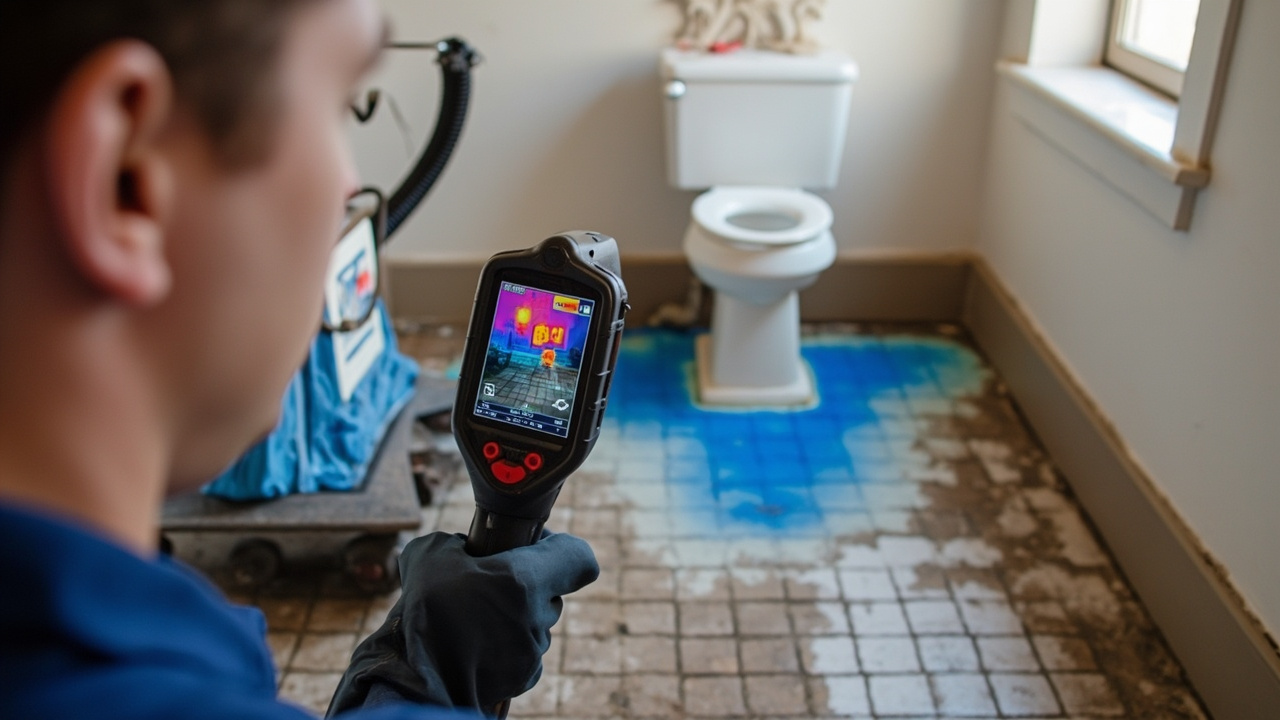
Trained restoration technicians use thermal imaging cameras to detect temperature differentials in wall surfaces caused by evaporative cooling of wet materials. They also use moisture mapping, a grid-based survey of moisture readings across walls, floors, and ceilings using calibrated moisture meters. This process follows IICRC S500 Standards, the industry benchmark for water damage restoration.
In Philadelphia rowhomes with plaster walls, common throughout Fairmount, Spring Garden, and the blocks surrounding Fairmount Park, moisture migration behaves differently than in modern drywall construction. Wet materials expand the wet zone beyond what the surface shows because water travels further horizontally along plaster before producing visible surface signs. Shared wall plumbing stacks in rowhome construction create an additional pathway. A leak originating at one unit’s toilet flange can travel along the shared masonry wall into the adjacent unit’s framing before either owner sees a visible sign.
The 4-Step Restoration Process for Guest Bathroom Water Damage
| Step | What Technicians Do | Equipment Used | Typical Duration |
|---|---|---|---|
| 1. Extraction | Remove all standing and pooled water from floors, cavities, and subfloor | Truck-mounted or portable extraction units, weighted extraction tools | 1 to 3 hours |
| 2. Structural Drying | Set drying systems targeting walls, subfloor, and vanity framing | LGR (Low Grain Refrigerant) dehumidifiers, axial air movers, desiccant units | 3 to 5 days |
| 3. Sanitization | Apply antimicrobial treatment to all affected surfaces to stop mold colonization | EPA-registered antimicrobial agents, HEPA air scrubbers | Same day as drying setup |
| 4. Build-Back | Replace subfloor panels, drywall, baseboards, and any flooring damaged beyond drying | Standard carpentry and finish tools, moisture verification meters | 1 to 7 days depending on scope |
LGR dehumidifiers are the workhorses of structural drying. They pull moisture grain content from the air far below what a standard dehumidifier can achieve, which speeds up evaporation from wet materials. This is critical in Philadelphia where ambient humidity near the Schuylkill River corridor fights the drying process the entire time.
Psychrometrics, the science of air temperature, humidity, and moisture movement, guides every drying decision a certified technician makes. They adjust air mover placement and dehumidifier output daily based on moisture readings, not guesswork.
Black Water vs. Grey Water in Guest Bathrooms
The water category matters for both safety and restoration cost. A supply line burst produces clean water (Category 1). A toilet overflow with sewage produces black water (Category 3), which carries pathogens and requires a completely different decontamination protocol under IICRC S500 Standards.
Most guest bathroom supply line and angle stop failures produce Category 1 or Category 2 (grey water) losses. A wax ring failure that allows toilet bowl water to escape falls into Category 2, meaning it contains contaminants but not raw sewage. Philadelphia’s combined sewer overflow (CSO) system creates an important exception. During heavy rain events, the CSO system can push combined stormwater and sanitary sewage backward into building drains, which upgrades any bathroom floor drain or toilet backup to Category 3. Technicians must classify the loss correctly before determining which materials they can dry in place and which they must remove and discard.
Philadelphia-Specific Factors That Make Guest Bathroom Leaks Worse
Philadelphia’s climate and building stock create conditions that turn a small guest bathroom leak into a significant restoration job faster than most homeowners expect.
The age of the housing stock in Fairmount, Spring Garden, and Brewerytown is one of the most significant factors. Many of these rowhomes were built between 1870 and 1930. The original galvanized steel supply lines in these homes corroded from the inside out over decades. These pipes look intact from the outside but carry reduced flow and harbor pitting that leads to pinhole leaks under pressure. Holiday guest usage is often the trigger event that turns a compromised galvanized line into an active leak.
The masonry construction common in Philadelphia rowhomes holds moisture differently than wood-frame houses. Brick walls absorb water and release it slowly, which means the wet zone around a plumbing leak stays active for days longer than in a wood-frame structure. Restoration crews must account for this extended release when setting drying equipment.
Pennsylvania’s energy code provisions for vapor retarders in exterior wall assemblies also affect how restoration crews work in newer Philadelphia construction and in rowhomes that have undergone modern renovations. Vapor retarder placement can trap moisture during restoration if drying equipment placement does not account for it. An experienced crew knows to modify airflow patterns to dry both sides of that barrier layer.
Kensington and Fishtown properties share the same rowhome plumbing stack vulnerabilities as Fairmount Park neighbors. A second-floor guest bathroom leak in any of these neighborhoods can send water down through the floor assembly and into the ceiling of the room below within hours of a supply line failure upstairs.
Cost Factors for Guest Bathroom Water Damage Restoration in Philadelphia
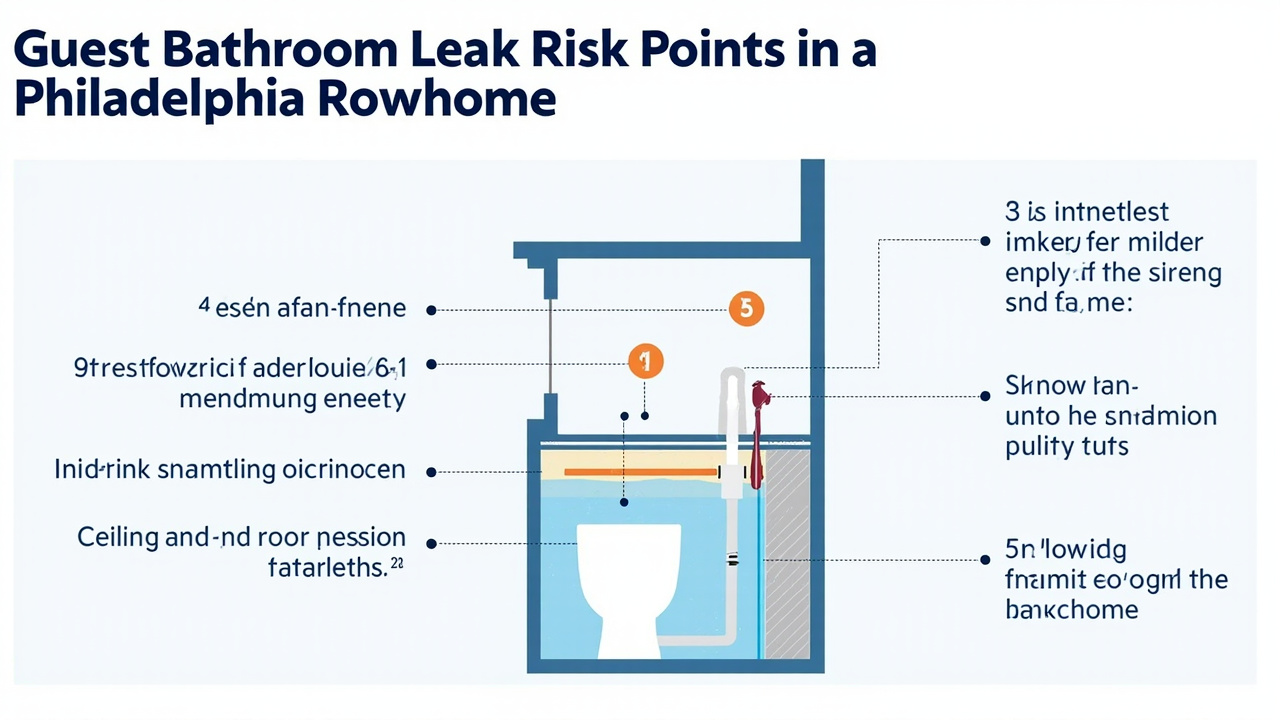
| Factor | Why It Affects Cost | Philadelphia-Specific Note |
|---|---|---|
| Water category | Category 3 requires full PPE, disposal of contaminated materials, and deeper sanitization | CSO system backups in Fairmount Park-adjacent properties can upgrade losses to Category 3 during storms |
| Affected area size | Larger wet zones require more equipment and longer drying cycles | Plaster walls in historic Philadelphia rowhomes expand the wet zone faster than modern drywall |
| Subfloor material | OSB subfloor absorbs water more aggressively than plywood and often requires replacement | Many Fairmount and Spring Garden rowhomes have original plank subfloor that can delaminate if dried too slowly |
| Access difficulty | Shared wall plumbing stacks, multi-story rowhome layouts, and finished ceilings increase labor | Philadelphia rowhomes with multi-story plumbing stacks often require ceiling demolition for lower-floor drying |
| Mold presence | Pre-existing mold discovered during restoration adds remediation scope and cost | Philadelphia’s year-round humidity near the Schuylkill means mold is often already present before a leak triggers discovery |
| Build-back scope | Tile, custom vanities, and specialty flooring cost more to restore than standard materials | Higher-end finishes in Art Museum area renovations increase this factor significantly |
Managing Your Insurance Claim for a Guest Bathroom Leak
Most Philadelphia homeowners’ insurance policies cover sudden and accidental water damage from plumbing failures. A supply line burst qualifies in most cases. A slow, long-term leak from a dried wax ring may face a coverage dispute if the adjuster determines the damage was gradual and should have been caught earlier.
Your documentation from the first minutes after discovery becomes critical here. Timestamped photos, written descriptions of when you first noticed symptoms, and a professional moisture assessment report all support your claim. A restoration company that provides written moisture mapping reports gives your adjuster the technical data they need to process the claim faster.
The IICRC ANSI S500 Standard for Professional Water Damage Restoration sets the protocols that restoration companies must follow. Knowing this standard exists helps you verify that any company you hire works to a measurable professional benchmark, not guesswork.
Before you authorize any work, verify Pennsylvania contractor licensing through the Bureau of Labor and Industry. You want to confirm that whoever enters your home holds active licensure and carries liability coverage that protects you if something goes wrong during the restoration. Check license status directly through Pennsylvania’s online contractor license lookup through the Bureau of Labor and Industry.
Why Waiting Makes Everything Harder
Every hour matters after a guest bathroom plumbing leak. Wet drywall paper becomes a mold substrate within 24 to 48 hours at Philadelphia’s typical indoor humidity levels. OSB subfloor panels that stay wet for more than 72 hours typically delaminate and require full replacement rather than in-place drying. A wax ring failure that seems like a minor toilet seal issue can saturate floor joists below, which adds structural repair to what started as a plumbing problem.
The same principle applies to secondary spaces. Water from a second-floor guest bathroom travels down through the floor assembly and into the ceiling of the room below. That ceiling drywall holds absorbed moisture long after the bathroom floor looks dry. Technicians must assess both floors independently. Delaying even one day after visible signs appear can push a straightforward extraction-and-dry job into a full demolition and rebuild.
Frequently Asked Questions
How long does it take to dry out a guest bathroom after a plumbing leak?
Most guest bathroom water damage requires 3 to 5 days of continuous structural drying with LGR dehumidifiers and air movers. A certified technician verifies dryness with daily moisture readings rather than a fixed calendar, because Philadelphia’s ambient humidity near the Schuylkill River corridor can slow the process in poorly ventilated rowhome spaces.
Can mold grow under bathroom tile after a wax ring failure?
Yes. Mold grows on the paper face of the drywall or cement board substrate beneath the tile, and on the wood subfloor if the moisture penetrated that far. The tile itself does not support mold, but everything behind it can. Thermal imaging helps technicians find this hidden growth without full demolition in some cases.
Does homeowners insurance cover a wax ring failure in Philadelphia?
Coverage depends on your policy language and how the adjuster classifies the loss. Sudden failures typically qualify for coverage. Gradual leaks that created long-term damage may face a denial based on the homeowner’s duty to maintain. Prompt reporting and professional documentation improve your position significantly.
Do older Philadelphia neighborhoods face higher risk of drain backups during storms?
Properties along the Passyunk Avenue corridor and throughout South Philadelphia sit above combined sewer infrastructure that Philadelphia Water Department built in the late 1800s. During heavy rain events, those older combined lines carry both stormwater and sanitary sewage, and the system can push water backward into building drains faster than it can discharge through the street mains. Philadelphia Water Department has mapped the highest-risk blocks for this type of backup, and homeowners in those areas benefit from a backwater valve inspection before the next storm season adds pressure to an already stressed system.
Your guest bathroom gave you a warning. Act on it before the next holiday season turns a manageable repair into a full structural restoration. Call us right now at any hour for a 24/7 emergency moisture inspection. Our team reaches Fairmount Park and the surrounding Philadelphia neighborhoods, including Brewerytown, Spring Garden, Fishtown, and the Art Museum area, with a certified technician on-site within 60 minutes of your call. We assess the full extent of the damage with thermal imaging and moisture mapping and start structural drying the same day. Do not wait for the smell to get worse or the ceiling below to collapse. Call now and get a certified technician on-site within the hour.