
When Water Hits Your Redmond Office, Every Hour Has a Price Tag
A pipe fails overnight in your Overlake tech corridor. By 7 AM, a facilities manager is standing in three inches of water inside a 20,000-square-foot office suite. The server room door is shut tight. The carpet tiles are saturated. And your team is scheduled to arrive in two hours.
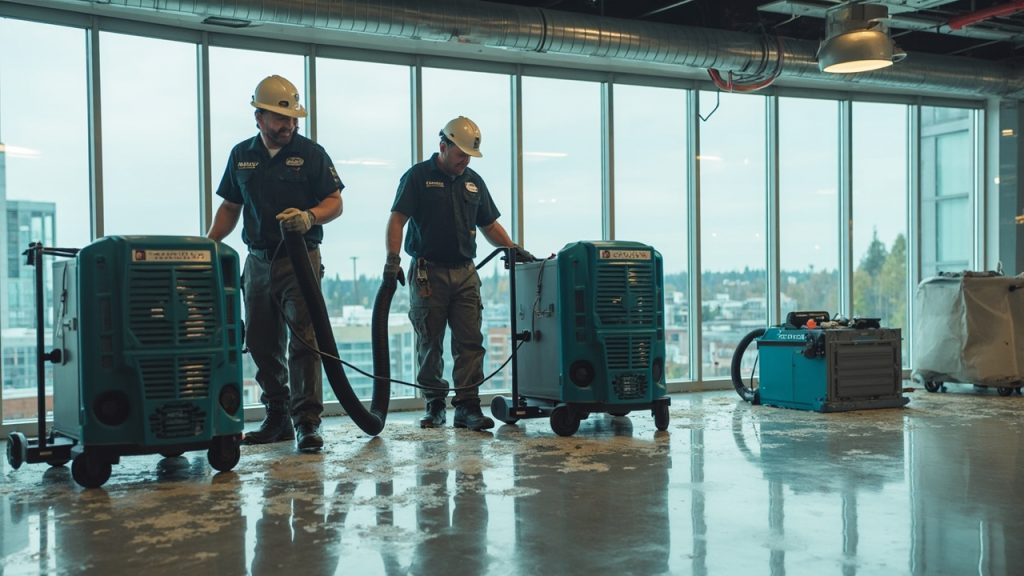
This is the scenario that defines commercial water damage in Redmond. It is not just property destruction. It is an operational crisis. At Evergreen Water Damage Restoration, we respond to these events specifically — not with residential-grade equipment loaded in a van, but with industrial mitigation resources sized for commercial loss.
If your facility is near the Microsoft Campus on NE 36th Street, in the Redmond Town Center retail corridor, or in the Bear Creek business parks off Highway 202, response time from our team is under 60 minutes. That window matters. The difference between a 4-hour loss and a 4-week closure often comes down to when extraction starts.
What Makes Commercial Water Damage Different From Residential
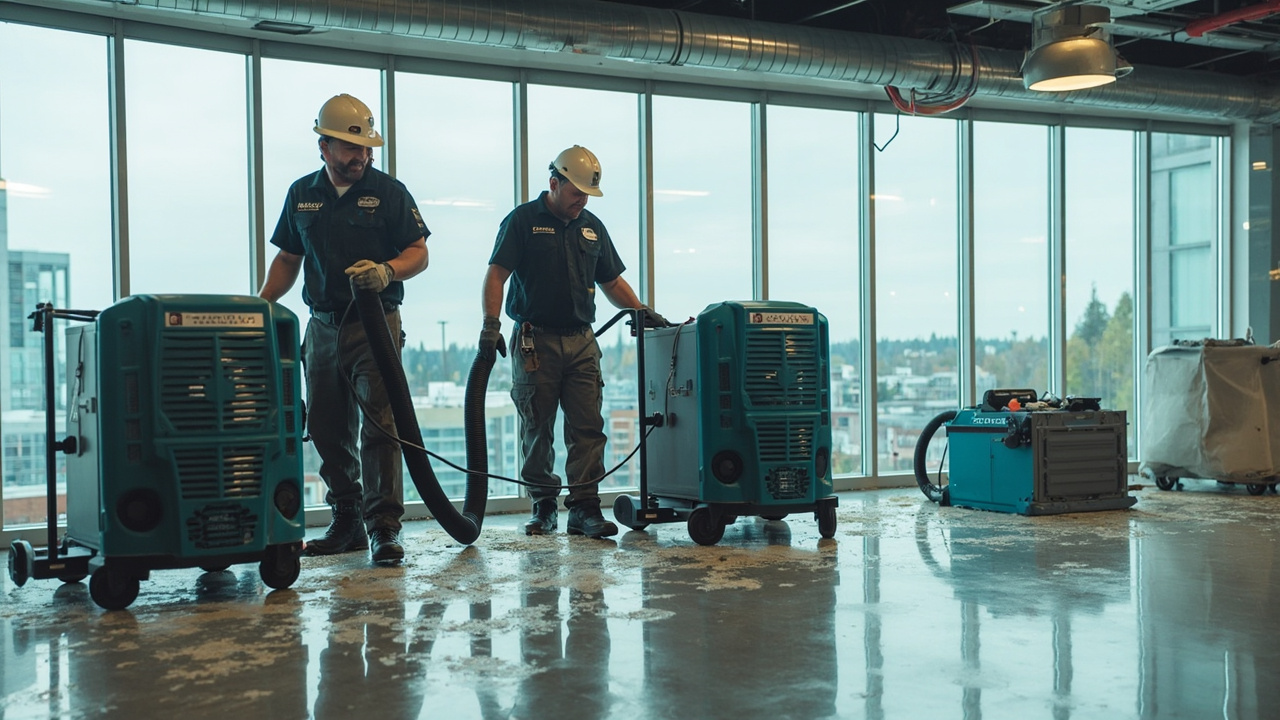
The physics of drying a 1,200-square-foot home and a 15,000-square-foot multi-tenant office floor are completely different problems. Residential jobs use standard Low Grain Refrigerant (LGR) dehumidifiers and axial air movers. Commercial jobs require a psychrometric approach — meaning the drying plan is built from calculated humidity ratios, dew points, and grain-per-pound measurements across every zone.
Redmond’s climate makes this harder. The Puget Sound region averages over 37 inches of annual precipitation, and the persistent cloud cover keeps outdoor relative humidity elevated for much of the year. That ambient moisture load fights against your drying process. You cannot simply open windows and run box fans. Without industrial dehumidification, you are fighting the Pacific Northwest itself.
Commercial structures also involve materials that residential drying protocols were never designed to handle — raised access flooring over data cable runs, drop ceiling grids with saturated mineral fiber tiles, and gypsum partition walls with internal insulation. Each of these materials requires a different drying target and a different monitoring schedule.
The Specific Risks Inside Redmond’s Tech Office Inventory
Redmond’s commercial real estate is dominated by tech-sector tenants. That means facilities managers here are not just managing wet carpet. They are managing electrostatic discharge (ESD) risk in hardware labs, moisture intrusion near server racks, and humidity levels that can destroy optical equipment. Water and electronics do not share a timeline — electronics must be protected within the first hour.
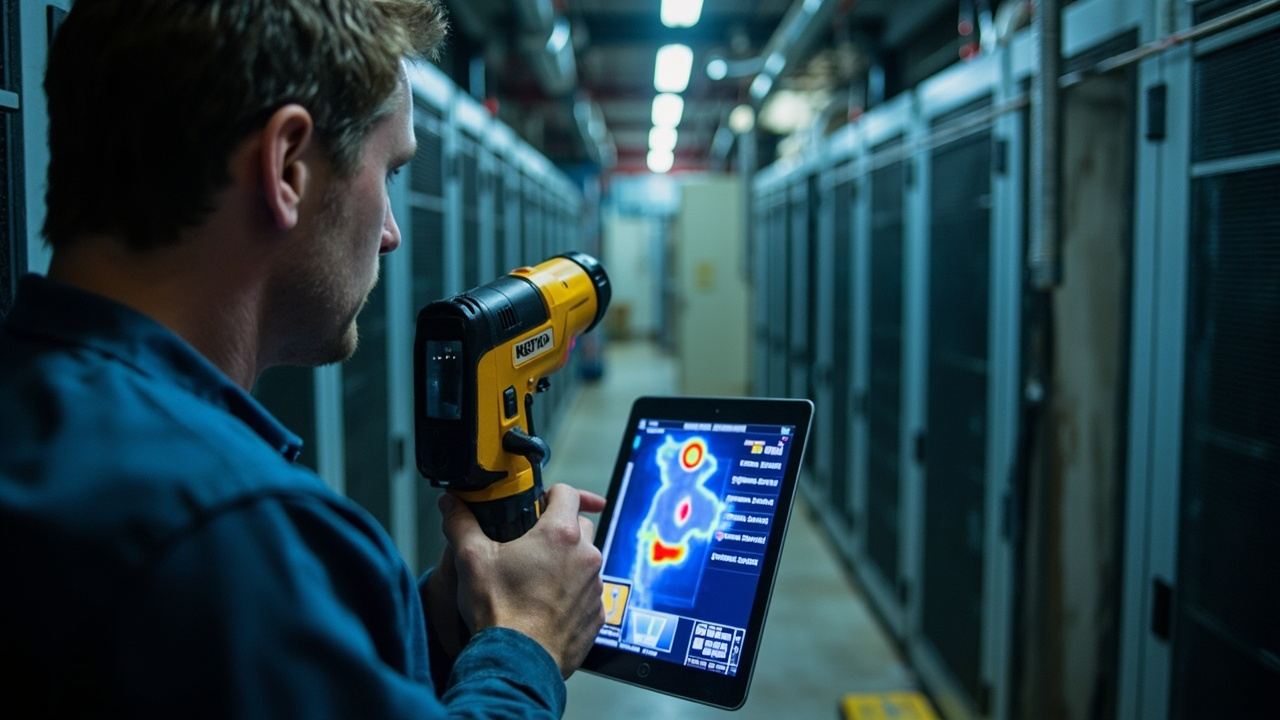
Our technicians are trained to address server room water damage as a separate containment priority. That means immediate humidity suppression in IT-adjacent spaces before we move to the broader structural drying scope. We also document every affected zone with thermal imaging cameras for insurance and liability records.
The Commercial Restoration Process Step by Step
- Emergency Dispatch and Site Assessment
We arrive on-site within 60 minutes of your call for Redmond locations. The lead technician performs a moisture mapping inspection using thermal imaging and pin-type moisture meters. Every affected material — concrete slab, drywall, suspended ceiling, flooring system — gets documented before extraction begins.
- Water Category Classification
We classify the water source using the IICRC S500 standard. Category 1 (clean water from a supply line break) has a different remediation scope than Category 3 (black water from a sewage backup or exterior flooding event). Getting this classification wrong affects both your health safety protocol and your insurance claim. For commercial sewage events, see our commercial sewage cleanup process.
- Industrial Water Extraction
Truck-mounted extractors remove standing water at rates exceeding 25,000 gallons per hour for large-loss events. We use weighted extraction tools on carpet systems and specialty wands for hard surface flooring to pull water from the substrate, not just the surface layer.
- Structural Drying Setup
We place industrial desiccant or LGR dehumidifiers and high-velocity air movers based on calculated drying zone ratios. In Redmond office environments with complex floor plans, we typically run one dehumidifier per 500 to 800 square feet of affected space, adjusted for ceiling height and material density.
- Daily Psychrometric Monitoring
Each morning, a certified technician records temperature, relative humidity, specific humidity, and dew point at every monitoring station. These readings get entered into drying documentation software that produces the daily logs your insurance adjuster will require.
- Antimicrobial Application and Mold Prevention
If materials stay wet past 48 to 72 hours, microbial growth becomes probable. We apply EPA-registered antimicrobial agents to at-risk surfaces as a standard commercial protocol — not an upsell. In Redmond’s climate, skipping this step is not an option.
- Controlled Demolition When Required
Saturated gypsum wallboard, wet insulation, and compromised flooring systems that cannot reach drying targets get removed. We perform this scope with negative air pressure containment to protect the dry zones of your facility and keep operations running in unaffected areas.
- Final Clearance and Documentation Package
At project close, we provide a full documentation package — moisture logs, thermal images, equipment placement records, and a signed clearance report. This package goes directly to your commercial insurance adjuster.
Equipment Comparison for Commercial vs Residential Drying
One of the biggest mistakes facility managers make when choosing a restoration vendor is assuming all water damage companies operate the same equipment. They do not. Here is a direct comparison of what gets used on residential jobs versus what a commercial large-loss event in Redmond actually requires.
| Equipment Type | Residential Grade | Commercial Grade (Required for Redmond Offices) |
|---|---|---|
| Dehumidification | LGR residential units, 90-120 pints/day | Industrial LGR or desiccant units, 300-800 pints/day per unit |
| Air Movement | Axial air movers, 1,500-2,000 CFM | High-velocity centrifugal blowers, 3,000-5,000 CFM |
| Water Extraction | Portable electric extractors, 100-150 GPH | Truck-mount or trailer-mount systems, 1,000+ GPH |
| Air Quality | Standard air movers only | HEPA air scrubbers for particulate filtration during demolition phases |
| Moisture Detection | Pin moisture meters | Thermal imaging cameras plus pin and non-invasive meters across full floor mapping |
| Drying Validation | Basic end-of-job reading | Daily psychrometric logs per IICRC S500 commercial standard |
For large-loss commercial events, we draw on our industrial drying services fleet, which is staged specifically for Eastside King County commercial response. This equipment does not get shared with residential crews on the same day.
Business Continuity Is the Core of Our Commercial Approach
Most restoration companies focus on drying your building. We focus on keeping your business running while we dry your building. Those are two different objectives.
For Redmond tech tenants, retail operators at Redmond Town Center, and warehouse operations near Marymoor Park, every day of closure has a measurable revenue cost. Our approach to business interruption mitigation starts at the initial site assessment.
We triage the floor plan into zones — critical operational areas that need same-day stabilization, and secondary areas that can be contained and dried over a multi-day window. If your break room and a secondary conference room flooded but your production floor is dry, your team works tomorrow. That zoning strategy is built into the first hour of our response, not figured out later.
Working With Facility Managers and Commercial Insurance Adjusters
Commercial water losses involve multiple stakeholders. You have a property owner, a tenant, a commercial general liability carrier, and potentially a business interruption policy all running simultaneously. Adjusters for commercial accounts work differently than residential adjusters — they expect IICRC-compliant documentation, equipment logs, and clear scope narratives.
Our documentation meets the requirements used by most commercial carriers operating in King County. We coordinate directly with your adjuster or TPA (third-party administrator), provide preliminary scope estimates within 24 hours, and flag any supplemental scope changes in writing before we proceed. For guidance on navigating the claims process, see our insurance claims resource.
The IICRC (Institute of Inspection Cleaning and Restoration Certification) sets the industry standards that commercial adjusters recognize. When a technician hands an adjuster documentation that references S500 drying protocols and psychrometric logs, the claim moves faster. That matters for your business interruption timeline.
Response Time Benchmarks for Redmond Commercial Accounts
| Redmond Area Location | Estimated Response Time | Typical Commercial Loss Type |
|---|---|---|
| Overlake (NE 40th St corridor) | Under 45 minutes | Multi-floor office water intrusion, pipe failures |
| Redmond Town Center and adjacent retail | Under 50 minutes | Retail unit flooding, sprinkler activations |
| Bear Creek Business Parks (Hwy 202 zone) | Under 55 minutes | Warehouse flooding, Category 2 and 3 events |
| Marymoor Village area | Under 60 minutes | Mixed-use commercial flooding, slab leaks |
| Downtown Redmond (Leary Way corridor) | Under 45 minutes | Retail and restaurant water intrusion |
We also serve commercial accounts across nearby Kirkland, Bellevue, and Sammamish. Our Kirkland commercial restoration team and Bellevue office water damage crew operate on the same response protocols as our Redmond crews, with shared large-loss equipment staging across the Eastside.
Mold Risk in Commercial Buildings Is a Compliance Issue
Redmond facility managers need to understand that mold in a commercial building is not just a property problem. It is a King County health code issue and a potential OSHA liability. Once visible microbial growth appears, the remediation scope and documentation requirements increase significantly.
Mold growth in commercial drywall cavities can begin within 48 to 72 hours of water intrusion. In Redmond’s ambient humidity conditions, that window can shrink. A water loss that gets addressed within the first four hours rarely develops mold. A loss that sits over a weekend because a facilities team tried to manage it with portable fans almost always does.
Our commercial mold remediation team operates under Washington State Department of Labor and Industries guidelines. We also maintain containment standards during remediation work to prevent cross-contamination of occupied areas — a requirement that generic residential companies frequently miss on commercial jobs.
For detailed information on microbial risks in occupied spaces, the EPA’s mold remediation guide for commercial buildings outlines the scope standards that drive our remediation protocols.
Industries We Serve in the Redmond Commercial Market
- Technology and Software Offices — Server room isolation protocols, ESD-sensitive environment drying, moisture monitoring for hardware-adjacent spaces near the Microsoft Campus corridor.
- Retail and Mixed-Use Properties — Redmond Town Center tenants, restaurant and food service facilities, and storefront retail requiring after-hours extraction to maintain business hours.
- Medical and Professional Offices — Compliance-sensitive environments where documentation integrity and clean dry-out procedures are required. Includes document drying and restoration for records-sensitive operations.
- Warehousing and Light Industrial — High-volume extraction for concrete slab flooding, shelving system protection, and inventory triage across Bear Creek and Highway 520 industrial zones.
- Multi-Tenant Office Buildings — Coordinated response across multiple tenants and property managers, with individual documentation packages per affected unit for insurance purposes.
What Happens If You Wait on a Commercial Water Loss
The decision to call immediately versus waiting to assess the damage yourself is the single biggest cost variable in commercial water restoration. Waiting does not save money. It compounds the loss.
Here is what the timeline looks like when extraction is delayed. Within the first four hours, water migrates under partition walls, into wall cavities, and beneath flooring systems. By hour eight, gypsum wallboard begins to lose structural integrity. By hour 24, insulation in walls becomes saturated and non-salvageable. By hour 48, mold colonization becomes likely in concealed cavities.
Each of those thresholds adds scope to the restoration project. More scope means more cost and more days before your facility is back to full operation. The psychrometric math is straightforward — wet materials dry fastest in the first 48 hours, and drying efficiency drops sharply after that window. Calling our 24/7 emergency water removal team at the first sign of water intrusion is always the correct financial decision for a commercial account.
For Redmond facility managers building formal emergency response protocols, our disaster recovery planning resource outlines the pre-loss agreements and documentation frameworks that the fastest-recovering commercial accounts use.
Getting a Commercial Account Set Up Before a Loss Occurs
The fastest commercial restorations happen when the facility already has a vendor relationship in place. Pre-loss inspections, documented floor plans, and a known contact chain eliminate the 20 to 30 minutes of triage that a new commercial caller has to go through before work can begin.
We offer pre-loss commercial site assessments for Redmond facilities. That includes a baseline moisture reading survey, a documented evacuation route for equipment access, and a stored contact tree that goes directly to our dispatch team at any hour. When water hits, you call one number and work starts — no intake forms, no callback queues.
Reach out to our commercial accounts team through our contact page to schedule a pre-loss assessment for your Redmond facility. If you have an active commercial water loss right now, call us directly. Every minute of the first hour has a disproportionate impact on how quickly your business recovers.
Frequently Asked Questions
How fast can you reach a commercial property in Redmond during a water emergency?
For Redmond commercial accounts, our average on-site arrival time is under 60 minutes from the initial call. Properties in the Overlake and Downtown Redmond corridors typically see arrival in 45 minutes or less. We operate 24 hours a day, 7 days a week, with no after-hours surcharge for emergency dispatch.
Can you work around our business hours to minimize employee disruption?
Yes. We structure our work schedule around your operational hours whenever the safety situation permits. Extraction and demolition phases can often be scheduled for evenings and weekends. Dehumidification equipment runs continuously but is placed to allow normal foot traffic in unaffected zones. We communicate the daily drying schedule to your facilities team every morning.
What documentation do you provide for a commercial insurance claim?
We provide a full psychrometric drying log, thermal imaging reports, equipment placement records, daily moisture readings, a scope narrative, and a signed project clearance report. This documentation is formatted for commercial insurance adjusters and meets IICRC S500 commercial drying standards.
What is the difference between water mitigation and water restoration for a commercial building?
Mitigation covers the emergency phase — extraction, drying, and preventing further damage. Restoration covers returning the structure to its pre-loss condition, including reconstruction, flooring replacement, and finish work. We manage both phases under one project to avoid the coordination delays that come from using separate vendors. See our full breakdown of water mitigation versus restoration.